All species › Pigeons and doves › Pigeons and doves › Red Collared Dove
Red Collared Dove | Streptopelia tranquebarica
Rode tortel | Tórtola cabecigrís
A small, short-tailed dove from South and East Asia and not a breeding bird of the region. It is seen regularly in the Emirates and rarely in Oman; because the species is also kept as a cage bird, the origin of these birds is often uncertain.

Voice
A deep, rolling, grunting coo, groo-groo-groo, low and dry, quite unlike the clear coo of Eurasian Collared-Dove. Vagrants are usually silent.
Recording: Sam Hambly — CC BY-NC-SA 4.0 · converted to mono · xeno-canto
Identification
Clearly smaller and more compact than other doves, with a short tail. The male is striking: a blue-grey head, a narrow black neck band, a vinous- to brick-red mantle and wing, dark primaries and a grey rump. The female is duller brownish-sandy with a greyer head, but also has the black neck band and so resembles a small Eurasian Collared-Dove. The tail has broad white corners.
Confusion species
The female resembles Eurasian Collared-Dove (Streptopelia decaocto), but is much smaller, shorter-tailed and more compact, with a darker, browner ground colour and more white in the tail corners. Laughing Dove (Spilopelia senegalensis) is just as small but long-tailed, without a neck band and with a spotted breast shield.
Habitat
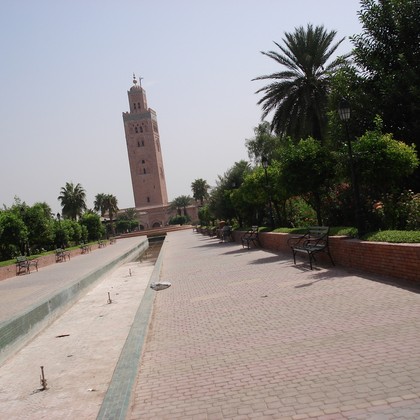
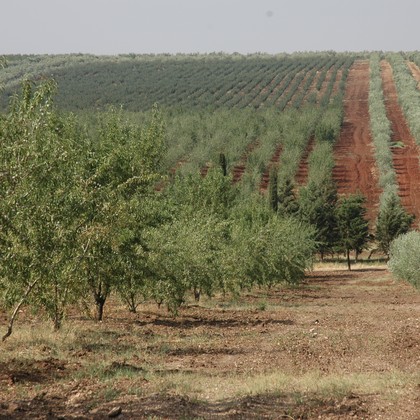
Vagrants are seen in parks, gardens, on golf courses and on farmland on the edge of towns, often among Eurasian Collared-Doves and Laughing Doves.
Where the bird is most at home, classified by the habitats of North Africa and the Middle East.
Range and movements
In the region only as a vagrant: reported regularly in the United Arab Emirates, mainly around Dubai and Abu Dhabi, and rare in Oman; in both countries some records are attributed to escaped cage birds. Beyond the region it breeds from Pakistan and India to China, Taiwan and the Philippines; western birds are partly migratory.
How and when to look
In parks and on lawns in the Emirates, check flocks of Eurasian Collared-Doves for a strikingly small, short-tailed bird. With every record, note rings, behaviour and wariness, which may say something about a possible captive origin.
Conservation status
Not globally threatened and common in Asia. As a vagrant in the region it has no conservation significance of its own; the species does not originate from the region itself.
Scientific name
Streptopelia tranquebarica | (Hermann, 1804)
Hermann described the species in 1804 as Columba tranquebarica; because it was later moved to another genus, the author and year stand in brackets. The genus Streptopelia was introduced in 1855 by Bonaparte. Streptopelia is Greek, from streptos 'collar, twisted chain' and peleia 'dove', after the dark neck collar of these doves. tranquebarica refers to Tranquebar (now Tharangambadi), a former Danish trading post on the coast of Tamil Nadu, India. The specimen the first description was based on came from Tranquebar (Tharangambadi), India.