All species › Waders, gulls and terns › Gulls and terns › Armenian Gull
Armenian Gull | Larus armenicus
Armeense meeuw | Gaviota armenia
A compact large gull of the mountain lakes of the Caucasus, eastern Turkey and north-west Iran, which winters almost entirely in the eastern Mediterranean. The Levant coast of Israel and Lebanon is its main wintering area, which makes the region of global importance for this species.
Voice
A laughing call lower and hoarser than European Herring Gull and similar to Yellow-legged Gull; in winter mostly short kyow calls while feeding.
Recording: Marcin Sołowiej — CC BY-NC-SA 4.0 · converted to mono · xeno-canto
Identification
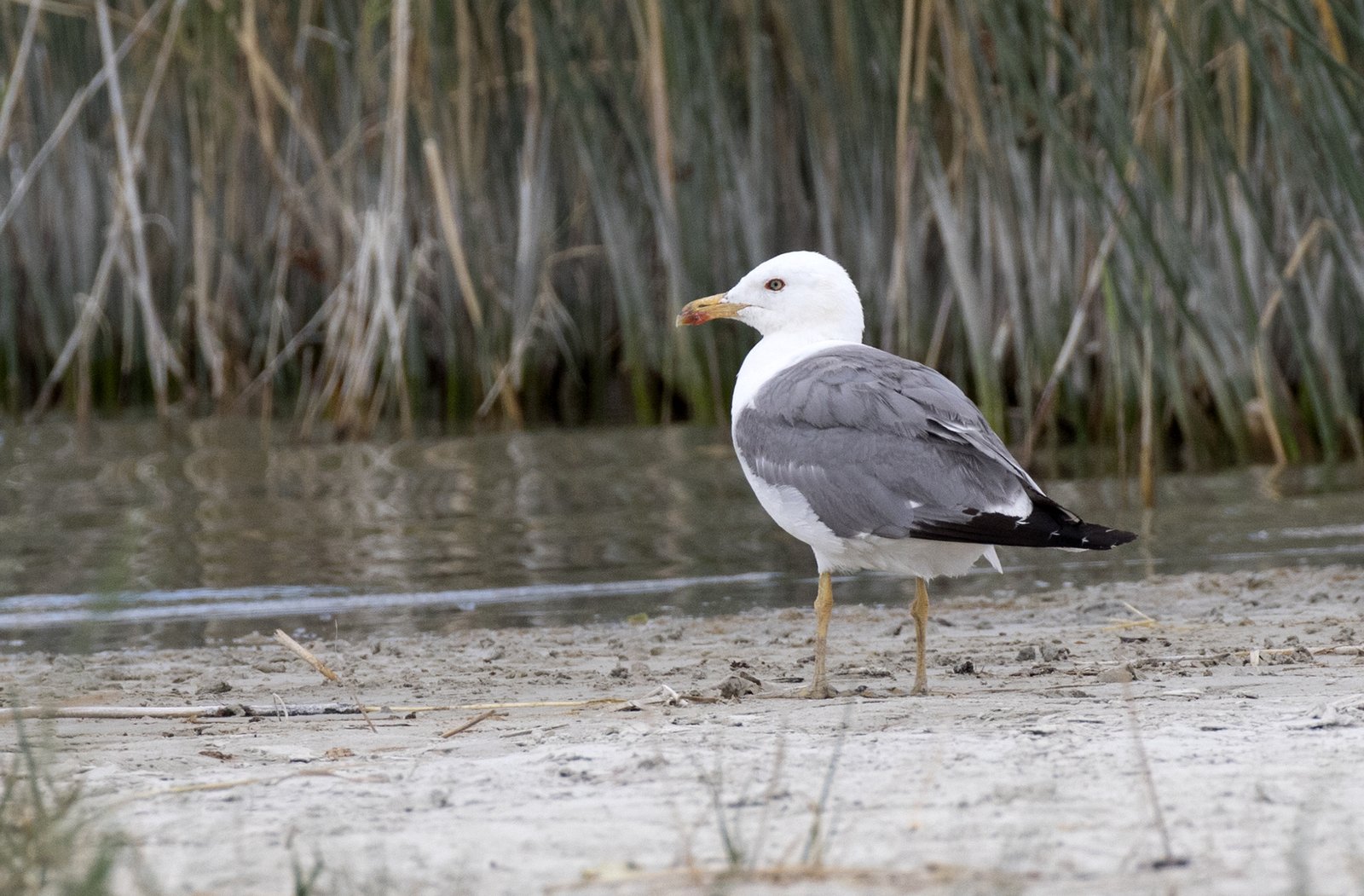
Medium-sized for a large gull, compact and round-headed, with a mid-grey mantle slightly darker than Yellow-legged Gull. The bill is short and blunt, yellow with a red gonys spot and in winter, and often in the breeding season too, a black subterminal band; the eye is often dark or speckled, with a red orbital ring. The legs are yellow. The wingtip is mostly black, with only a small white mirror on p10 and sometimes a spot on p9; the head is lightly streaked in winter. First-years resemble young Yellow-Legged Gulls but are smaller with a shorter bill, more uniformly brown upperparts and a broader tail band.
Confusion species
Yellow-legged Gull (Larus michahellis) is larger and bulkier, with a longer bill without a black band, a pale eye and somewhat more white in the wingtip. Caspian Gull (Larus cachinnans) is longer and slimmer, with a long, thin bill, a paler mantle, dull pink legs and much white in the wingtip. Lesser Black-backed Gull (Larus fuscus), especially the form barabensis, also has yellow legs, but a darker mantle and longer wings. Ring-billed Gull (Larus delawarensis) also has a ringed bill, but is much smaller and hardly occurs in this part of the region.
Habitat
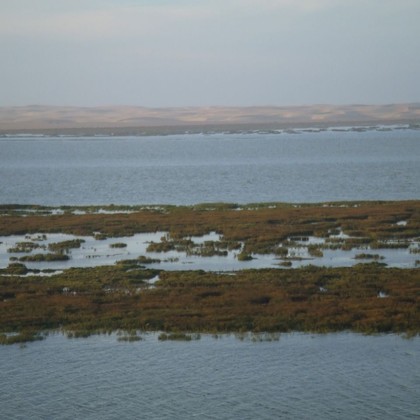
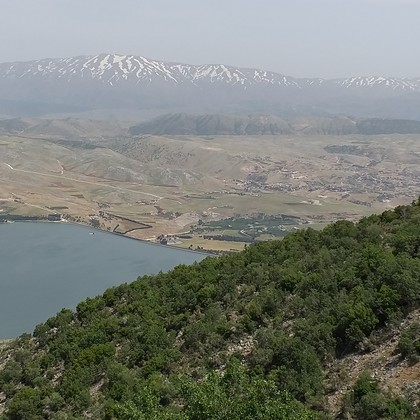
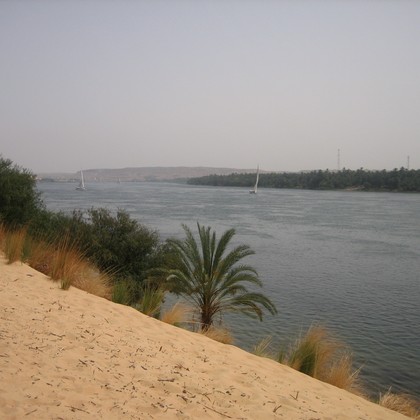
In winter on the coast, in harbours, estuaries, fishponds, reservoirs and on rubbish tips, also on inland lakes and rivers. Breeds outside the region in colonies on islets in mountain lakes at 1,500–2,500 metres.
Where the bird is most at home, classified by the habitats of North Africa and the Middle East.
Range and movements
In winter numerous along the coast of Israel (from Rosh HaNikra to Ashdod), in the Hula Valley and in smaller numbers south to Eilat, and along the coast of Lebanon; in smaller numbers on the coast of Syria, in Egypt in the Nile Delta, at the Suez Canal and on the northern Red Sea, in Jordan at Aqaba, and in Iraq; rare on the Persian Gulf. Not known west of Egypt. Beyond the region it breeds in Armenia (mainly Lakes Sevan and Arpi), Georgia, eastern Turkey and north-west Iran, and also winters in Turkey and on Cyprus.
- Resident
- Summer visitor (c. Apr–Sep)
- Winter visitor (c. Oct–Mar)
- Passage (Mar–Apr, Oct–Nov)
- dark = core range, pale = thinly spread
How and when to look
The fishponds and coast at Ma'agan Michael and the harbours of Haifa and Acre in Israel are classic winter sites to see the species alongside Yellow-Legged and Caspian Gulls; look for the short, banded bill and the dark eye.
Conservation status
Not globally threatened (assessed 2021), but the world population is small and concentrated on a limited number of breeding lakes, so disturbance and changes in water level there weigh heavily. In the region it depends on rubbish tips, fishponds and coastal waters along a heavily urbanised Levant coast.
Scientific name
Larus armenicus | Buturlin, 1934
Buturlin described the species in 1934 and placed it straight away in the genus where it still stands. The genus Larus was introduced in 1758 by Linnaeus. Larus is Latin, from Ancient Greek laros, and appears to have referred to a gull or another large seabird. armenicus means 'Armenian', after Armenia, where the species breeds. The specimen the first description was based on came from Lake Sevan, Armenia.