All species › Waders, gulls and terns › Gulls and terns › European Herring Gull
European Herring Gull | Larus argentatus
Zilvermeeuw | Gaviota argéntea
The familiar large gull of north-west European coasts, which only rarely appears in the region: mainly in winter on the coasts of Morocco, where it has to be picked out among the far more numerous Yellow-Legged and Lesser Black-Backed Gulls. Older reports of 'Herring Gulls' from the Middle East mostly refer to other species.
Voice
A clear, yelping laughing call kyow-kyow-kyow, higher and clearer than Yellow-legged Gull, and a short ga-ga-ga when alarmed.
Recording: Sam Hambly — CC BY-NC-SA 4.0 · converted to mono · xeno-canto
Identification
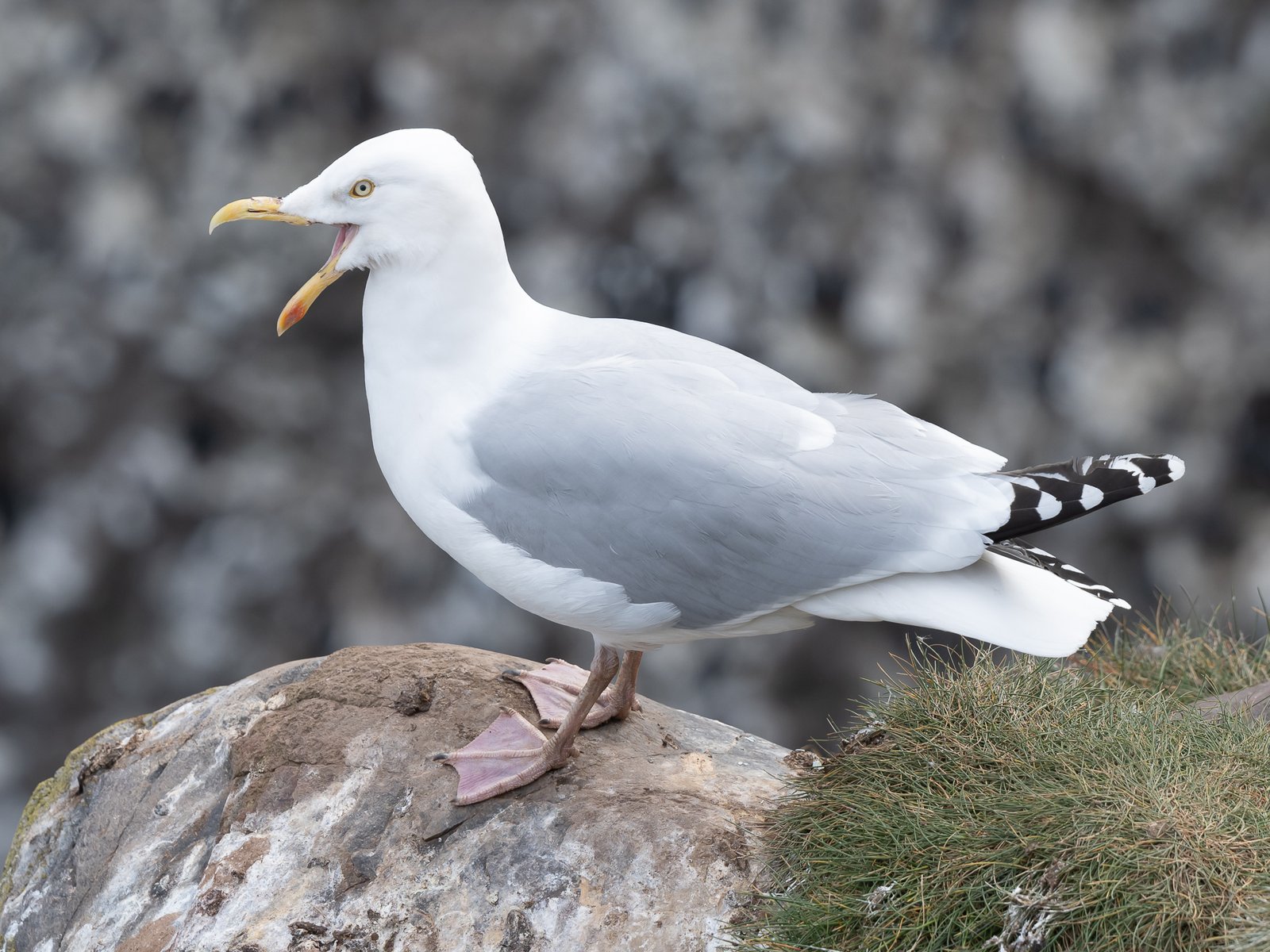
A large, powerful gull with a pale grey mantle, the palest of the large gulls in the region. Adults have a yellow eye with an orange-yellow orbital ring, a yellow bill with a small red gonys spot and flesh-pink legs. The wingtip is black with white mirrors on p9 and p10. In winter the head and neck are densely streaked and spotted brown, just when Yellow-legged Gull already has a white head. First-years are evenly grey-brown, chequered and streaked, with pale inner primaries forming a pale 'window' in flight, a dark bill and a broad, untidy tail band.
Confusion species
Yellow-legged Gull (Larus michahellis) has a darker mantle, bright yellow legs, a red orbital ring, more black in the wingtip and a white head in winter. Caspian Gull (Larus cachinnans) is slimmer, with a small white head, a long parallel bill, a small dark eye and much white in the wingtip. Armenian Gull (Larus armenicus) is smaller and darker, with a blunt bill with a black band. Ring-billed Gull (Larus delawarensis) is much smaller, with yellow legs and a ringed bill.
Habitat
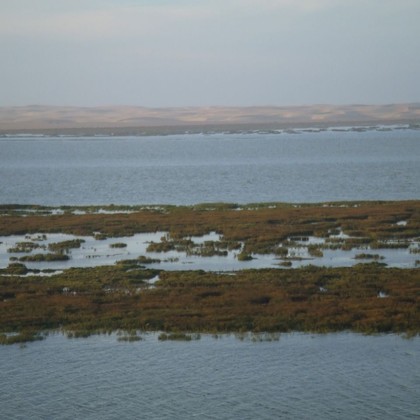
In the region on beaches, estuaries, harbours and rubbish tips, usually among other large gulls. In Europe it breeds on dunes, cliffs, islands and roofs.
Where the bird is most at home, classified by the habitats of North Africa and the Middle East.
Range and movements
In Morocco a scarce to rare winter visitor on the Atlantic and Mediterranean coasts, with a few birds each year among other large gulls, mainly first-years; even rarer in Algeria and Tunisia. Exceptional in Libya, Egypt and the Levant, and reliable records from Arabia and Iraq are hardly known: old reports there almost always refer to Caspian Gulls, Armenian Gulls or eastern Lesser Black-Backed Gulls. Beyond the region it breeds from Iceland and the British Isles through north-west Europe and Scandinavia to north-west Russia and the White Sea; it winters largely in those areas, south to northern Spain.
- Winter visitor (c. Oct–Mar)
- Passage (Mar–Apr, Oct–Nov)
- dark = core range, pale = thinly spread
How and when to look
In winter, check the fishing harbours and estuaries of northern Morocco, for example at Tangier, Larache or Kenitra, for a large gull with a streaked head, pink legs and a strikingly pale mantle among the white-headed Yellow-Legged Gulls.
Conservation status
Not globally threatened, although the species has declined sharply in parts of north-west Europe since the 1990s. In the region a rare visitor with no role as a breeding bird.
Scientific name
Larus argentatus | Pontoppidan, 1763
Pontoppidan described the species in 1763 and placed it straight away in the genus where it still stands. The genus Larus was introduced in 1758 by Linnaeus. Larus is Latin, from Ancient Greek laros, and appears to have referred to a gull or another large seabird. argentatus is Latin for 'decorated with silver', after the silvery grey plumage. The specimen the first description was based on came from Christiansø, Denmark.