All species › Bustards › Bustards › African Houbara
African Houbara | Chlamydotis undulata
Westelijke kraagtrap | Avutarda hubara africana
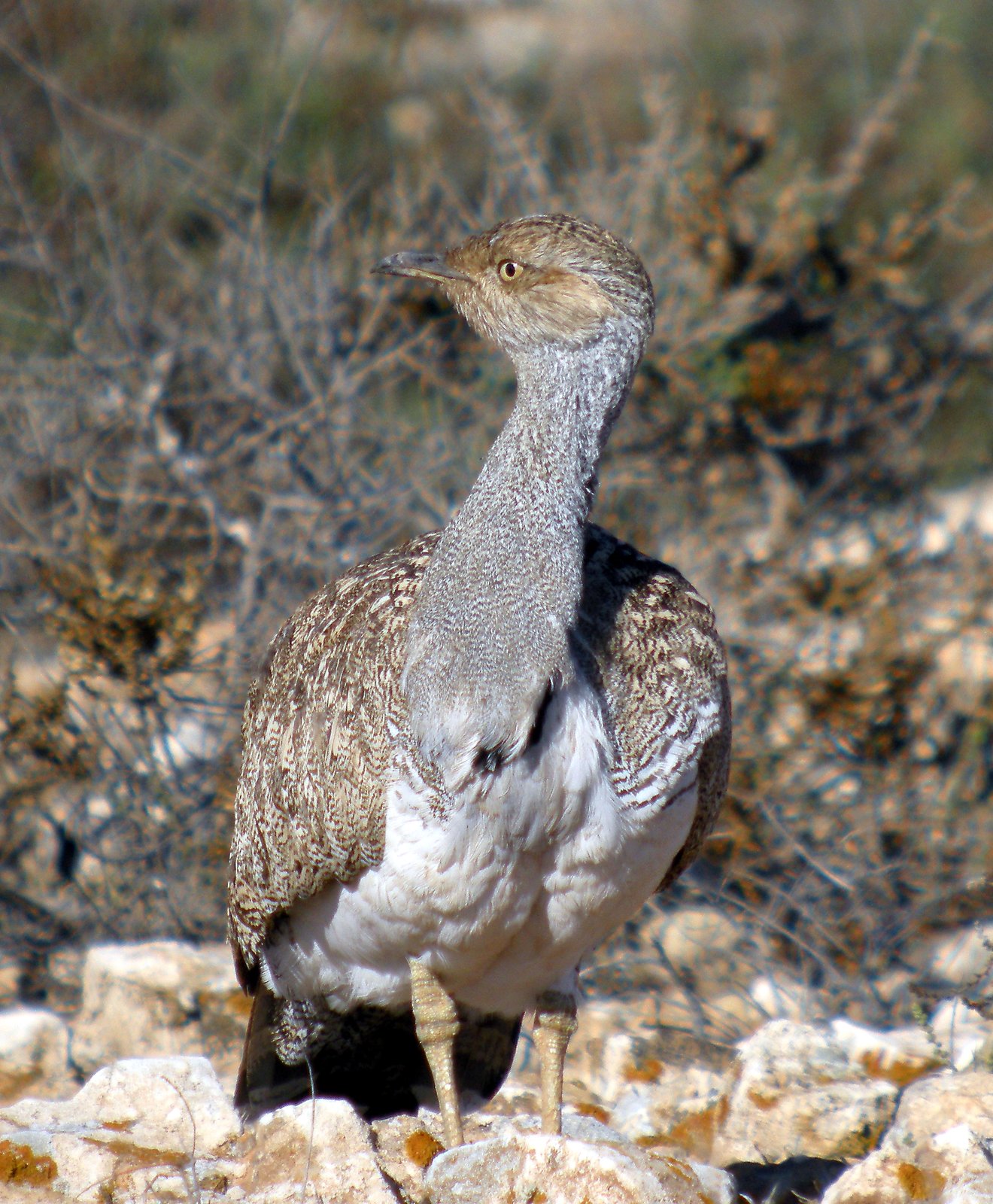
The houbara of the Maghreb and the Sahara, split from its eastern relative as a separate species in 2003. It lives scattered across the stony deserts and steppes from Morocco to the Western Desert of Egypt, and its shyness and camouflage make it one of the hardest birds to find in North Africa.
Voice
Practically silent. A displaying male gives at most a low, muffled booming that fades against the wind within thirty metres. This is a species you find with binoculars or not at all.
Recording: Larbi Badaoui — CC BY-NC 4.0 · converted to mono · xeno-canto
Identification
Long-legged bustard with a long grey neck and a short, broad body. Upperparts warm sandy brown with dense dark vermiculation and arrowheads, underparts white. Down the side of the neck hangs a band of loose, elongated black feathers with white bases, and the crown has a short, mainly black crest. Legs long and greenish grey. In display the male throws its neck and crown plumes over its head and trots a fixed circuit like a white ball, from December to March. In flight a large white patch at the base of the primaries with a black tip, the neck straight out and slow, deep beats.
Confusion species
MacQueen's Bustard (Chlamydotis macqueenii), east of the Nile, is paler and greyer sandy, with a white, black-tipped crest and a longer neck ruff; range separates the two. Great Bustard (Otis tarda) of northern Morocco is much larger and lives among cereals, and Little Bustard (Tetrax tetrax) is smaller, shorter-necked and flies fast on whistling wings.
Habitat
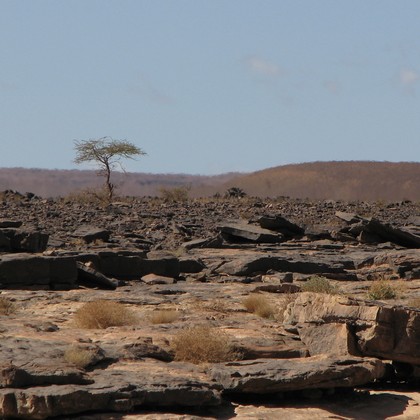
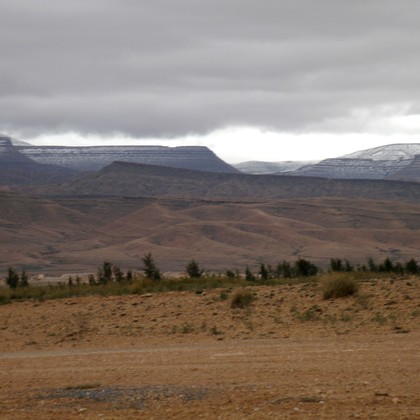
Flat to gently rolling stony and gravel desert, alfa steppe and semi-desert with scattered low shrubs, and sparsely vegetated plains on the edge of the sand desert; in the north also dry, stony pastures. Avoids mountains, woodland and densely settled areas. Lives very secretively and presses itself flat to the ground when threatened.
Where the bird is most at home, classified by the habitats of North Africa and the Middle East.
Range and movements
Morocco: scattered over the eastern high plateaus, the plains south of the High Atlas, the Souss and the Draa basin, south into Western Sahara. Algeria: the High Plateaus and the northern Sahara. Tunisia: the south and the edges of the chotts. Libya: the semi-deserts of Tripolitania and Cyrenaica. Egypt: the Western Desert and the north coast west of the Nile. Large numbers of captive-bred birds have been released in eastern Morocco since the 1990s. Outside the region: Mauritania and the northern fringe of Mali, Niger and Chad; a separate subspecies lives on the eastern Canary Islands.
- Resident
- Winter visitor (c. Oct–Mar)
- Passage (Mar–Apr, Oct–Nov)
- dark = core range, pale = thinly spread
How and when to look
The best chances are in eastern Morocco, on the high plateaus between Missour, Tendrara and Bouarfa, where the release programme keeps densities high, and in winter on the plains of Western Sahara. Drive slowly along the tracks early in the morning and scan with a telescope: a standing houbara is almost invisible on the stony plain, but a displaying male is a moving white dot.
Conservation status
Vulnerable. Falconry, in winter mainly by hunting parties from the Gulf states, poaching, egg collecting and the loss of steppe to overgrazing, cultivation and building have caused steep declines across much of North Africa. Releases in Morocco keep numbers up there, but it is unclear how many wild birds remain in Algeria, Libya and Egypt.
Scientific name
Chlamydotis undulata | (Jacquin, 1784)
Jacquin described the species in 1784 as Psophia undulata; because it was later moved to another genus, the author and year stand in brackets. The genus Chlamydotis was introduced in 1839 by Lesson. Chlamydotis is Greek, from khlamus, a horseman's cloak with weights sewn into the corners, and otis 'bustard'. undulata is Latin for 'wavy', for the finely vermiculated markings of the plumage. The specimen the first description was based on came from Tripoli, Libya.