All species › Passerines › Sylvia warblers › African Desert Warbler
African Desert Warbler | Curruca deserti
Afrikaanse woestijngrasmus | Curruca sahariana
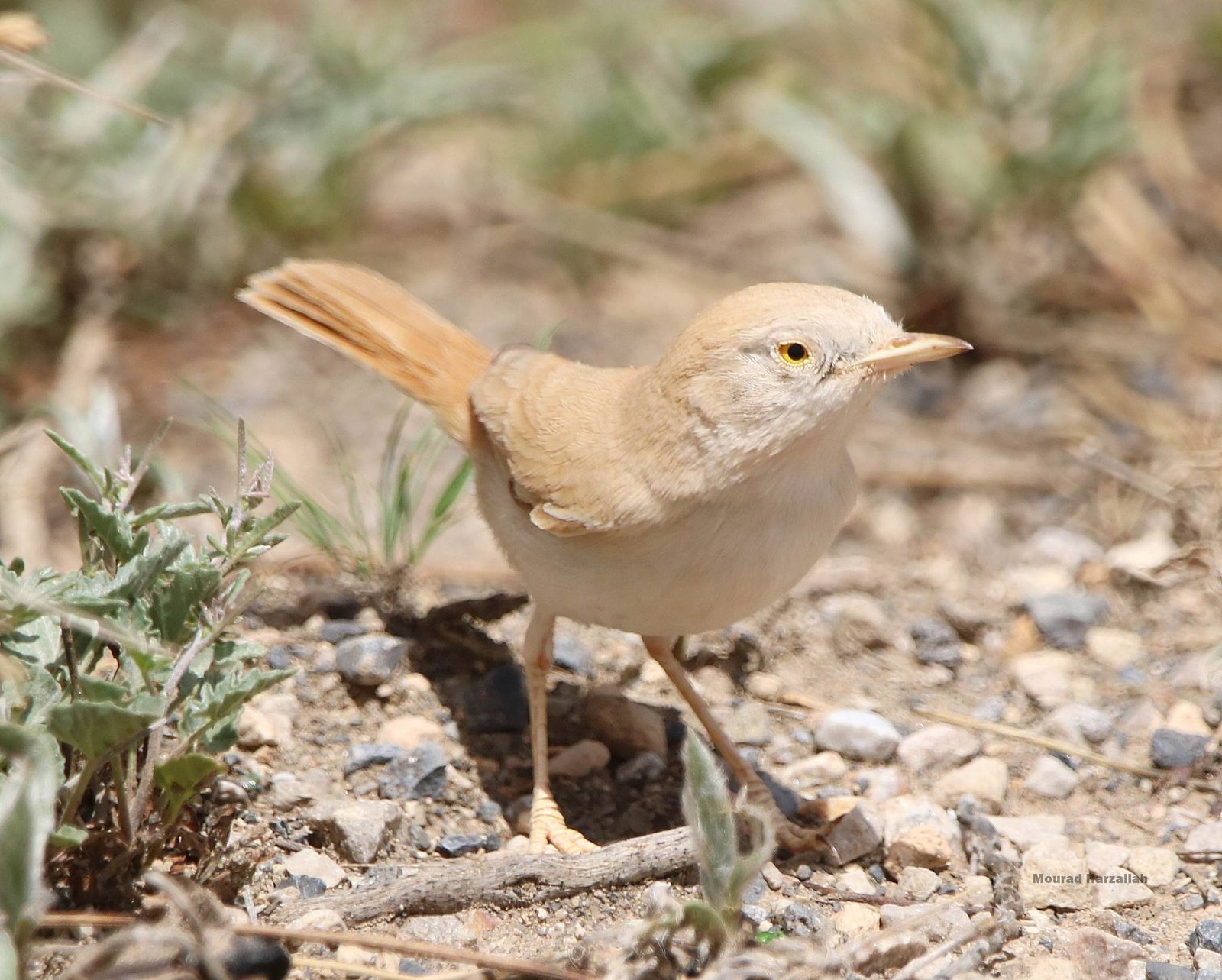
The African Desert Warbler is the smallest warbler in the guide and a true Saharan bird: a pale, golden-sandy sprite of dunes and shrubby plains that lives running between the bushes and in spring hangs over the plain in a fluttering song flight. Long treated as one species with the Asian Desert Warbler, it has been regarded as separate since 2025.
Voice
A short, clear and musical phrase with more pure whistles and less scratching than Asian Desert Warbler, almost always given in a display flight in which the bird hovers a few metres above the bush on quivering wings and parachutes down. The call is a dry, rattling trrrt and a soft chek. Sings mainly from February to May, most in the first hour after sunrise.
Recording: Stanislas Wroza — CC BY-NC-SA 4.0 · converted to mono · xeno-canto
Identification
11–12 cm. Very small and exceptionally pale: warm sandy above with a golden wash, off-white below, with a rufous rump and tail and white outer tail feathers. The folded wing is uniform, without obvious dark centres to coverts and tertials, so the upperparts look smooth and unmarked. The iris is bright yellow with a narrow white ring, the tiny bill yellowish with a dark tip, the legs pale straw. Sexes alike. Often holds the tail slightly raised and fanned.
Confusion species
Asian Desert Warbler (Curruca nana) is colder and greyer above, with dark centres in the wing and a more contrasting tail; it occurs only east of the Nile, as a winter visitor, so the two hardly ever meet in the region. Streaked Scrub Warbler (Scotocerca inquieta), often in the same scrub, has a streaked crown, a dark eye, a clear supercilium and a long dark tail. Tristram's Warbler (Curruca deserticola) and Spectacled Warbler (Curruca conspicillata) have greyer heads and a rufous wing panel.
Habitat
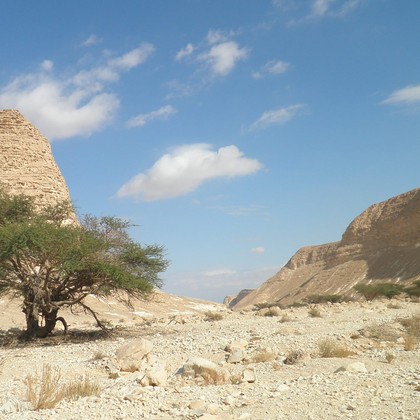
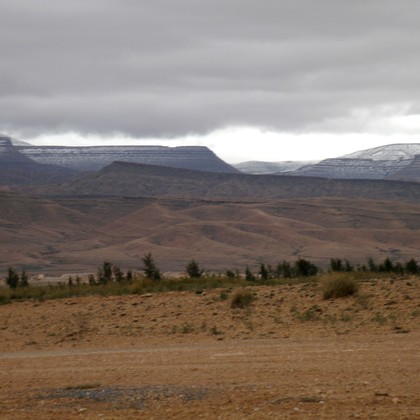
Sandy plains and stabilised dunes with scattered shrubs such as Calligonum, Retama and Zygophyllum, wadi edges and sandy parts of the steppe on the Saharan fringe. Often near a Desert Wheatear, which it follows while feeding. Avoids bare rocky desert without vegetation.
Where the bird is most at home, classified by the habitats of North Africa and the Middle East.

Range and movements
Only the north-western and central Sahara. In Morocco south of the High Atlas and Anti-Atlas, from the Drâa valley and Tafilalt (Merzouga, Erfoud) to the eastern border, and in Western Sahara; in Algeria in the northern Sahara from the Saoura and Grand Erg Occidental to the Grand Erg Oriental and south to the Hoggar; in southern Tunisia (around Douz, Ksar Ghilane and the Grand Erg) and in western Libya (Ghadames, Fezzan). Not proven to breed in Egypt. Beyond the region in Mauritania, northern Mali and Niger. Vagrants have reached the Canary Islands and once north-west Europe.
- Resident
- Winter visitor (c. Oct–Mar)
- Passage (Mar–Apr, Oct–Nov)
- dark = core range, pale = thinly spread
How and when to look
In Morocco the shrubby plains around Merzouga and Erg Chebbi and the tracks near Zagora are good places; in Tunisia the dune edges around Douz. Come early on a spring morning, when males hang over the bushes in song flight, and look for a Desert Wheatear: the warbler is often nearby.
Conservation status
Not globally threatened. Little studied over most of its remote range; locally sensitive to overgrazing and cutting of shrubs for firewood around oases and villages.
Scientific name
Curruca deserti | (Loche, 1858) (GBIF: Sylvia deserti)
Loche described the species in 1858 as Stoparola Deserti; because it was later moved to another genus, the author and year stand in brackets. The genus Curruca was introduced in 1802 by Bechstein. Curruca is Latin, the name of an unidentified small bird mentioned by the Roman poet Juvenal. deserti is Latin for 'of the desert', after its Saharan habitat. The specimen the first description was based on came from the Algerian Sahara.