All species › Passerines › Sylvia warblers › Tristram's Warbler
Tristram's Warbler | Curruca deserticola
Atlasgrasmus | Curruca del Atlas
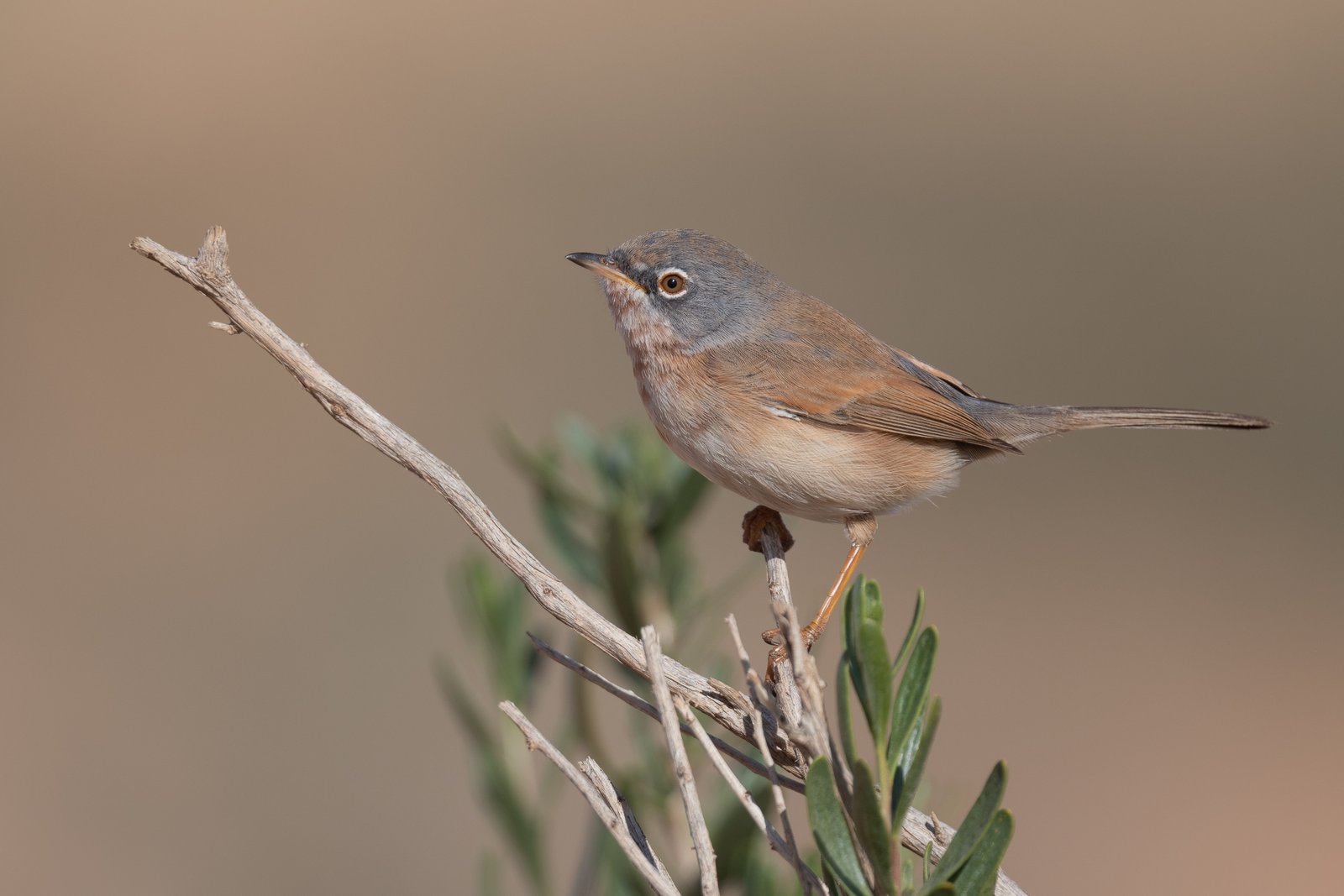
Tristram's Warbler is the Maghreb warbler par excellence: its entire world range lies within the region, in the mountains of Morocco, Algeria and Tunisia. A small, long-tailed warbler with a rufous wing and warm orange-brown underparts, it breeds in montane and juniper scrub in summer and descends to the desert edge in winter.
Voice
A fast, high, sweet phrase of two to three seconds, fuller and more musical than that of Western Subalpine Warbler, sung from a low bush or in a short song flight. The call is the most useful feature: a dry, hard chet, often doubled, and a buzzing trrrt when agitated. Sings from February at lower levels, from April in the high mountains.
Recording: Guido O. Keijl — CC BY-NC-SA 4.0 · shortened to the first 60 s, mono · xeno-canto
Identification
11.5–12.5 cm. Small and slim, with a long, graduated tail with white outer feathers, often cocked. The male has a blue-grey head with an orange-red eye-ring and a short white moustache, and rusty orange-brown underparts from throat to belly without a sharp border. The mantle is warm brown and the wing shows a broad rufous panel formed by wide fringes to the secondaries and tertials. Legs orange to flesh. The female is duller, with a grey-brown head, an ochre eye-ring and a soft orange-buff breast, but has the same rufous wing panel.
Confusion species
Western Subalpine Warbler (Curruca iberiae) passes through the same scrub in March and April and also has a grey head, red eye-ring and white moustache, but a plain grey-brown wing without rufous and a white belly below the coloured breast. Spectacled Warbler (Curruca conspicillata) also has a rufous wing, but a dark mask with a white eye-ring, a white throat and a shorter tail, and lives lower in flat country. Dartford Warbler (Curruca undata) is dark slate-grey above and wine-red below, with white speckles on the throat and no rufous in the wing.
Habitat
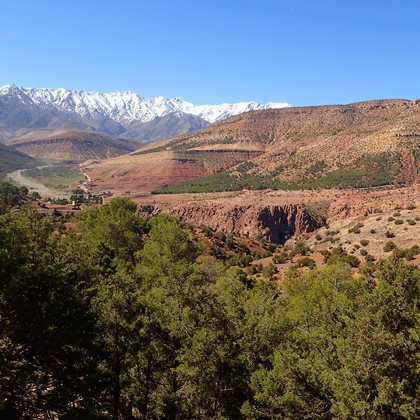
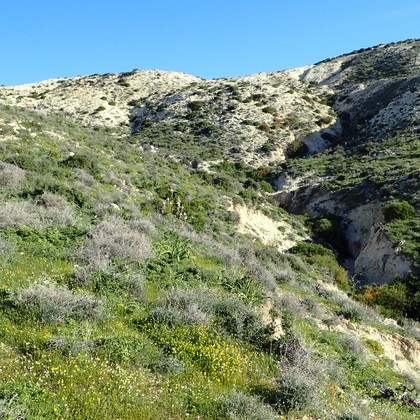
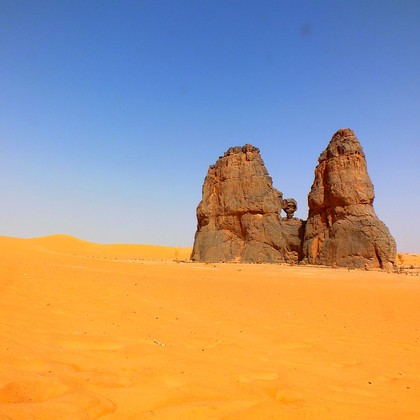
In the breeding season open montane and hillside scrub between about 1000 and 2500 m: juniper, holm oak, box, rosemary and Genista, often on steep rocky slopes and in open Atlas cedar or Aleppo pine woodland. In winter also lower down, in the scrub of the alfa steppe, in wadis with tamarisk and in oases on the edge of the Sahara.
Where the bird is most at home, classified by the habitats of North Africa and the Middle East.
Range and movements
Endemic to the Maghreb. In Morocco in the Middle Atlas, High Atlas and Anti-Atlas, with an outpost in the eastern highlands; in Algeria in the Tell Atlas, Saharan Atlas and Aurès mountains; in Tunisia in the Dorsale and the western highlands. In north-west Libya (Jebel Nafusa) at most scarce and poorly known. In winter birds spread to the lowlands, southern slopes and the northern edge of the Sahara, as far as southern Morocco, Western Sahara and northern Algeria. Almost never recorded outside the Maghreb.
- Resident
- Winter visitor (c. Oct–Mar)
- Passage (Mar–Apr, Oct–Nov)
- dark = core range, pale = thinly spread
How and when to look
In Morocco the species is easy to find in the juniper scrub of the Middle Atlas around Ifrane and Zeida, at the Tizi n'Tichka in the High Atlas and in the Todra gorge; in winter in the scrub around Ouarzazate, Boumalne and Erfoud. In Tunisia at Jebel Chambi. Listen for the hard chet.
Conservation status
Not globally threatened. Locally common but patchily distributed; sensitive to overgrazing, firewood cutting and loss of montane and juniper scrub. As an almost wholly Maghreb endemic, the region bears a special responsibility for this species.
Scientific name
Curruca deserticola | (Tristram, 1859) (GBIF: Sylvia deserticola)
Tristram described the species in 1859 as Sylvia deserticola; because it was later moved to another genus, the author and year stand in brackets. The genus Curruca was introduced in 1802 by Bechstein. Curruca is Latin, the name of an unidentified small bird mentioned by the Roman poet Juvenal. deserticola is Latin, from desertum 'desert' and -cola 'dweller': desert-dweller. The specimen the first description was based on came from the Sahara of southern Algeria.