All species › Passerines › Tyrant flycatchers and allies › Yellowish Flycatcher
Position in the tree Birds Aves › Birds with a flexible palate Neognathae › All other modern birds Neoaves › Landbirds Telluraves › Falcons, parrots and passerines Australaves › Falcons and passerines Eufalconimorphae › Parrots and passerines Psittacopasserae
Yellowish Flycatcher | Empidonax flavescens
Gele feetiran | Mosquero amarillento
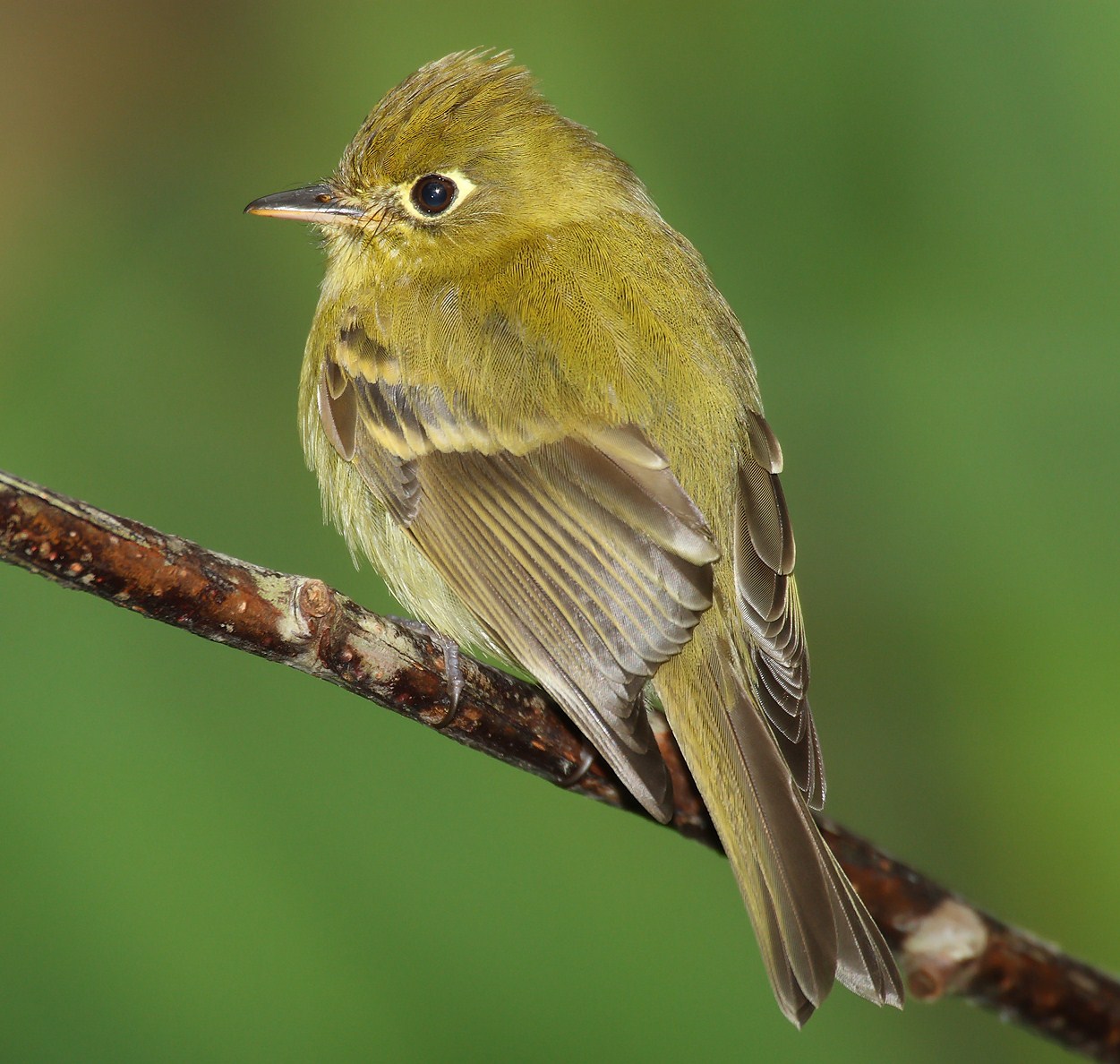
The Yellowish Flycatcher is a small, ochre-yellow Empidonax of humid montane forest. It usually perches low to mid-level at forest edges and in clearings and is the commonest Empidonax in the mountains of southern Central America. It occurs only in the guide area, from south-eastern Mexico to western Panama.
Voice
The usual call is a high, thin, rising pseet.
Recording: Max Noack — CC BY-NC-SA 4.0 · converted to mono · xeno-canto
Identification
12–13 cm. Upperparts olive-green. A conspicuous yellowish-white eye-ring that comes to a point behind the eye (teardrop-shaped). Wings dark with two pale ochre wing bars. Underparts yellow, strongly washed ochre to brownish olive on the breast. Lower mandible pale. Male and female are alike.
Confusion species
Yellow-bellied Flycatcher Empidonax flaviventris (winter visitor, mainly lower) is greener, with a round eye-ring, whiter wing bars and no ochre breast. Western Flycatcher Empidonax difficilis (Mexico) is very similar, but paler and less ochre below. Northern Tufted Flycatcher Mitrephanes phaeocercus has a distinct crest and an ochre-brown breast.
Habitat
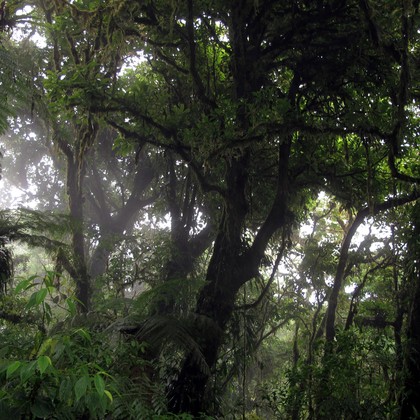
Humid montane forest and cloud forest, mainly at forest edges, clearings, along trails and in ravines, also in mature secondary forest and shade coffee. It perches low to mid-level and catches insects from a perch.
Where the bird is most at home, classified by the vegetation units of Mexico and Central America.




Range and movements
Endemic to the guide area: the mountains of south-eastern Mexico, through Guatemala, El Salvador, Honduras, Nicaragua and Costa Rica to western Panama.
- Resident
- dark = core range, pale = thinly spread
How and when to look
In the montane forest of Costa Rica often seen at forest edges and along trails, perching low on a branch.
Conservation status
Not threatened. Fairly common in montane forest within its range.
Scientific name
Empidonax flavescens | Lawrence, 1865
Lawrence described the species in 1865 and placed it straight away in the genus where it still stands. The genus Empidonax was introduced in 1855 by Cabanis. Empidonax is Greek, from empis 'gnat' and anax 'master': 'gnat-king', after its insect hunting. flavescens is Latin for 'yellowish', after the yellow plumage. The specimen the first description was based on came from Barranca, Costa Rica.