All species › Passerines › Tyrant flycatchers and allies › Yellow-bellied Flycatcher
Position in the tree Birds Aves › Birds with a flexible palate Neognathae › All other modern birds Neoaves › Landbirds Telluraves › Falcons, parrots and passerines Australaves › Falcons and passerines Eufalconimorphae › Parrots and passerines Psittacopasserae
Yellow-bellied Flycatcher | Empidonax flaviventris
Berkenfeetiran | Mosquero vientre amarillo
The Yellow-bellied Flycatcher is the yellowest Empidonax of eastern North America. It breeds in the conifer forests of Canada and the north-eastern United States and winters largely within the guide area, from eastern and southern Mexico to Panama, low in humid forest.
Voice
The usual call on the wintering grounds is a rising two-syllable chu-wee or per-wee, and also a short, sharp chip.
Recording: Stanislas Wroza — CC BY-NC-SA 4.0 · shortened to the first 60 s, mono · xeno-canto
Identification
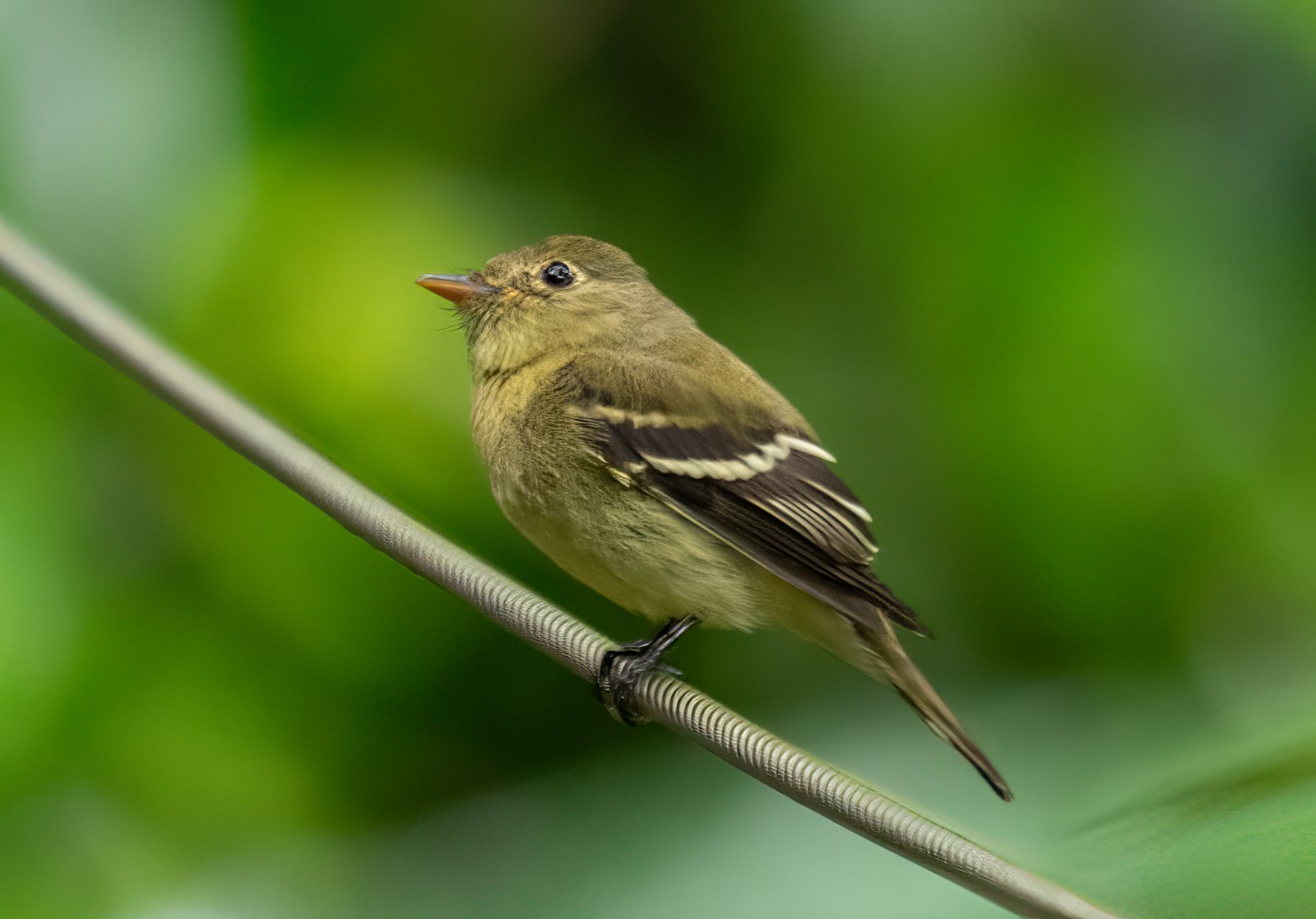
13–14 cm. Upperparts olive-green, with a distinct, round yellowish-white eye-ring. Wings blackish with two sharply contrasting white to pale yellow wing bars and a fairly short primary projection. Throat yellow, breast washed olive-green, belly bright yellow. Lower mandible pale. Male and female are alike.
Confusion species
Acadian Flycatcher Empidonax virescens is larger, with a whitish throat, a whiter belly and a longer primary projection. Yellowish Flycatcher Empidonax flavescens (resident in the mountains) has a teardrop-shaped eye-ring and an ochre-yellow to brownish-washed breast. Western Flycatcher Empidonax difficilis (Mexico) is browner olive, with a teardrop-shaped eye-ring and ochre wing bars.
Habitat
Winters in the understorey and at the edges of humid lowland and foothill forest, in secondary forest and in shade coffee and other shaded plantations. It perches low and inconspicuously and catches insects from a shaded perch.
Where the bird is most at home, classified by the vegetation units of Mexico and Central America.




Range and movements
Migrates through eastern Mexico and winters from eastern and southern Mexico through all of Central America to Panama. Outside the guide area it breeds in Canada and the north-eastern United States.
- Winter visitor (c. Oct–Mar)
- dark = core range, pale = thinly spread
How and when to look
In winter fairly common low in humid forest and shade coffee; listen for the rising chu-wee.
Conservation status
Not threatened. Common across its large breeding range in the boreal forest.
Scientific name
Empidonax flaviventris | (Baird & Baird, 1843)
Baird & Baird described the species in 1843 as Tyrannula flaviventris; because it was later moved to another genus, the author and year stand in brackets. The genus Empidonax was introduced in 1855 by Cabanis. Empidonax is Greek, from empis 'gnat' and anax 'master': 'gnat-king', after its insect hunting. flaviventris is Latin, from flavus 'yellow' and venter 'belly', after the yellowish underparts. The specimen the first description was based on came from near Carlisle, Pennsylvania (USA).