All species › Passerines › Shrike-babblers, Erpornis and vireos › Yellow-winged Vireo
Position in the tree Birds Aves › Birds with a flexible palate Neognathae › All other modern birds Neoaves › Landbirds Telluraves › Falcons, parrots and passerines Australaves › Falcons and passerines Eufalconimorphae › Parrots and passerines Psittacopasserae
Yellow-winged Vireo | Vireo carmioli
Geelbandvireo | Vireo aliamarillo
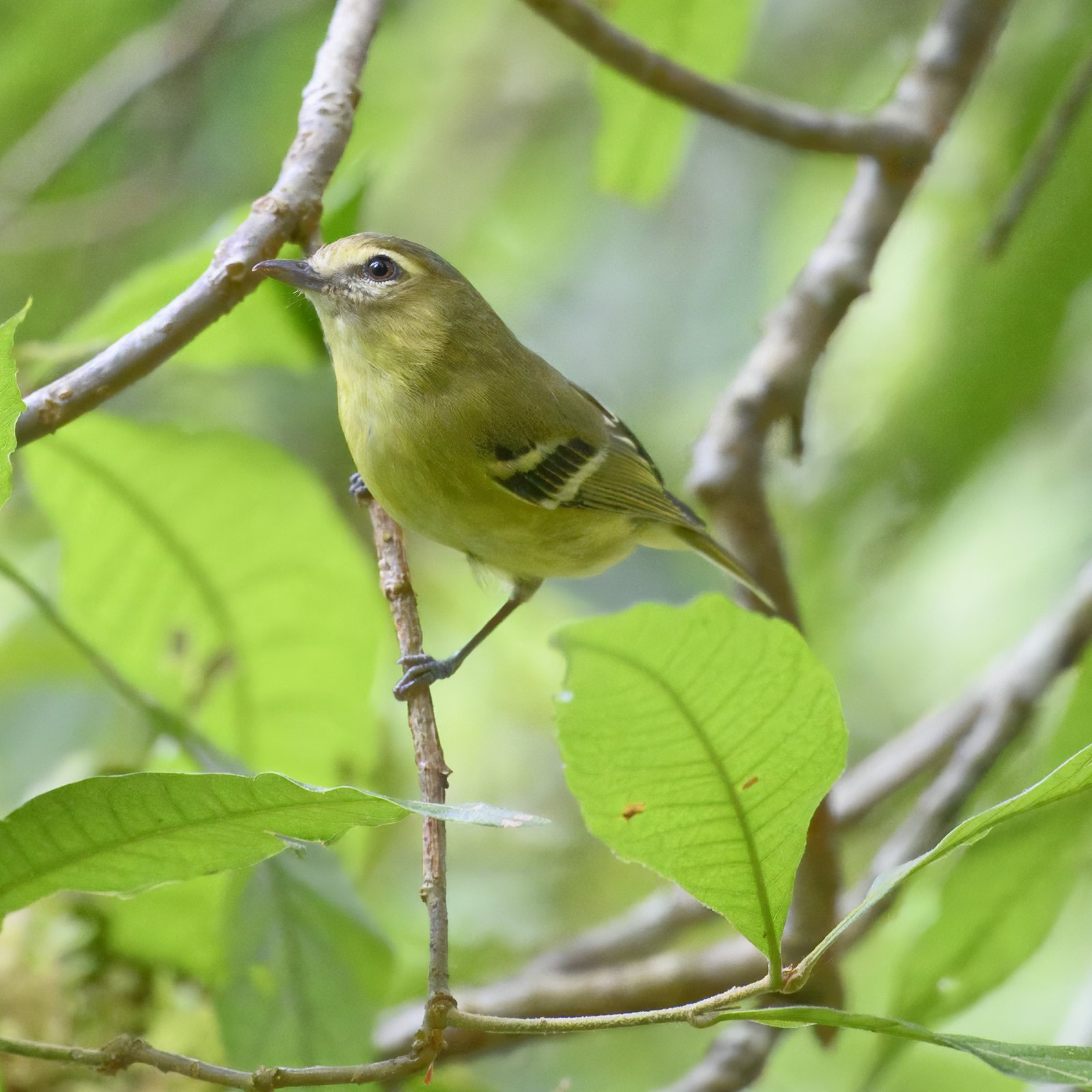
The Yellow-winged Vireo is a small vireo of the montane forest of Costa Rica and western Panama, found nowhere else in the world. It is marked by two yellow wing bars and pale spectacles. It usually forages high in the trees, often in mixed flocks.
Voice
The song is a slow series of short, somewhat hoarse phrases with pauses in between.
Recording: GABRIEL LEITE — CC BY-NC-SA 4.0 · converted to mono · xeno-canto
Identification
11–12 cm. Upperparts olive-green, head somewhat greyer. Pale, yellowish-white spectacles around the eye. Two broad yellow wing bars and yellow-edged flight feathers. Underparts whitish with yellowish flanks.
Confusion species
Brown-capped Vireo Vireo leucophrys has a brownish crown, a white eyebrow and no wing bars. Yellow-throated Vireo Vireo flavifrons, a winter visitor found mainly lower down, is larger, with a bright yellow throat and white wing bars.
Habitat
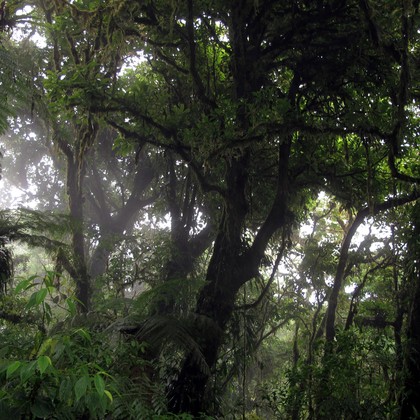
Canopy and edges of montane rainforest and oak forest, also forest edges and clearings with tall trees, in the upper mountain zone, mostly above about 2000 m. It searches the foliage for insects and also eats small fruits.
Where the bird is most at home, classified by the vegetation units of Mexico and Central America.
Range and movements
Only in the highlands of Costa Rica (Cordillera Central and Cordillera de Talamanca) and western Panama (Chiriquí and adjacent mountains). It does not occur outside the guide area.
- Resident
- dark = core range, pale = thinly spread
How and when to look
Best found in mixed flocks in the oak forest of the Cordillera de Talamanca, for example around Cerro de la Muerte in Costa Rica, and on the slopes of Volcán Barú in Panama.
Conservation status
Not threatened. Fairly common within its small range.
Scientific name
Vireo carmioli | Baird, 1866
Baird described the species in 1866 and placed it straight away in the genus where it still stands. The genus Vireo was introduced in 1808 by Vieillot. Vireo was used by Latin authors for a small, green, migratory bird, probably the Eurasian golden oriole, though the European greenfinch has also been suggested. carmioli honours Julian Carmiol (1807?–1885), a German-born collector who did much for the ornithology of Costa Rica. The specimen the first description was based on came from Santa María de Dota, San José, Costa Rica.