All species › Passerines › Thrushes and allies › Yellow-throated Nightingale-Thrush
Position in the tree Birds Aves › Birds with a flexible palate Neognathae › All other modern birds Neoaves › Landbirds Telluraves › Falcons, parrots and passerines Australaves › Falcons and passerines Eufalconimorphae › Parrots and passerines Psittacopasserae
Yellow-throated Nightingale-Thrush | Catharus dryas
Goulds dwerglijster | Zorzal pecho amarillo
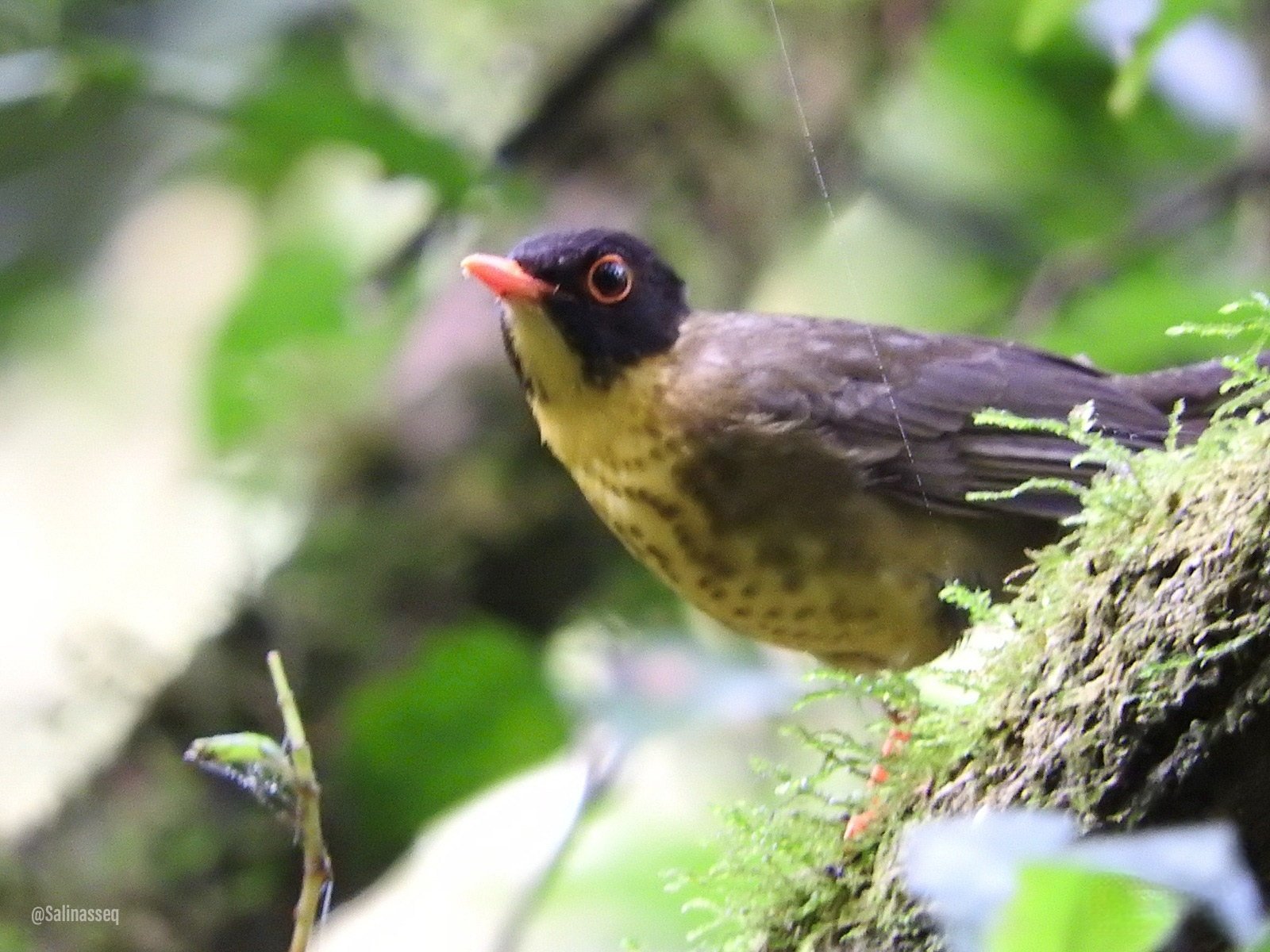
The Yellow-throated Nightingale-Thrush is a nightingale-thrush of cloud forest in northern Central America, with a black head, an orange bill and eye-ring and a yellow-orange throat and breast. It keeps hidden in the understorey and is mainly detected by its fluting song. The species occurs only from southern Mexico to Honduras and Nicaragua.
Voice
The song consists of short, clear, fluting phrases of a few notes, repeated with pauses in between; fuller and more musical in tone than in most other nightingale-thrushes. The call is a nasal, mewing meeah.
Recording: Bill Pyle — CC BY-NC-SA 4.0 · converted to mono · xeno-canto
Identification
16–18 cm. Head black, sharply contrasting with the dark olive-green back, wings and tail. Orange eye-ring; bill and legs orange. Throat, breast and belly warm yellow to apricot, often with faint dark spots on the breast; flanks olive-grey. The sexes are alike. Juveniles are duller, with dark spots on the underparts and a dark bill.
Confusion species
Black-headed Nightingale-Thrush Catharus mexicanus also has a black cap, but has a grey throat and breast without a yellow tone and usually lives lower down. Ruddy-capped Nightingale-Thrush Catharus frantzii has a rufous crown, grey sides of the head and grey underparts. Other cloud-forest birds with a black head and yellow underparts, such as some brushfinches, have a thick bill and do not live on the forest floor.
Habitat
Understorey of humid cloud forest and upper foothill forest, often in ravines and along streams with dense undergrowth; mostly between about 900 and 2500 m. It searches the leaf litter for insects and other invertebrates and also eats berries.
Where the bird is most at home, classified by the vegetation units of Mexico and Central America.


Range and movements
Southern Mexico (Chiapas and adjacent Oaxaca) through the highlands of Guatemala and El Salvador to Honduras and northern Nicaragua. As now defined restricted to the guide area; the related Andean form, Catharus maculatus, is now regarded as a separate species.
- Resident
- dark = core range, pale = thinly spread
How and when to look
Found in the cloud forests of El Triunfo in Chiapas and Cusuco National Park in Honduras. Most active and easiest to hear in the early morning.
Conservation status
Not threatened (LC). Dependent on undisturbed cloud forest, which is becoming heavily fragmented in places in northern Central America.
Scientific name
Catharus dryas | (Gould, 1855)
Gould described the species in 1855 as Malacocichla dryas; because it was later moved to another genus, the author and year stand in brackets. The genus Catharus was introduced in 1850 by Bonaparte. Catharus is from Ancient Greek katharos 'pure, clean', a name given for the clean plumage of the orange-billed nightingale-thrush. dryas is Greek for 'dryad, tree nymph', alluding to the woodland habitat or the graceful appearance. The specimen the first description was based on came from Guatemala.