All species › Passerines › Cardinals and allies › Yellow Grosbeak
Position in the tree Birds Aves › Birds with a flexible palate Neognathae › All other modern birds Neoaves › Landbirds Telluraves › Falcons, parrots and passerines Australaves › Falcons and passerines Eufalconimorphae › Parrots and passerines Psittacopasserae
Yellow Grosbeak | Pheucticus chrysopeplus
Gele kardinaal | Picogordo amarillo
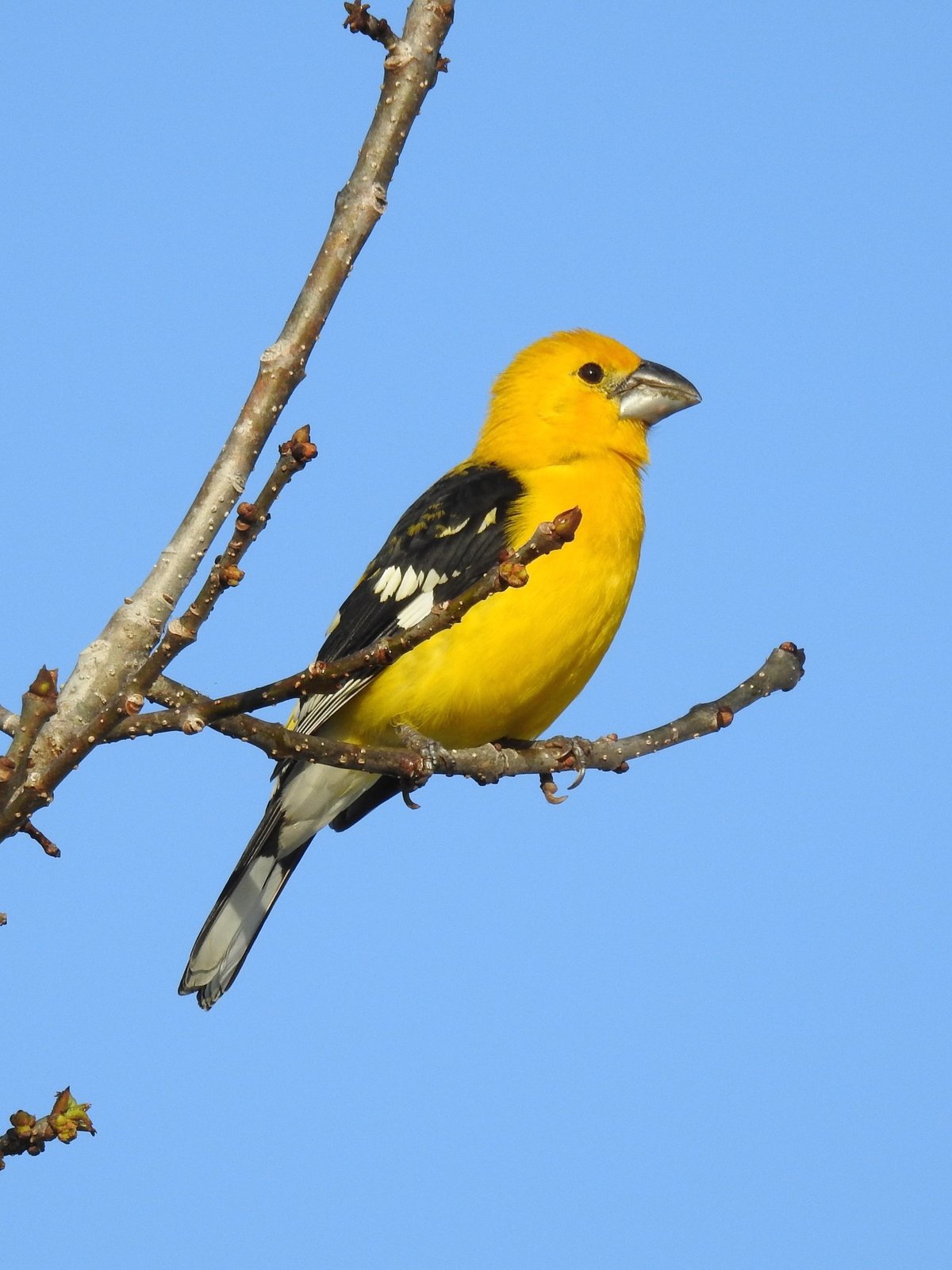
The Yellow Grosbeak is a large yellow finch-like bird with black-and-white wings and a heavy, dark bill. It lives in dry forest and semi-open country on the Pacific slope of Mexico, with a separate population in the highlands of Chiapas and Guatemala. Almost its entire range lies within the guide area.
Voice
The song is a series of rich, whistled phrases, similar to that of Black-headed Grosbeak but slower and fuller. The call is a metallic, sharp peek.
Recording: Bill Pyle — CC BY-NC-SA 4.0 · shortened to the first 60 s, mono · xeno-canto
Identification
21–24 cm. Bill very heavy and triangular, dark grey with a paler lower mandible. The male has a golden-yellow head and underparts, a black back with yellow or olive spots, a black rump with yellow, and black wings with broad white wing bars and a large white patch at the base of the primaries. Tail black with white spots near the tips of the outer feathers. The female is duller olive-yellow, with dark streaks on the crown and back and brownish-black wings with less white. Young birds resemble the female.
Confusion species
Black-headed Grosbeak Pheucticus melanocephalus, whose females and young birds occur in the same regions, is smaller with an orange-buff breast and a pale eyebrow. Black-thighed Grosbeak Pheucticus tibialis lives only in Costa Rica and Panama, and has a black back without yellow spots and less white in the wing. Western Tanager Piranga ludoviciana has yellow wing bars and a much smaller bill.
Habitat
Tropical dry and semi-evergreen forest, gallery forest along rivers, forest edges, scrub and pastures with scattered trees; from sea level to about 1500 m on the Pacific slope, in Chiapas and Guatemala in pine-oak forest and semi-open woodland to about 2500 m. It eats seeds, fruit, buds and insects.
Where the bird is most at home, classified by the vegetation units of Mexico and Central America.





Range and movements
Pacific slope of Mexico from southern Sonora and south-western Chihuahua to Oaxaca, including the Balsas basin. A separate population lives in the highlands of Chiapas and western Guatemala. A very rare vagrant to the south-western United States.
- Resident
- Summer visitor (c. Apr–Sep)
- Winter visitor (c. Oct–Mar)
- dark = core range, pale = thinly spread
How and when to look
Occurs in dry forest and along rivers in Sinaloa, Nayarit and Jalisco, for example around San Blas; it often sings from high in a tree.
Conservation status
Not threatened (LC). Fairly common in dry forest and semi-open country on the Pacific slope; the population in Chiapas and Guatemala is smaller and scarcer.
Scientific name
Pheucticus chrysopeplus | (Vigors, 1832)
Vigors described the species in 1832 as Coccothraustes chrysopeplus; because it was later moved to another genus, the author and year stand in brackets. The genus Pheucticus was introduced in 1850 by Reichenbach. Pheucticus is Greek, from pheuktikos 'shy, inclined to avoid'. chrysopeplus is Greek, from khrusos 'gold' and peplos 'robe': 'gold-robed', after the yellow plumage. The specimen the first description was based on came from San Blas, Nayarit, Mexico.