All species › Passerines › Cardinals and allies › Black-thighed Grosbeak
Position in the tree Birds Aves › Birds with a flexible palate Neognathae › All other modern birds Neoaves › Landbirds Telluraves › Falcons, parrots and passerines Australaves › Falcons and passerines Eufalconimorphae › Parrots and passerines Psittacopasserae
Black-thighed Grosbeak | Pheucticus tibialis
Zwartdijkardinaal | Picogrueso muslinegro
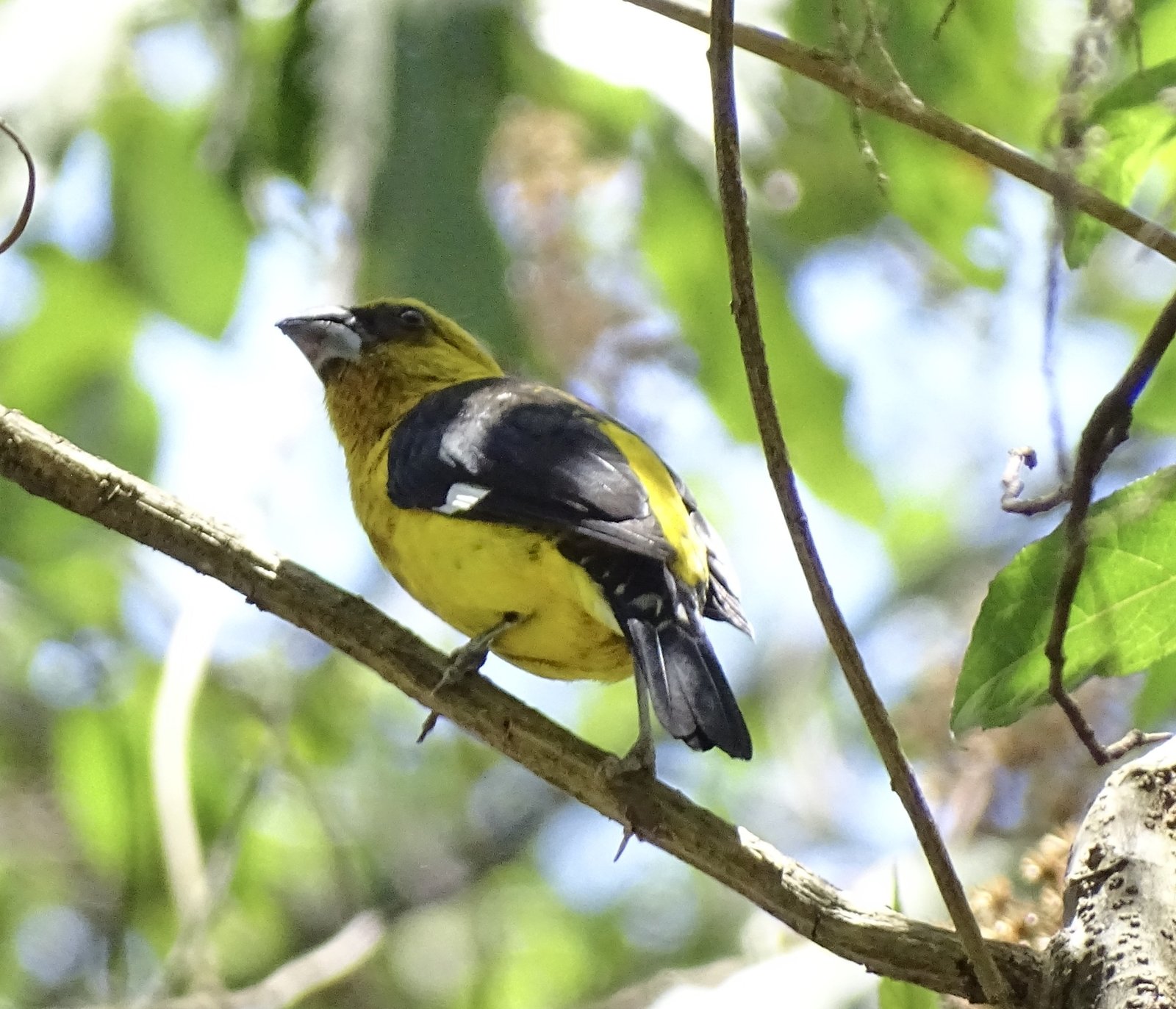
The Black-thighed Grosbeak is a large yellow-and-black grosbeak with a heavy bill, found only in the mountains of Costa Rica and western Panama. It lives along forest edges and in semi-open country in mountain forest. The black thighs that give it its name are usually hidden in the field.
Voice
The song is a long, rich series of clear, whistled phrases, similar to the song of a thrush. The call is a sharp, metallic peek.
Recording: Enrique Varela — CC BY-NC-SA 4.0 · converted to mono · xeno-canto
Identification
19–21 cm. Bill very heavy and triangular, blackish. The male has a yellow head and underparts with an olive or orange-yellow tinge on the head, a black back, black wings with a white patch at the base of the primaries and a black tail. The thighs are black. The female is duller, with an olive-green back mottled black and less pure yellow. Young birds resemble the female.
Confusion species
Yellow Grosbeak Pheucticus chrysopeplus lives only in Mexico and Guatemala and has broad white wing bars and a spotted back. Female Flame-colored Tanager Piranga bidentata is smaller, with a smaller bill, two white wing bars and a streaked back. Yellow-green Grosbeak Caryothraustes canadensis occurs only in the lowlands of eastern Panama and has a black face and an olive-green back.
Habitat
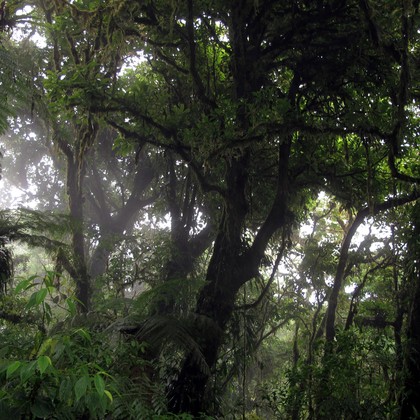
Edges of humid montane forest and cloud forest, mature secondary forest, clearings with scrub, pastures with scattered trees and shade coffee; mostly between 1000 and 2500 m, locally lower. It eats fruit, seeds and insects, often feeding in pairs or small groups in the middle levels and canopy.
Where the bird is most at home, classified by the vegetation units of Mexico and Central America.



Range and movements
Only in the guide area: the mountains of Costa Rica, from the Cordillera de Guanacaste and Cordillera de Tilarán to the Cordillera de Talamanca, and western Panama, in Chiriquí, Bocas del Toro and Veraguas.
- Resident
- dark = core range, pale = thinly spread
How and when to look
Regularly seen at forest edges and in gardens in the highlands of Costa Rica, for example in the San Gerardo de Dota valley and around Monteverde. It often sings from a prominent branch.
Conservation status
Not threatened (LC). Fairly common within its small range and tolerates semi-open, partly cleared landscapes.
Scientific name
Pheucticus tibialis | Lawrence, 1867
Lawrence described the species in 1867 and placed it straight away in the genus where it still stands. The genus Pheucticus was introduced in 1850 by Reichenbach. Pheucticus is Greek, from pheuktikos 'shy, inclined to avoid'. tibialis is Latin for 'of the shin', after the black thighs. The specimen the first description was based on came from Cervantes, Cartago, Costa Rica.