All species › Passerines › New World blackbirds, troupials and allies › Yellow-breasted Chat
Position in the tree Birds Aves › Birds with a flexible palate Neognathae › All other modern birds Neoaves › Landbirds Telluraves › Falcons, parrots and passerines Australaves › Falcons and passerines Eufalconimorphae › Parrots and passerines Psittacopasserae
Yellow-breasted Chat | Icteria virens
Geelborstzanger | Buscabreña
The Yellow-breasted Chat is a large, long-tailed songbird of dense thickets. It was long placed among the New World warblers, but is now treated as a family of its own, related to the blackbirds and orioles. It breeds in northern Mexico; elsewhere in the guide area it is mainly a winter visitor.
Voice
The song is an irregular series of whistles, chuckles, harsh notes and dry clicks, with long pauses between them; often also at night. The male sometimes sings in a short display flight with dangling legs. The call is a harsh, nasal chak.
Recording: Mario Reyes Jr — CC BY-NC-SA 4.0 · shortened to the first 60 s, mono · xeno-canto
Identification
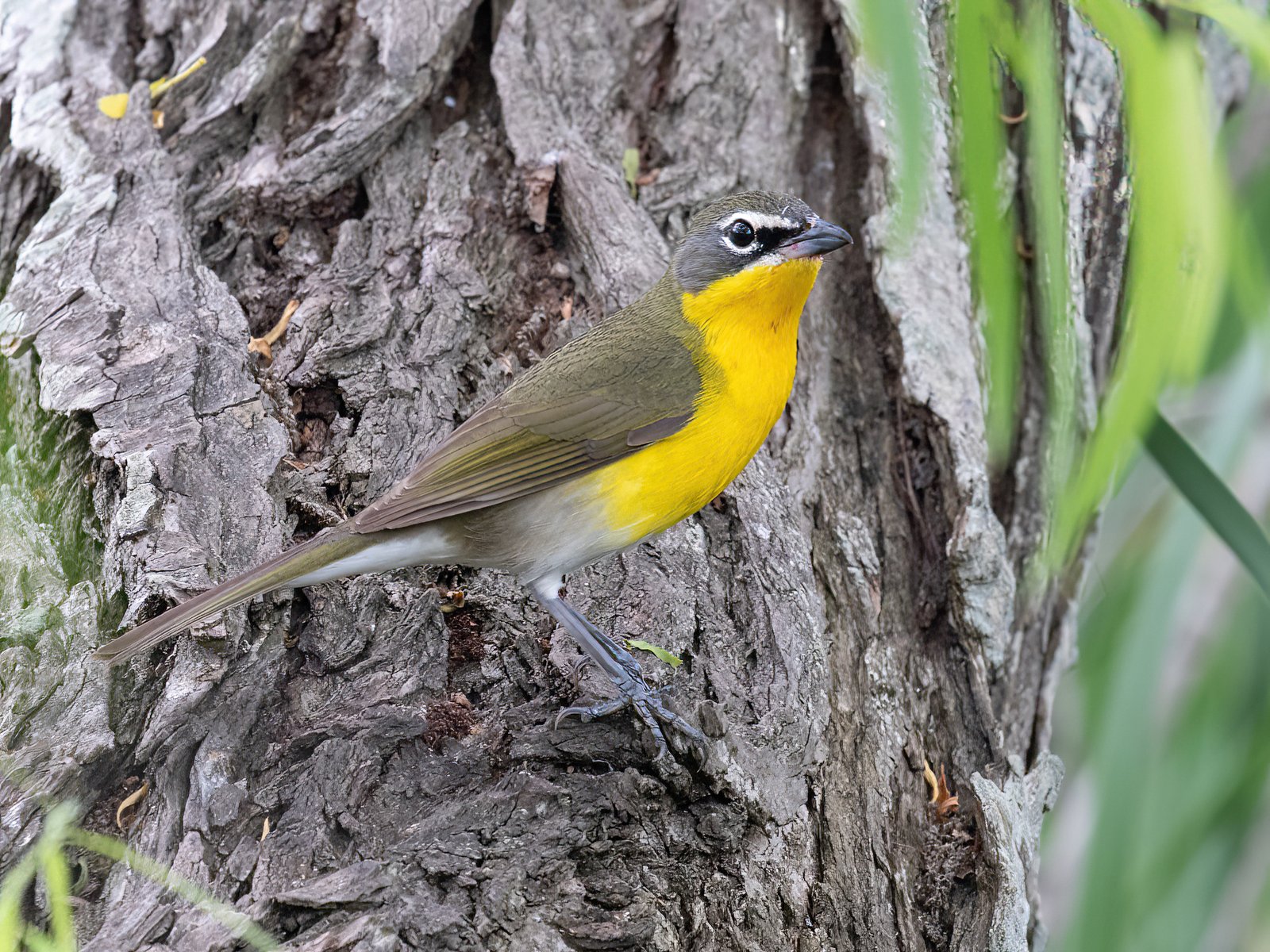
17–19 cm. Large for a songbird, with a thick, slightly curved black bill and a long tail. Upperparts olive-green, head greyish with white spectacles and a white stripe from the bill to above the eye, plus a white moustachial stripe. Throat and breast bright lemon-yellow, belly and undertail coverts white. Lores black in the male, grey in the female; otherwise the sexes are nearly alike.
Confusion species
Common Yellowthroat Geothlypis trichas and Grey-crowned Yellowthroat Geothlypis poliocephala also have a yellow throat and breast, but are much smaller, with a thin bill and no white spectacles or moustachial stripe. Tanagers with yellow underparts lack the white head stripes and have a differently shaped bill.
Habitat
Dense scrub, forest edges, thickets along rivers, abandoned fields and young secondary forest. In winter also in scrub in drier regions. It lives hidden in low, dense shrubbery and eats insects and, mainly outside the breeding season, berries.
Where the bird is most at home, classified by the vegetation units of Mexico and Central America.




Range and movements
Breeds from southern Canada through the United States into northern and central Mexico. Winters from Mexico, mainly along the slopes towards the Gulf of Mexico and the Pacific and on the Yucatán Peninsula, south to western Panama.
- Summer visitor (c. Apr–Sep)
- dark = core range, pale = thinly spread
How and when to look
The song is often the first sign: a bird singing loudly and erratically from a dense bush is frequently a chat. Waiting patiently at the edge of the scrub sometimes produces a bird that briefly comes out onto an open branch.
Conservation status
Not threatened (LC). Widespread and locally common. It has declined locally through the loss of rank scrub, among other things through forest regrowth on abandoned land and the clearing of thickets.
Scientific name
Icteria virens | (Linnaeus, 1758)
Linnaeus described the species in 1758 as Turdus virens; because it was later moved to another genus, the author and year stand in brackets. The genus Icteria was introduced in 1808 by Vieillot. Icteria derives from Greek ikteros 'jaundice', also the name of a yellow bird, after the bright yellow breast. virens is Latin for 'green', after the olive-green upperparts. The specimen the first description was based on came from inland South Carolina.