All species › Passerines › Tyrant flycatchers and allies › Yellow-bellied Elaenia
Position in the tree Birds Aves › Birds with a flexible palate Neognathae › All other modern birds Neoaves › Landbirds Telluraves › Falcons, parrots and passerines Australaves › Falcons and passerines Eufalconimorphae › Parrots and passerines Psittacopasserae
Yellow-bellied Elaenia | Elaenia flavogaster
Geelbuikelenia | Elenia vientre amarillo
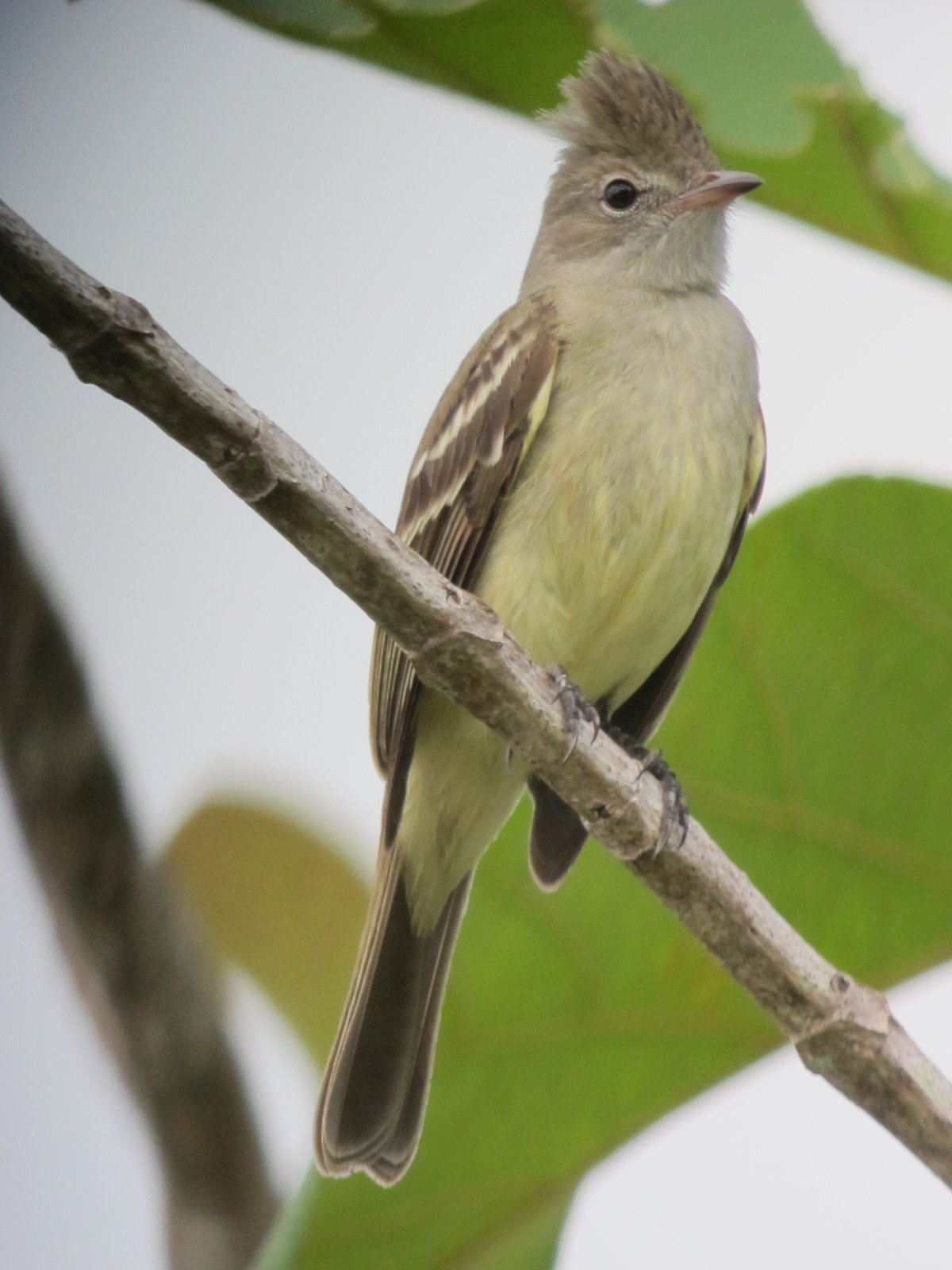
The Yellow-bellied Elaenia is a medium-sized, greyish-olive tyrant flycatcher with a prominent crest that is often parted in the middle to reveal a white crown patch. It is one of the commonest birds of gardens, pastures and forest edges and is noisy, with harsh calls. In the guide area it lives from southern Mexico to Panama.
Voice
Noisy. Gives a harsh, raspy breeer or jweeer; at dawn it sings a repeated, hoarse wheee-beer, wheee-beer. Pairs often call together.
Recording: JAYRSON ARAUJO DE OLIVEIRA — CC BY-NC-SA 4.0 · converted to mono · xeno-canto
Identification
15–17 cm. Head with a full, often erect crest, parted in the middle by a white crown patch; narrow whitish eye-ring. Upperparts greyish olive-brown. Wings dark with two whitish wing-bars and pale edges to the tertials. Throat and breast grey, belly pale yellow. Bill fairly short, black with a pale base to the lower mandible. Male and female are alike.
Confusion species
Lesser Elaenia Elaenia chiriquensis is smaller and duller, with a lower, rounder head and a smaller, often hidden white crown patch. Mountain Elaenia Elaenia frantzii of the highlands has a round head with no crest and no white crown patch. Caribbean Elaenia Elaenia martinica (islands off Yucatán and Belize) has a less full crest and a mainly white belly. Greenish Elaenia Myiopagis viridicata is smaller, lacks a crest and has no distinct wing-bars.
Habitat
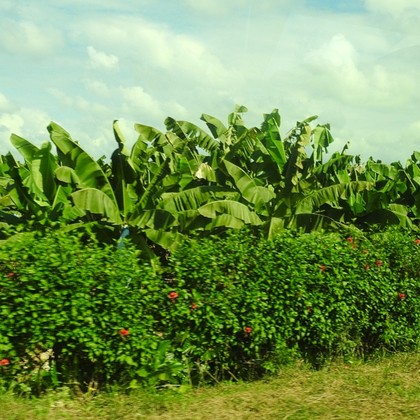
Semi-open country with trees and shrubs: gardens, parks, villages, pasture with scattered trees, plantations, savanna, forest edges and clearings, from the lowlands to about 2000 m. Absent from closed forest. It eats many small fruits and berries as well as insects. It builds a small, open cup nest of plant material, lined with feathers, on a horizontal branch.
Where the bird is most at home, classified by the vegetation units of Mexico and Central America.





Range and movements
From southern Mexico through Belize, Guatemala, El Salvador, Honduras, Nicaragua and Costa Rica to Panama. Outside the guide area over much of South America to northern Argentina, on Trinidad and Tobago and on some of the southern Lesser Antilles.
- Resident
- dark = core range, pale = thinly spread
How and when to look
Found almost everywhere in the guide area in gardens and along roads with trees. Note the harsh chatter and the erect, parted crest; a bird holding its crest flat can resemble Lesser Elaenia.
Conservation status
Not threatened. Very widespread and common; benefits from deforestation and the spread of semi-open farmland.
Scientific name
Elaenia flavogaster | (Thunberg, 1822)
Thunberg described the species in 1822 as P[ipra] flavogaster; because it was later moved to another genus, the author and year stand in brackets. The genus Elaenia was introduced in 1836 by Sundevall. Elaenia comes from Greek elaineos 'oily, olive-coloured', after the olive-green plumage. flavogaster combines Latin flavus 'yellow' with Greek gastēr 'belly', after the yellow belly. The specimen the first description was based on came from probably Rio de Janeiro, Brazil.