All species › Passerines › Thrushes and allies › Wood Thrush
Position in the tree Birds Aves › Birds with a flexible palate Neognathae › All other modern birds Neoaves › Landbirds Telluraves › Falcons, parrots and passerines Australaves › Falcons and passerines Eufalconimorphae › Parrots and passerines Psittacopasserae
Wood Thrush | Hylocichla mustelina
Amerikaanse boslijster | Zorzal maculado
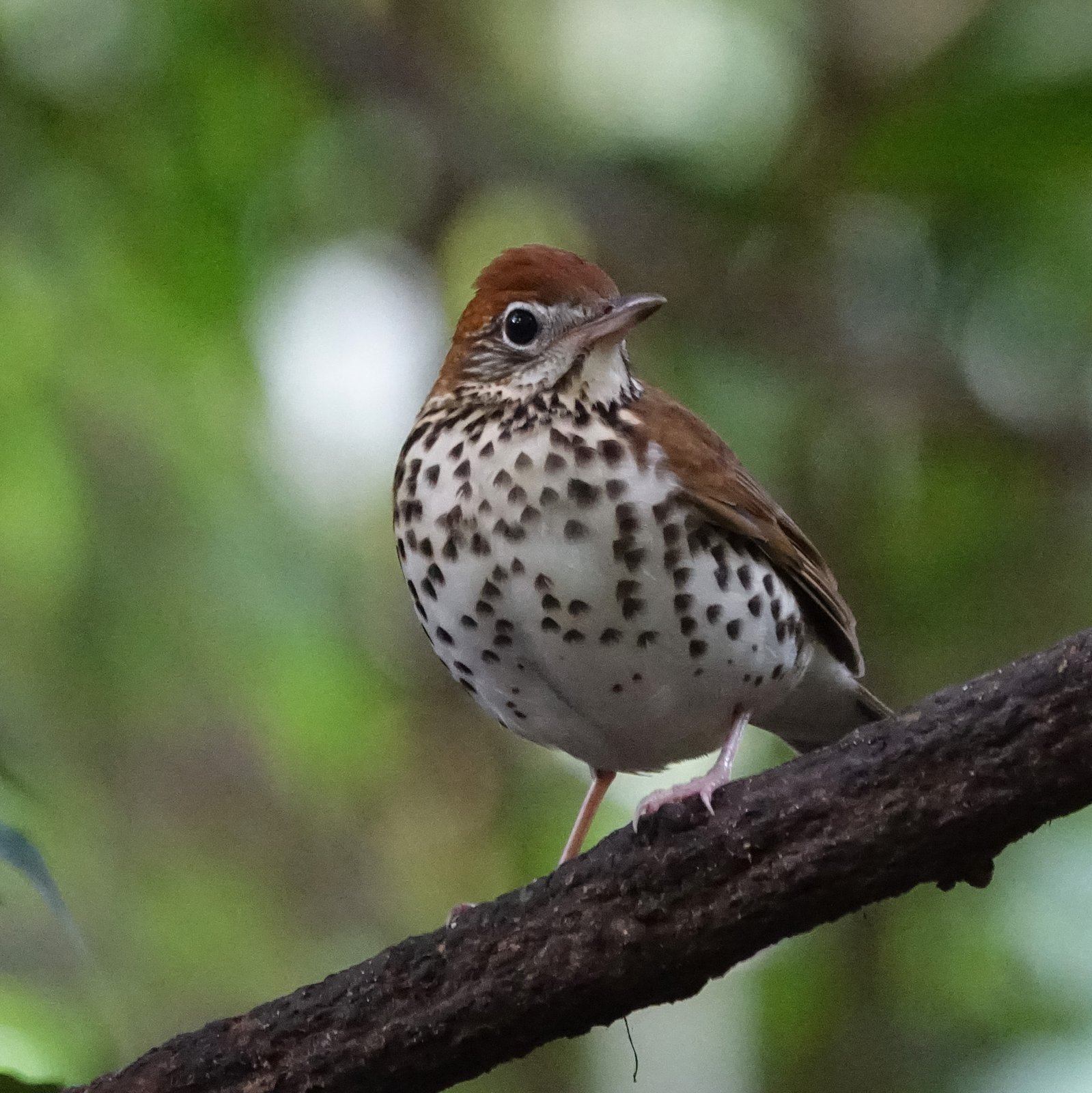
The Wood Thrush is a stocky brown thrush with large black spots on white underparts. It breeds in deciduous forest in eastern North America and winters in the understorey of humid forest from southern Mexico to Panama. In the guide area it is a winter visitor and passage migrant.
Voice
Usually silent in the guide area. The alarm call is a rapid, dry pit-pit-pit; also a soft puk. Migrants give a buzzy hee at night. The fluting, multi-part song, like ee-oh-lay with a trilled final note, is heard mainly on the breeding grounds, sometimes also during spring migration.
Recording: Jacob Saucier — CC BY-NC-SA 4.0 · converted to mono · xeno-canto
Identification
18–21 cm. Large and round-bodied, with a fairly short tail. Crown and nape warm rusty brown, back, wings and tail cooler olive-brown. Distinct white eye-ring; cheeks finely streaked black and white. Underparts white with large, round black spots on breast, flanks and belly. Legs pink. The sexes are alike.
Confusion species
Hermit Thrush Catharus guttatus is smaller, has a rufous tail contrasting with a browner back and smaller, less crisp spots mainly on the breast. Swainson's Thrush Catharus ustulatus and Veery Catharus fuscescens are smaller and slimmer, with faint, small breast spots and an unspotted white belly. Gray-cheeked Thrush Catharus minimus has grey cheeks and a greyish-brown head without a rusty tone.
Habitat
In winter the shady understorey of humid lowland and foothill forest, mostly below 1200 m, also mature secondary forest, forest edges with dense undergrowth and shade coffee. On migration also in drier forest and in parks. It searches the leaf litter on the ground for insects and other invertebrates and also eats fruit. Wintering birds hold their own territory.
Where the bird is most at home, classified by the vegetation units of Mexico and Central America.





Range and movements
Breeds in the eastern United States and extreme south-eastern Canada. Winters from southern Mexico (southern Veracruz, Oaxaca, Chiapas and the Yucatán Peninsula) through Belize, Guatemala, Honduras and Nicaragua to Costa Rica and Panama, mainly on the Caribbean slope. Passes through eastern Mexico in spring and autumn.
- Winter visitor (c. Oct–Mar)
- dark = core range, pale = thinly spread
How and when to look
In winter regularly seen in the understorey at La Selva in Costa Rica, at Tikal in Guatemala and along Pipeline Road (Camino del Oleoducto) in Panama. It is often first noticed by the dry pit-pit-pit from the undergrowth.
Conservation status
Not threatened (LC). The breeding population has declined steeply since the 1960s. Fragmentation of breeding forests in North America and loss of lowland forest in the wintering range are the main threats.
Scientific name
Hylocichla mustelina | (Gmelin, 1789)
Gmelin described the species in 1789 as T[urdus] mustelinus; because it was later moved to another genus, the author and year stand in brackets. The genus Hylocichla was introduced in 1864 by Baird. Hylocichla is Greek, from hulē 'woodland' and kikhlē 'thrush': 'wood thrush'. mustelina is Latin for 'weasel-like', from mustela 'weasel', after the warm tawny-brown upperparts. The specimen the first description was based on came from New York, USA.