All species › Passerines › Thrushes and allies › Aztec Thrush
Position in the tree Birds Aves › Birds with a flexible palate Neognathae › All other modern birds Neoaves › Landbirds Telluraves › Falcons, parrots and passerines Australaves › Falcons and passerines Eufalconimorphae › Parrots and passerines Psittacopasserae
Aztec Thrush | Ridgwayia pinicola
Aztekenlijster | Mirlo azteca
The Aztec Thrush is a large, dark thrush with conspicuous white wing patches that occurs only in the mountains of Mexico. It lives in highland pine-oak and conifer forest and feeds mainly on fruit. Outside the breeding season it wanders in small groups to places where berries are ripe.
Voice
Often silent. The call is a soft, thin, somewhat nasal, rising wheee or a hoarse prreee; also a short, dry tick. The song, rarely heard, is a series of short, shrill, whistled phrases.
Recording: Manuel Grosselet — CC BY-NC-SA 4.0 · converted to mono · xeno-canto
Identification
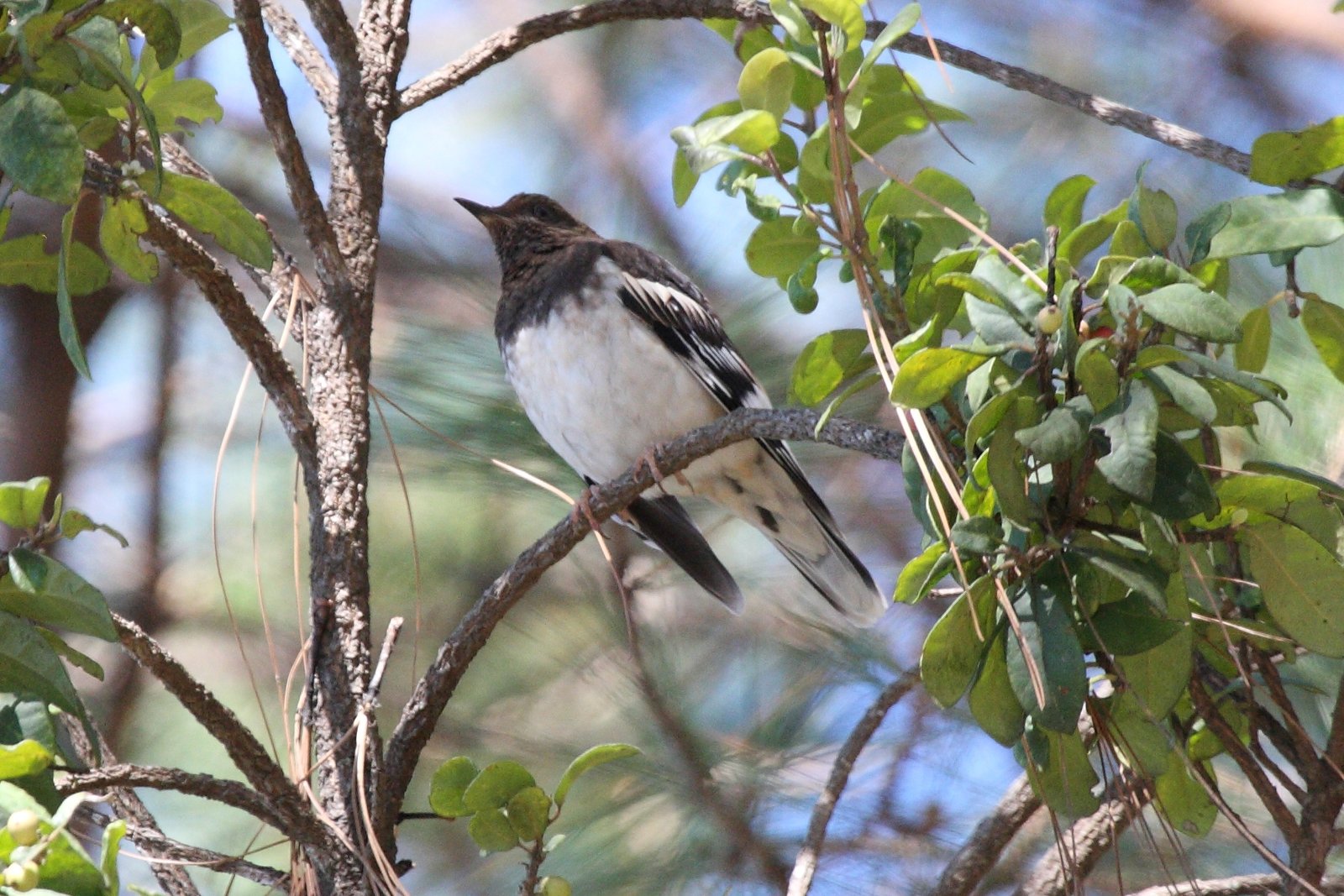
21–24 cm. Male: head, breast and upperparts dark blackish brown, with fine pale streaks on head and mantle; belly and undertail coverts white. Wings blackish with a broad white patch on the coverts and white along the flight feathers, showing as white bands in flight. Rump white; tail black with white tips. The female is browner and more heavily streaked on head, back and breast. Juveniles are densely spotted with pale markings. Bill dark, legs flesh-coloured.
Confusion species
American Robin Turdus migratorius has an orange-red breast and no white wing patches. White-throated Thrush Turdus assimilis has a white throat patch, a yellow eye-ring and plain brown wings. Seen from above or in flight, the pattern of white wing bands, white rump and white-tipped tail is shown only by Aztec Thrush among the thrushes of this region.
Habitat
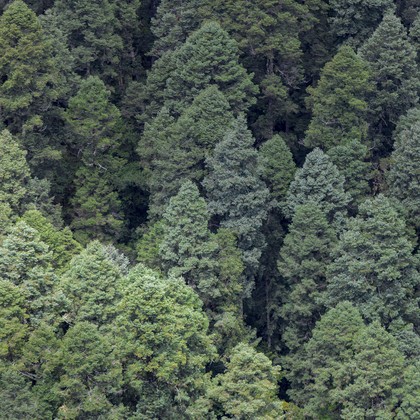
Humid pine-oak forest, conifer forest and wooded ravines in the mountains, mostly between 1800 and 3500 m; lower in winter. It takes mainly fruit and berries in the canopy, including those of madrones (Arbutus), and also comes to the ground. Outside the breeding season in small wandering groups, sometimes with other thrushes.
Where the bird is most at home, classified by the vegetation units of Mexico and Central America.


Range and movements
Endemic to the mountains of Mexico. Mainly in the Sierra Madre Occidental, from Sonora and Chihuahua south through Sinaloa, Durango, Nayarit and Jalisco, and further in the Trans-Mexican Volcanic Belt and the Sierra Madre del Sur to Guerrero and Oaxaca; locally in the Sierra Madre Oriental. Outside the guide area only as a vagrant to the southern United States, mainly Arizona and Texas.
- Resident
- Winter visitor (c. Oct–Mar)
- Passage (Mar–Apr, Oct–Nov)
- dark = core range, pale = thinly spread
How and when to look
Most often searched for along the mountain road from Mazatlán to Durango, around El Palmito, and on the slopes of the Nevado de Colima. The chance is highest at fruiting trees and shrubs; numbers vary greatly from year to year.
Conservation status
Not threatened (LC). Fairly scarce and irregular in occurrence. Logging of montane and conifer forest can cause local declines.
Scientific name
Ridgwayia pinicola | (Sclater, 1859)
Sclater described the species in 1859 as Turdus pinicola; because it was later moved to another genus, the author and year stand in brackets. The genus Ridgwayia was introduced in 1883 by Stejneger. Ridgwayia honours the American ornithologist Robert Ridgway (1850–1929), curator of birds at the Smithsonian. pinicola is Latin, from pinus 'pine' and -cola 'dweller', after the highland pine forests it inhabits. The specimen the first description was based on came from pine forests above Xalapa, Veracruz, Mexico.