All species › Passerines › Antbirds › Wing-banded Antbird
Position in the tree Birds Aves › Birds with a flexible palate Neognathae › All other modern birds Neoaves › Landbirds Telluraves › Falcons, parrots and passerines Australaves › Falcons and passerines Eufalconimorphae › Parrots and passerines Psittacopasserae
Wing-banded Antbird | Myrmornis torquata
Bonte mierlijster | Hormiguero alifranjeado
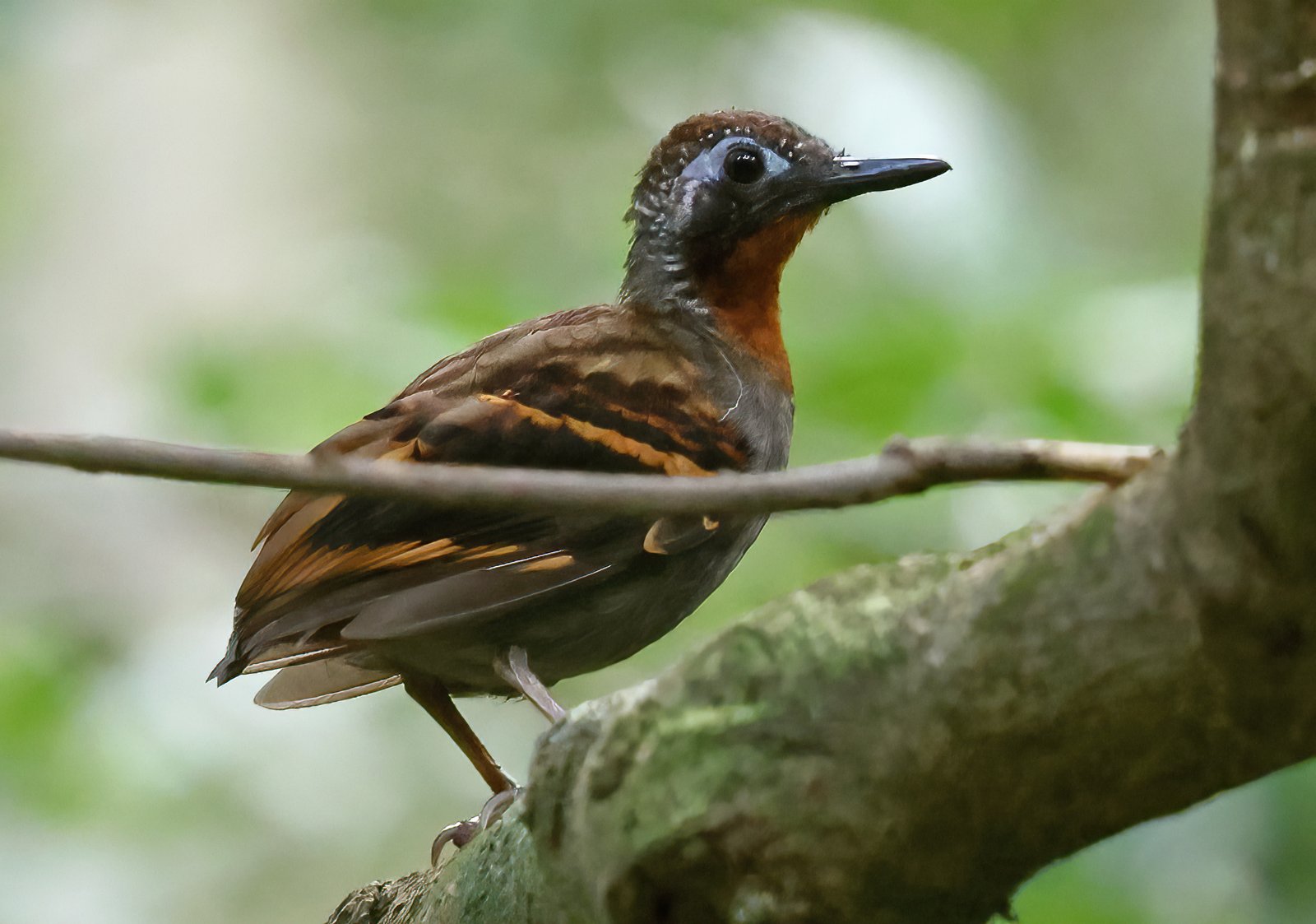
The Wing-banded Antbird is a stocky, short-tailed antbird that lives on the forest floor and flicks leaves aside with its long bill. Characteristic are the black wing coverts with broad buff bands and the black-and-white checkered sides of the neck. In the guide area it is local and scarce, in Nicaragua and Panama.
Voice
A series of clear, rising whistles that gradually becomes slightly faster and louder. Also a sharp, short call.
Recording: Paul Lenrumé — CC BY-NC-SA 4.0 · shortened to the first 60 s, mono · xeno-canto
Identification
14–15 cm; tail short and rufous. Upperparts warm brown with black scaling on crown and back. Wing coverts black with two or three broad buff-brown bands. Male with black throat and breast, bordered by black-and-white scaled neck sides; belly grey. Female has a cinnamon throat and breast instead of black. Bare bluish skin around the eye. Bill long and fairly strong.
Confusion species
Black-faced Antthrush Formicarius analis also walks on the forest floor, but carries its tail cocked, lacks wing bands and has plain brown upperparts. Other ground-dwelling antbirds lack the combination of wing bands and checkered neck sides.
Habitat
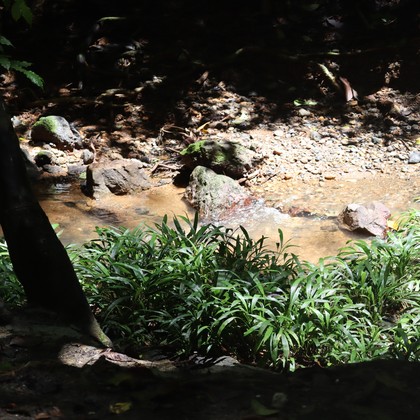
Floor of humid evergreen lowland and foothill forest with an open understorey. It forages alone or in pairs among the leaf litter for insects and other invertebrates, tossing leaves aside with its bill. It rarely joins mixed flocks.
Where the bird is most at home, classified by the vegetation units of Mexico and Central America.


Range and movements
Locally on the Caribbean slope of Nicaragua and in Panama, mainly in the centre and east. Outside the guide area in north-western Colombia and, as a different subspecies, in Amazonia and the Guianas.
- Resident
- Winter visitor (c. Oct–Mar)
- Passage (Mar–Apr, Oct–Nov)
- dark = core range, pale = thinly spread
How and when to look
Usually heard first: the rising song gives the bird away, after which it often stays still on the forest floor for long periods. Known sites lie in the forests of the Canal Area and Darién in Panama.
Conservation status
Not threatened. Scarce and local in the guide area; sensitive to forest fragmentation.
Scientific name
Myrmornis torquata | (Boddaert, 1783)
Boddaert described the species in 1783 as Formicarius torquatus; because it was later moved to another genus, the author and year stand in brackets. The genus Myrmornis was introduced in 1783 by Hermann. Myrmornis is Greek, from murmēx 'ant' and ornis 'bird': 'ant-bird'. torquata is Latin for 'collared', after the black throat bordered with white. The specimen the first description was based on came from Cayenne, French Guiana.