All species › Passerines › Antbirds › Russet Antshrike
Position in the tree Birds Aves › Birds with a flexible palate Neognathae › All other modern birds Neoaves › Landbirds Telluraves › Falcons, parrots and passerines Australaves › Falcons and passerines Eufalconimorphae › Parrots and passerines Psittacopasserae
Russet Antshrike | Thamnistes anabatinus
Rosse mierklauwier | Batará café
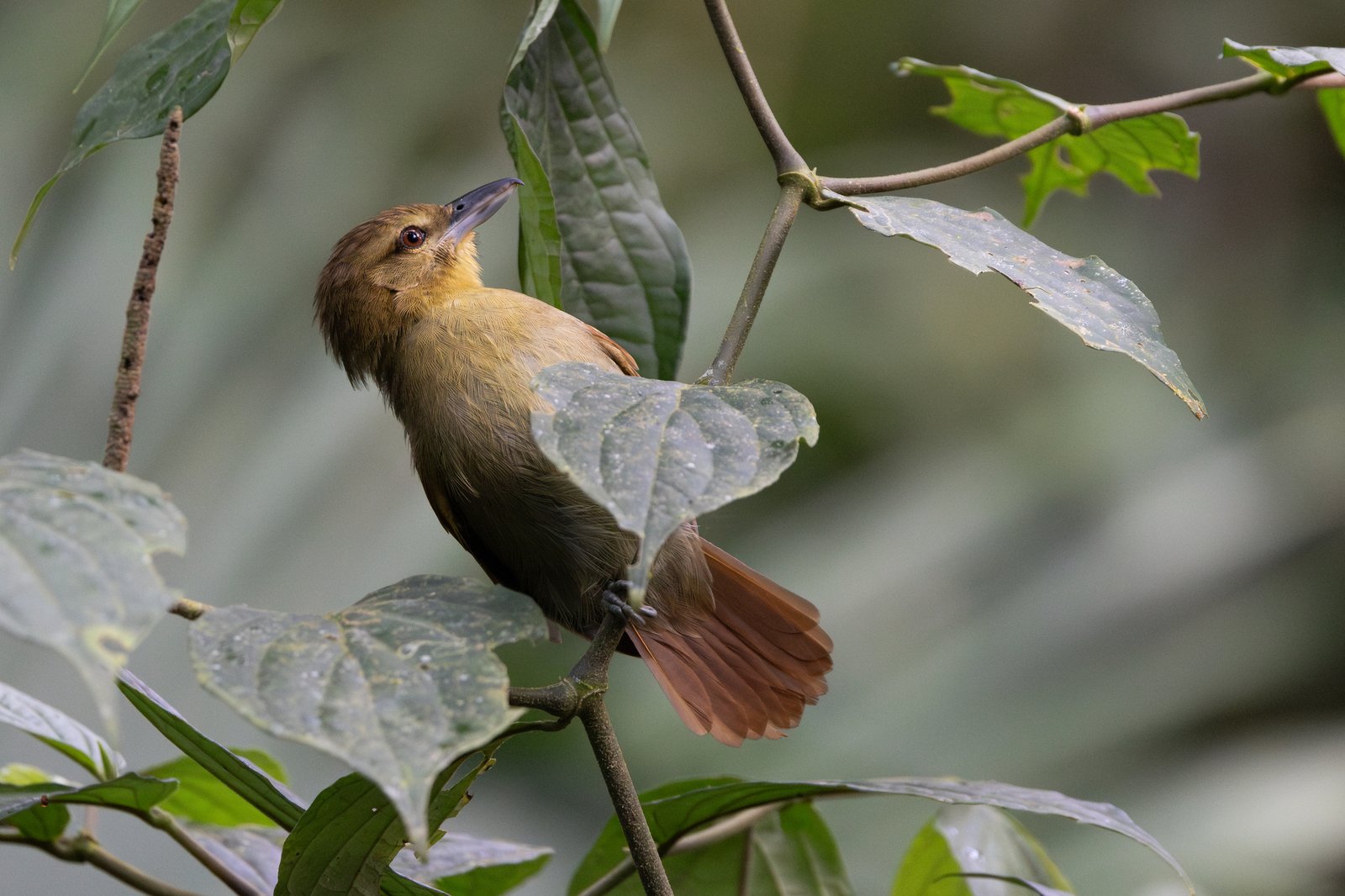
The Russet Antshrike is a brown, inconspicuous antshrike of the canopy of humid forest. With its rufous-brown colour, pale eyebrow and heavy hooked bill it looks more like a foliage-gleaner than a typical antshrike. It usually travels with mixed flocks in the canopy. In the guide area it lives from south-eastern Mexico to Panama.
Voice
The song is a short series of high, sharp notes, often slightly descending. The call is a thin, sharp tsip or a double tsip-tsip.
Recording: Juan Freile — CC BY-NC-SA 4.0 · converted to mono · xeno-canto
Identification
14–15 cm. Upperparts rufous-brown, wings and tail brighter cinnamon. Pale buff eyebrow and a dark eye-line. Underparts plain buffy olive-brown, throat paler. Bill fairly heavy with a hooked tip. The male has a concealed orange-rufous patch on the mantle that shows only when excited.
Confusion species
Foliage-gleaners such as Ochre-throated Foliage-gleaner Automolus ochrolaemus are similarly brown but have a slimmer bill without an obvious hook and usually forage lower in the forest. The female Black-crowned Antshrike Thamnophilus atrinucha has pale spots on the wings and forages in the understorey.
Habitat
Canopy and middle levels of humid evergreen lowland, foothill and lower montane forest, also forest edges and tall second growth, from sea level to about 1500 m. It searches leaves and branches for insects and other arthropods, nearly always in mixed flocks.
Where the bird is most at home, classified by the vegetation units of Mexico and Central America.



Range and movements
Caribbean slope of south-eastern Mexico through Belize, Guatemala, Honduras, Nicaragua and Costa Rica to Panama. Outside the guide area in South America, mainly along the Andes to Bolivia.
- Resident
- dark = core range, pale = thinly spread
How and when to look
Most often seen in mixed flocks high in the trees along forest edges and roads, as a rufous-brown bird moving along branches like a foliage-gleaner.
Conservation status
Not threatened. Fairly common in suitable forest, but often overlooked because it lives in the canopy.
Scientific name
Thamnistes anabatinus | Sclater & Salvin, 1860
Sclater & Salvin described the species in 1860 and placed it straight away in the genus where it still stands. He introduced the genus Thamnistes in that same work. Thamnistes is Greek, from thamnos 'bush' and -istēs 'one who does': 'bush-dweller'. anabatinus refers to the foliage-gleaner genus Anabates (Greek anabatēs 'climber') with Latin -inus 'resembling'. The specimen the first description was based on came from Verapaz, Guatemala.