All species › Waterfowl › Ducks, swans and geese › White-winged Scoter
Position in the tree Birds Aves › Birds with a flexible palate Neognathae › Fowl Galloanserae
White-winged Scoter | Melanitta deglandi
Witvleugelzee-eend | Negrón aliblanco
The White-winged Scoter is the largest scoter of North America. The guide area lies at the southern edge of its winter range: in Mexico the species is a rare winter visitor along the northern Pacific coast, usually among Surf Scoters. The Asian Melanitta stejnegeri and the European Velvet Scoter Melanitta fusca are treated as separate species.
Voice
Usually silent. On take-off the wings make a heavy, clattering sound. In display the male gives a thin, high whistle and the female a hoarse, low croak.
Recording: Andrew Spencer — CC BY-NC-SA 4.0 · converted to mono · xeno-canto
Identification
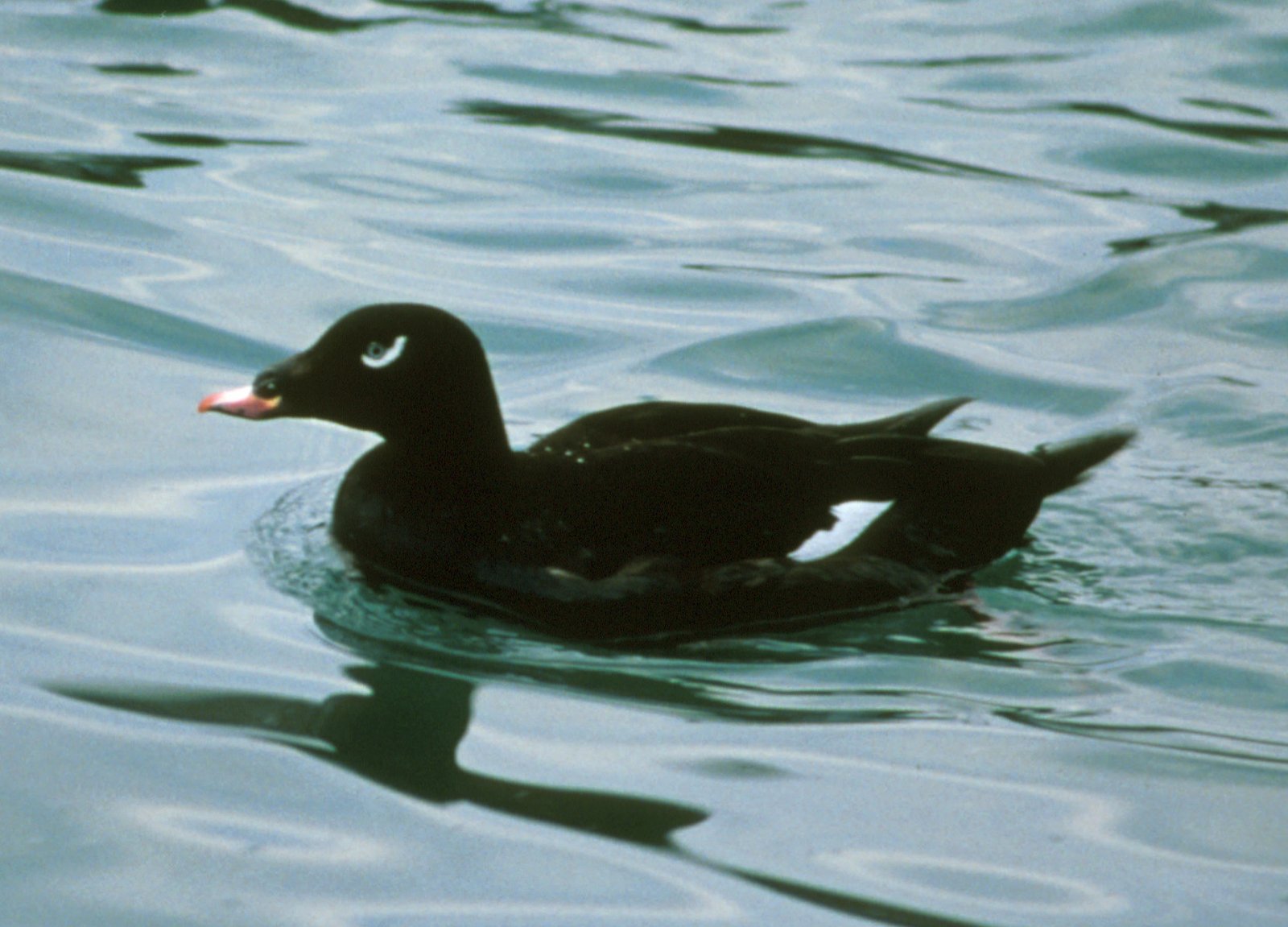
48–58 cm. Heavily built, with a long, wedge-shaped bill whose feathering at the base reaches beyond the nostrils. The male is black with brownish flanks, a small white hook behind the pale eye and an orange-red bill with a black knob at the base. The female is dark sooty brown with two faint pale patches on the side of the head and a dark bill. Both sexes have a white patch on the secondaries, which is broad and sharply defined in flight and on swimming birds often shows as a narrow white line along the flank.
Confusion species
Surf Scoter Melanitta perspicillata has no white in the wing in any plumage; the male has white patches on the forehead and nape. Females of both species have two pale head patches, so on a swimming bird that does not show its wings only a wing stretch or take-off is conclusive.
Habitat
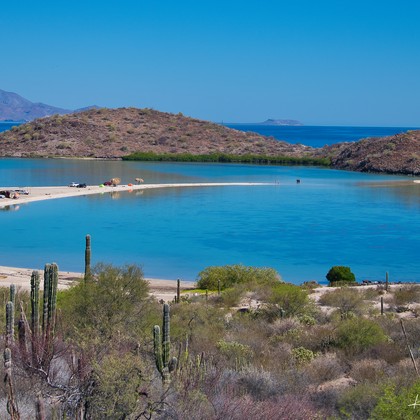
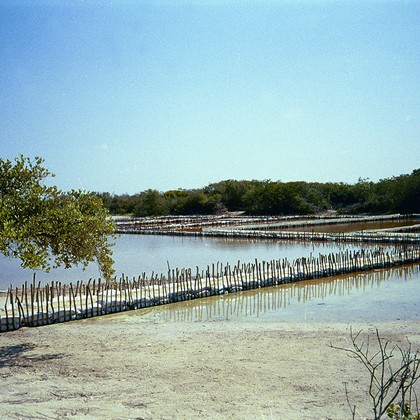
Coastal water, bays and lagoons, where the birds often dive for shellfish in deeper water than Surf Scoter; exceptionally on lakes and reservoirs inland.
Where the bird is most at home, classified by the vegetation units of Mexico and Central America.
Range and movements
In Mexico mainly along the Pacific coast of Baja California, with scattered records in Sonora and inland in Chihuahua. Otherwise it winters mainly along the Pacific and Atlantic coasts of the United States and Canada and on the Great Lakes. Breeds on lakes in north-western North America, from Alaska to western Canada.
- Winter visitor (c. Oct–Mar)
- dark = core range, pale = thinly spread
How and when to look
Flocks of Surf Scoters along the northern Pacific coast of Baja California, where a White-winged Scoter stands out by its bulkier build and, when it stretches its wings, the white wing patch.
Conservation status
Not threatened globally. The North American population has declined sharply since the middle of the twentieth century; the causes are not fully known. In the guide area a rare winter visitor in small numbers.
Scientific name
Melanitta deglandi | (Bonaparte, 1850)
Bonaparte described the species in 1850 as Oedemia deglandi; because it was later moved to another genus, the author and year stand in brackets. The genus Melanitta was introduced in 1822 by Boie. Melanitta is Greek, from melas 'black' and netta 'duck'. deglandi honours the French zoologist Côme-Damien Degland (1787–1856). The specimen the first description was based on came from North America.