All species › Jacamars and puffbirds › Puffbirds › White-whiskered Puffbird
Position in the tree Birds Aves › Birds with a flexible palate Neognathae › All other modern birds Neoaves › Landbirds Telluraves › Raptors, owls, kingfishers and woodpeckers Afroaves › Mousebirds, rollers and woodpeckers Coraciimorphae › Trogons and cavity nesters Cavitaves › Hornbills, kingfishers and woodpeckers Picocoraciae › Kingfishers, bee-eaters and woodpeckers Picodynastornithes
White-whiskered Puffbird | Malacoptila panamensis
Witsnorbaardkoekoek | Buco barbón
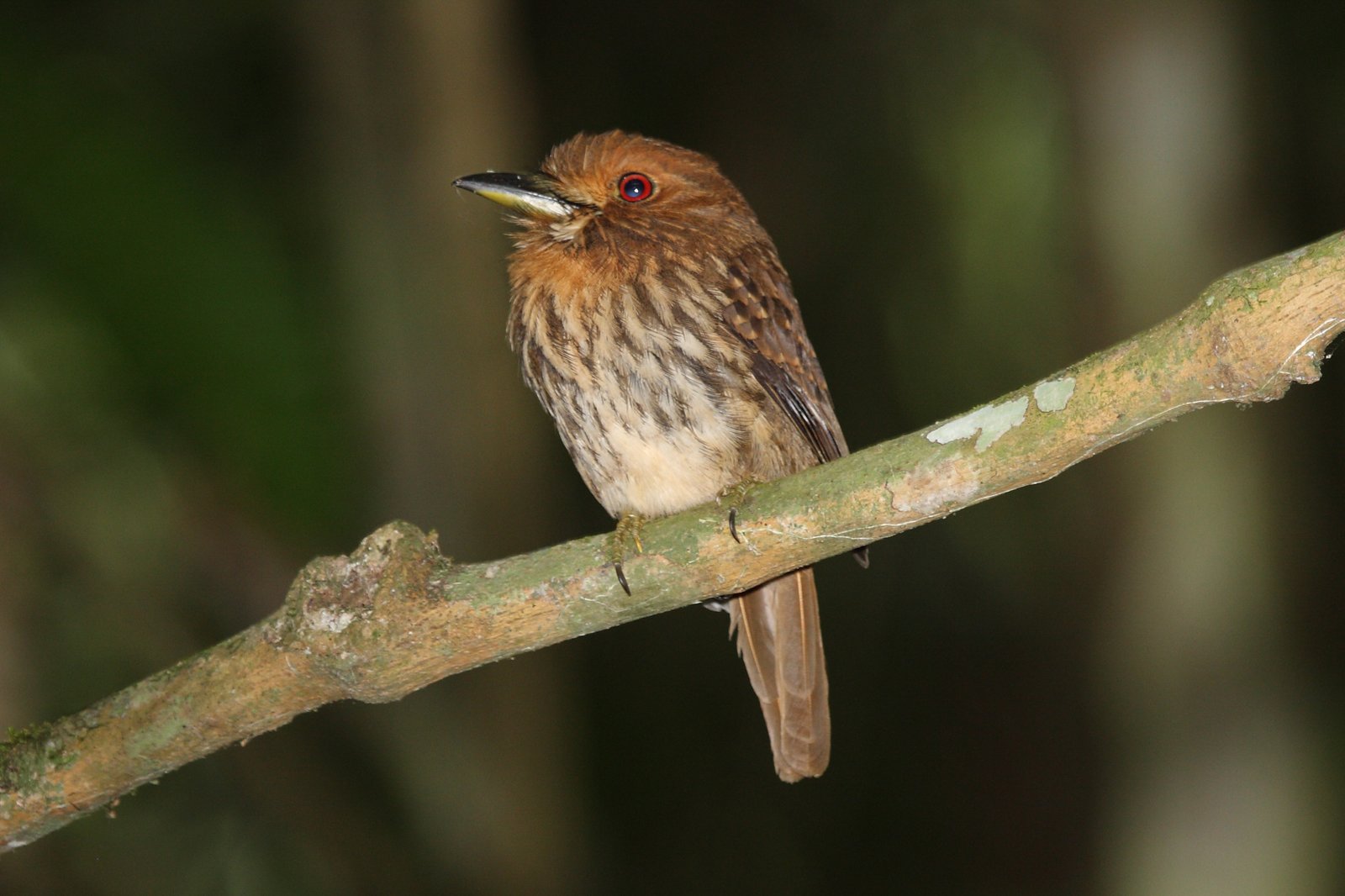
The White-whiskered Puffbird is a stocky, brown-streaked puffbird with a red eye and white whiskers. It often sits motionless for minutes in the understorey of humid forest and is often overlooked. In the guide area it lives from south-eastern Mexico to Panama.
Voice
A very high, thin, hissing whistle, tseeeeee, falling slightly and resembling an insect sound. Otherwise mostly silent.
Recording: GABRIEL LEITE — CC BY-NC-SA 4.0 · converted to mono · xeno-canto
Identification
18–20 cm. The male is warm rufous-brown above with fine pale spots, cinnamon on the breast and paler on the belly with dark streaks. White, bristly feathers around the base of the bill form a moustache, and the lores are white. The eye is red. The bill is fairly long, slightly curved and blackish. The female is greyer brown, less rufous and more heavily streaked. Tail short.
Confusion species
Lanceolated Monklet Micromonacha lanceolata is much smaller, white below with bold black streaks and without rufous tones. Grey-cheeked Nunlet Nonnula frontalis (central and eastern Panama) is smaller, with grey cheeks, an unstreaked cinnamon breast and no white whiskers. Barred Puffbird Nystalus radiatus is barred rather than streaked.
Habitat
Understorey and middle layer of humid lowland and foothill forest up to about 1200 m, also tall secondary forest and forest edges. It perches low on a branch, often near a gap or trail, and drops onto insects, spiders and small lizards on the ground or on foliage. It digs a nest burrow in the forest floor or a slope, with the entrance camouflaged by leaves.
Where the bird is most at home, classified by the vegetation units of Mexico and Central America.




Range and movements
Lowlands and foothills of south-eastern Mexico (mainly Chiapas, also Tabasco and the south of the Yucatán Peninsula) through Belize, Guatemala, Honduras and Nicaragua to Costa Rica and Panama, mainly on the Caribbean slope; in south-western Costa Rica and in Panama also on the Pacific side. Outside the guide area in western Colombia and western Ecuador.
- Resident
- dark = core range, pale = thinly spread
How and when to look
Regularly seen at La Selva and on the Osa Peninsula in Costa Rica, at Cockscomb in Belize and along Pipeline Road (Camino del Oleoducto) in Panama. It pays to look for a quietly perched brown bird near mixed flocks in the understorey.
Conservation status
Not threatened. Common in closed forest but disappears where forest is cleared.
Scientific name
Malacoptila panamensis | de Lafresnaye, 1847
De Lafresnaye described the species in 1847 and placed it straight away in the genus where it still stands. The genus Malacoptila was introduced in 1841 by Gray. Malacoptila is Greek, from malakos 'soft' and ptilon 'feather', after the loose, soft plumage. panamensis is Latin for 'of Panama', after the origin of the type. The specimen the first description was based on came from Panama.