All species › Jacamars and puffbirds › Puffbirds › Lanceolated Monklet
Position in the tree Birds Aves › Birds with a flexible palate Neognathae › All other modern birds Neoaves › Landbirds Telluraves › Raptors, owls, kingfishers and woodpeckers Afroaves › Mousebirds, rollers and woodpeckers Coraciimorphae › Trogons and cavity nesters Cavitaves › Hornbills, kingfishers and woodpeckers Picocoraciae › Kingfishers, bee-eaters and woodpeckers Picodynastornithes
Lanceolated Monklet | Micromonacha lanceolata
Kleine trappist | Monjilla lanceolada
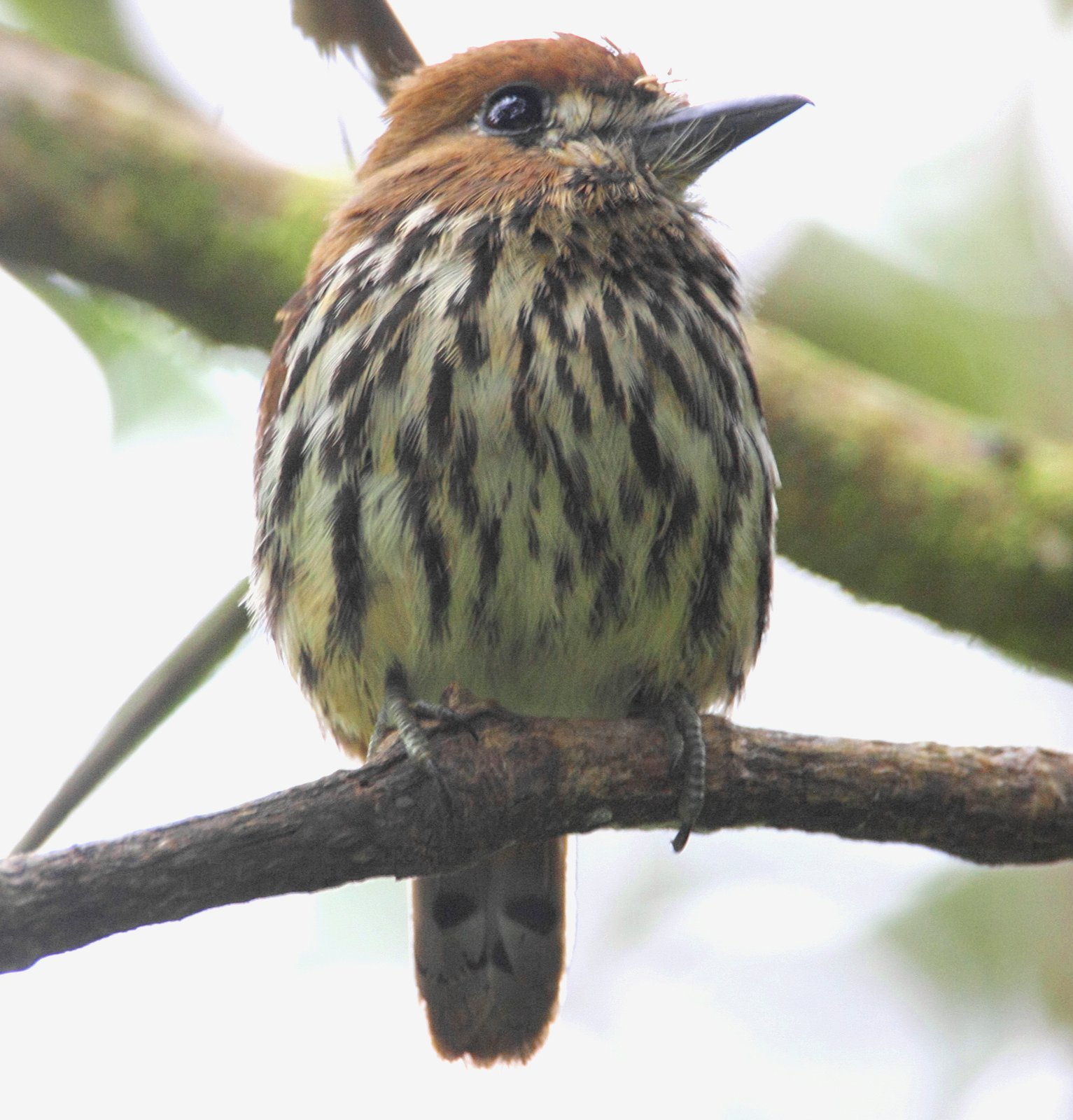
The Lanceolated Monklet is the smallest puffbird of the guide area: a stocky little brown bird with white, black-streaked underparts. It lives in the foothills of Costa Rica and western Panama and is scarce everywhere. Because it sits still for long periods, it is rarely noticed.
Voice
A series of high, thin, plaintive whistled notes, wheee, wheee, wheee, each rising slightly and repeated at short intervals. Often silent for long periods.
Recording: Jacob Wijpkema — CC BY-NC-SA 4.0 · converted to mono · xeno-canto
Identification
13–15 cm. Upperparts warm brown with fine pale spots; forehead and lores with white, bristly feathers. Underparts white with bold black streaks on the breast and flanks, the belly unstreaked. The bill is short, thick and black, the tail short and brown. Sexes alike.
Confusion species
White-whiskered Puffbird Malacoptila panamensis is much larger, with a red eye, a rufous or cinnamon breast and a longer bill. Grey-cheeked Nunlet Nonnula frontalis lives further east and has grey cheeks and an unstreaked cinnamon breast.
Habitat
Humid foothill forest and its edges on the Caribbean slope, mostly between 300 and 1200 m, locally lower. It sits still on a bare branch in the middle or lower layer, often near a gap, trail or stream, and catches insects in a short flight to foliage or the ground. It nests in a cavity in an earth bank or termite nest.
Where the bird is most at home, classified by the vegetation units of Mexico and Central America.


Range and movements
Caribbean foothills of Costa Rica, from the Cordillera de Guanacaste via the Arenal area to the Cordillera Central and the Turrialba valley, and in western Panama in Veraguas and the Ngäbe-Buglé comarca. Outside the guide area from Colombia to western Amazonia.
- Resident
- dark = core range, pale = thinly spread
How and when to look
Most records come from the foothills of Costa Rica, such as Arenal, the Turrialba area and Rancho Naturalista, and in Panama from the area around Santa Fe in Veraguas. The plaintive whistles are the best clue.
Conservation status
Not threatened. Scarce and local in the guide area, and sensitive to clearing of foothill forest.
Scientific name
Micromonacha lanceolata | (Deville, 1849)
Deville described the species in 1849 as Bucco lanceolata; because it was later moved to another genus, the author and year stand in brackets. The genus Micromonacha was introduced in 1881 by Sclater. Micromonacha is Greek, from mikros 'small' and monakhē 'nun': 'little nun', related to the nunbirds (Monasa). lanceolata is Latin for 'lance-shaped', after the lanceolate streaks on the breast and flanks. The specimen the first description was based on came from Pampa del Sacramento, upper Amazon, Peru.