All species › Birds of prey › Kites, Old World vultures, eagles and hawks › White-tailed Hawk
Position in the tree Birds Aves › Birds with a flexible palate Neognathae › All other modern birds Neoaves › Landbirds Telluraves › Raptors, owls, kingfishers and woodpeckers Afroaves › Hawks and owls Hieraves
White-tailed Hawk | Geranoaetus albicaudatus
Witstaartbuizerd | Aguililla cola blanca
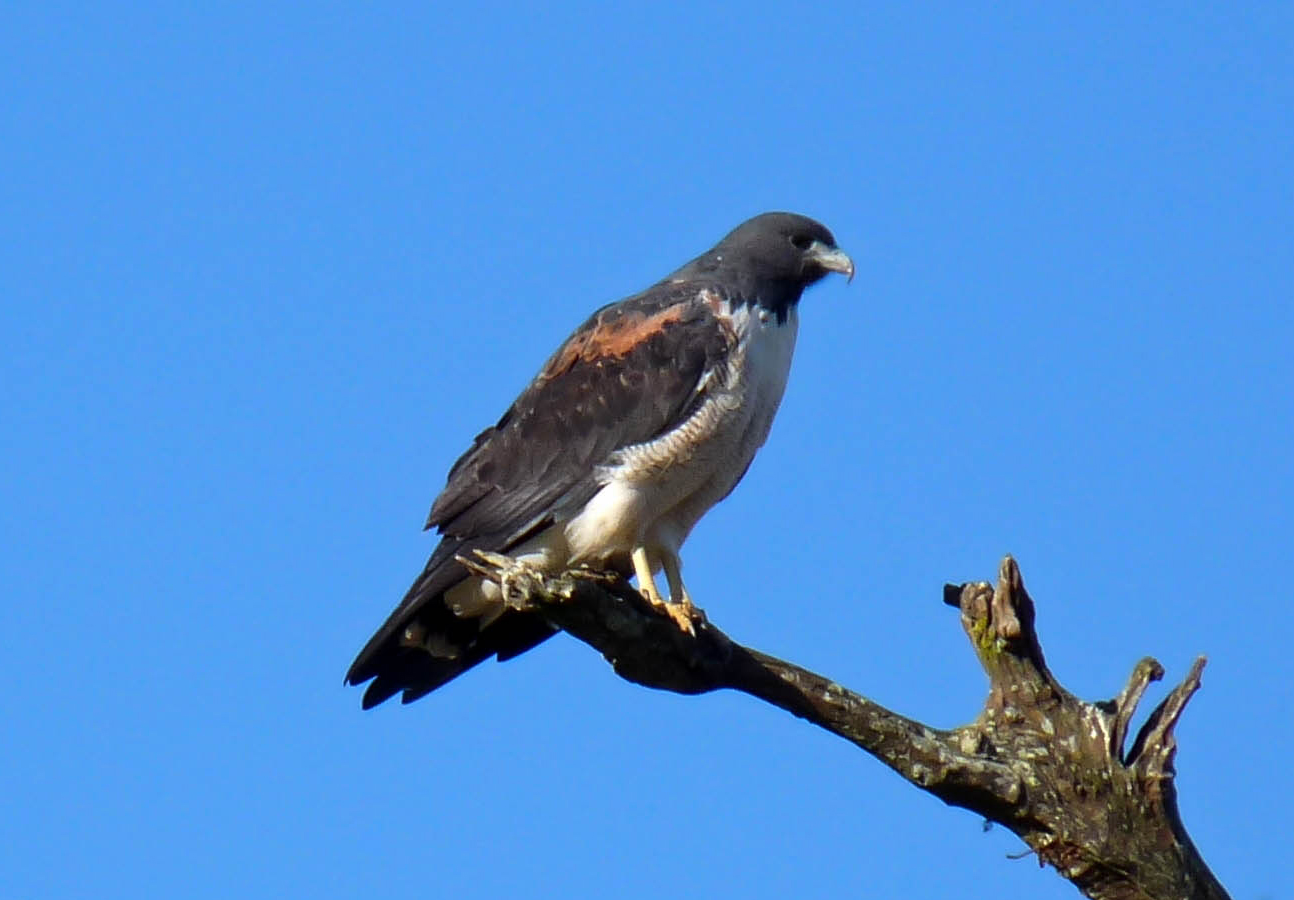
The White-tailed Hawk is a large buzzard of open country, with long, broad wings, a short white tail with a black band, grey upperparts with rufous shoulders and white underparts. It hunts rodents, snakes, lizards and large insects by hovering or from a post, and is attracted to grass and scrub fires. In the guide area it is a resident of savannas and grassland from Mexico to Panama.
Voice
A high, laughing series, ke-ha ke-ha ke-ha or kee-kee-kee, mainly around the nest.
Recording: JAYRSON ARAUJO DE OLIVEIRA — CC BY-NC-SA 4.0 · shortened to the first 60 s, mono · xeno-canto
Identification
44–60 cm, with long, broad wings that extend beyond the short tail in perched birds. Adults have a grey head and grey upperparts with rufous shoulders, a white throat and white underparts, sometimes with fine bars on the flanks. The tail is white with a narrow black band just before the tip. In flight the underwing coverts are white and the flight feathers grey with a dark trailing edge. Young birds are blackish brown with a white patch on the breast and a pale grey, finely barred tail; they take two to three years to acquire adult plumage. There is a rare dark morph with a dark slate body and white tail. Male and female are alike; the female is larger.
Confusion species
Swainson’s Hawk Buteo swainsoni has a dark breast band, dark flight feathers and a barred grey tail. The Red-tailed Hawk Buteo jamaicensis has a rufous tail and usually a streaked belly band. The light morph of the Short-tailed Hawk Buteo brachyurus is smaller, has dark upperparts without rufous and a grey-barred tail. Young White-tailed Hawks resemble other dark buzzards, but the white breast patch and long wings stand out.
Habitat
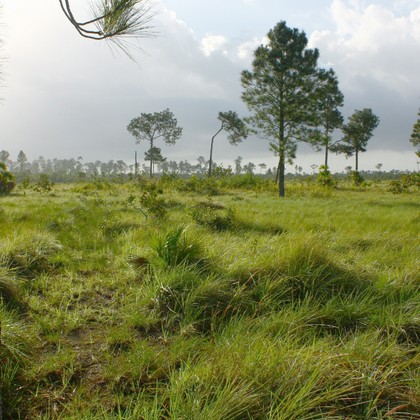
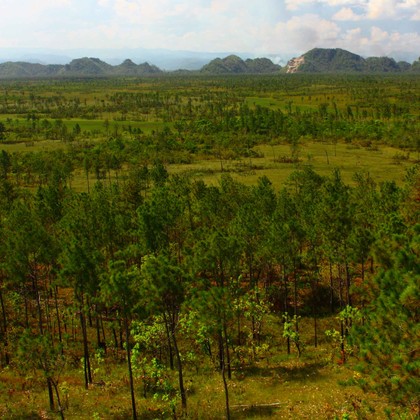
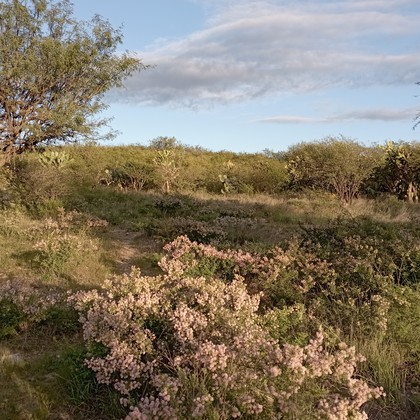
Lowland savanna, open grassland with scattered trees and shrubs, pine savanna, ranchland and semi-desert grassland, from the coast into the foothills. It perches on posts, hedges and isolated trees and often hovers high over the grass.
Where the bird is most at home, classified by the vegetation units of Mexico and Central America.


Range and movements
Resident in Mexico on the Gulf coastal plain of Tamaulipas and Veracruz and on the Pacific side from Sonora south to Chiapas, with local birds inland. In Central America mainly on the savannas of the Pacific side of Guatemala, El Salvador, Honduras, Nicaragua, Costa Rica (Guanacaste) and Panama, and in the pine savannas of Belize and the Mosquitia of Honduras and Nicaragua. Outside the guide area in southern Texas and in South America to Argentina.
- Resident
- dark = core range, pale = thinly spread
How and when to look
At grass and scrub fires in the dry season several birds sometimes gather to catch fleeing insects and lizards, for example in the pine savanna of Belize and on the savannas of Guanacaste and Pacific Panama. On the coastal plain of Tamaulipas and Veracruz it often perches on posts along the road.
Conservation status
Not threatened.
Scientific name
Geranoaetus albicaudatus | (Vieillot, 1816) (GBIF: Buteo albicaudatus)
Vieillot described the species in 1816 as Buteo albicaudatus; because it was later moved to another genus, the author and year stand in brackets. The genus Geranoaetus was introduced in 1844 by Kaup. Geranoaetus is Greek, from geranos 'crane' (here: grey) and aetos 'eagle': 'grey eagle'. albicaudatus is Latin, from albus 'white' and caudatus 'tailed': 'white-tailed', after the white tail with a black terminal band. The specimen the first description was based on came from South America; later fixed as Rio de Janeiro, Brazil.