All species › Birds of prey › Kites, Old World vultures, eagles and hawks › White Hawk
Position in the tree Birds Aves › Birds with a flexible palate Neognathae › All other modern birds Neoaves › Landbirds Telluraves › Raptors, owls, kingfishers and woodpeckers Afroaves › Hawks and owls Hieraves
White Hawk | Pseudastur albicollis
Grote bonte buizerd | Aguililla blanca
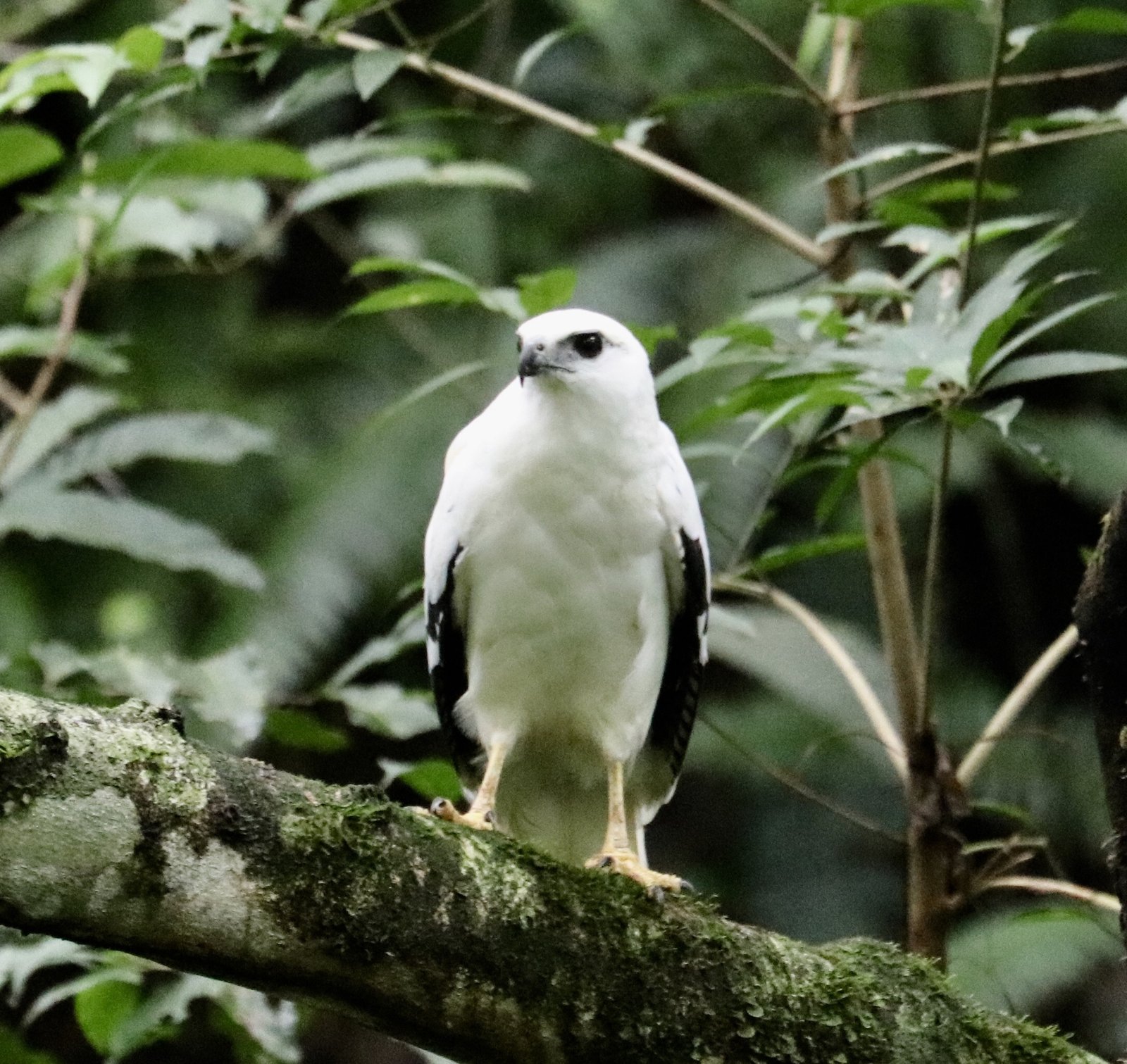
The White Hawk is a large, mostly white buzzard with broad, rounded wings, black markings on the wings and a broad black band in the tail. It lives in humid forest, where it catches snakes, lizards, frogs and small mammals from a branch in or below the canopy, and around midday it often soars over the forest. In the guide area it is a resident from southern Mexico to Panama.
Voice
A hoarse, high, hissing scream, shreeeer, often in flight over the forest.
Recording: JAYRSON ARAUJO DE OLIVEIRA — CC BY-NC-SA 4.0 · converted to mono · xeno-canto
Identification
46–56 cm, with broad, rounded wings and a fairly short, broad tail. Head, body and underparts are pure white. The wings have black tips to the primaries and black markings on the upperwing that increase to the south: birds in Mexico and Guatemala are almost entirely white, those in Costa Rica and Panama show clearly more black on the wings. The tail is white with a broad black band. The eye is dark, the cere grey and the legs yellow. Young birds resemble adults. Male and female are alike; the female is larger.
Confusion species
The Semiplumbeous Hawk Leucopternis semiplumbeus is much smaller, dark slate grey above, with an orange cere and legs and a short black tail with a single narrow white band. The Black-and-white Hawk-Eagle Spizaetus melanoleucus has black upperparts, a black mask around the eye and legs feathered to the toes. The White-tailed Kite Elanus leucurus is slimmer, pale grey above, has pointed wings and lives in open country.
Habitat
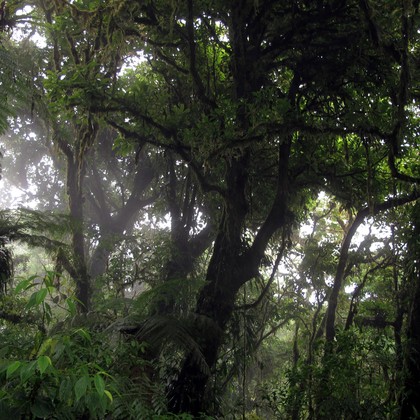
Humid lowland, foothill and montane forest up into cloud forest, including the rainforest of Darién, and forest edges, clearings and old secondary forest near large forest; mainly in hilly terrain. It sits still for long periods on a branch at mid-level and hunts from that perch.
Where the bird is most at home, classified by the vegetation units of Mexico and Central America.





Range and movements
Resident in southern Mexico, on the Gulf side from southern Veracruz and northern Oaxaca, through Tabasco, Chiapas and the south of the Yucatán Peninsula, and on through Belize, Guatemala, Honduras, Nicaragua and Costa Rica to Panama, mainly on the Caribbean side and in Panama also on the Pacific side. Very scarce in El Salvador. Outside the guide area in South America to the Amazon basin.
- Resident
- dark = core range, pale = thinly spread
How and when to look
In mid-morning and around midday, as thermals develop, it soars over forested hills, and the white silhouette can then be seen from afar. Good places are the Caribbean foothills of Costa Rica and the forests along the Panama Canal, such as at Pipeline Road.
Conservation status
Not threatened. Dependent on forest and therefore gone from deforested areas.
Scientific name
Pseudastur albicollis | (Latham, 1790) (GBIF: Leucopternis albicollis)
Latham described the species in 1790 as Falco albicollis; because it was later moved to another genus, the author and year stand in brackets. The genus Pseudastur was introduced in 1849 by Gray. Pseudastur is Greek-Latin, from pseudos 'false' and Astur, an old genus name for the goshawk: 'false goshawk'. albicollis is Latin, from albus 'white' and collum 'neck': 'white-necked', after the white head and neck. The specimen the first description was based on came from Cayenne, French Guiana.