All species › Passerines › Ovenbirds and woodcreepers › White-striped Woodcreeper
Position in the tree Birds Aves › Birds with a flexible palate Neognathae › All other modern birds Neoaves › Landbirds Telluraves › Falcons, parrots and passerines Australaves › Falcons and passerines Eufalconimorphae › Parrots and passerines Psittacopasserae
White-striped Woodcreeper | Lepidocolaptes leucogaster
Witbuikmuisspecht | Trepatroncos escarchado
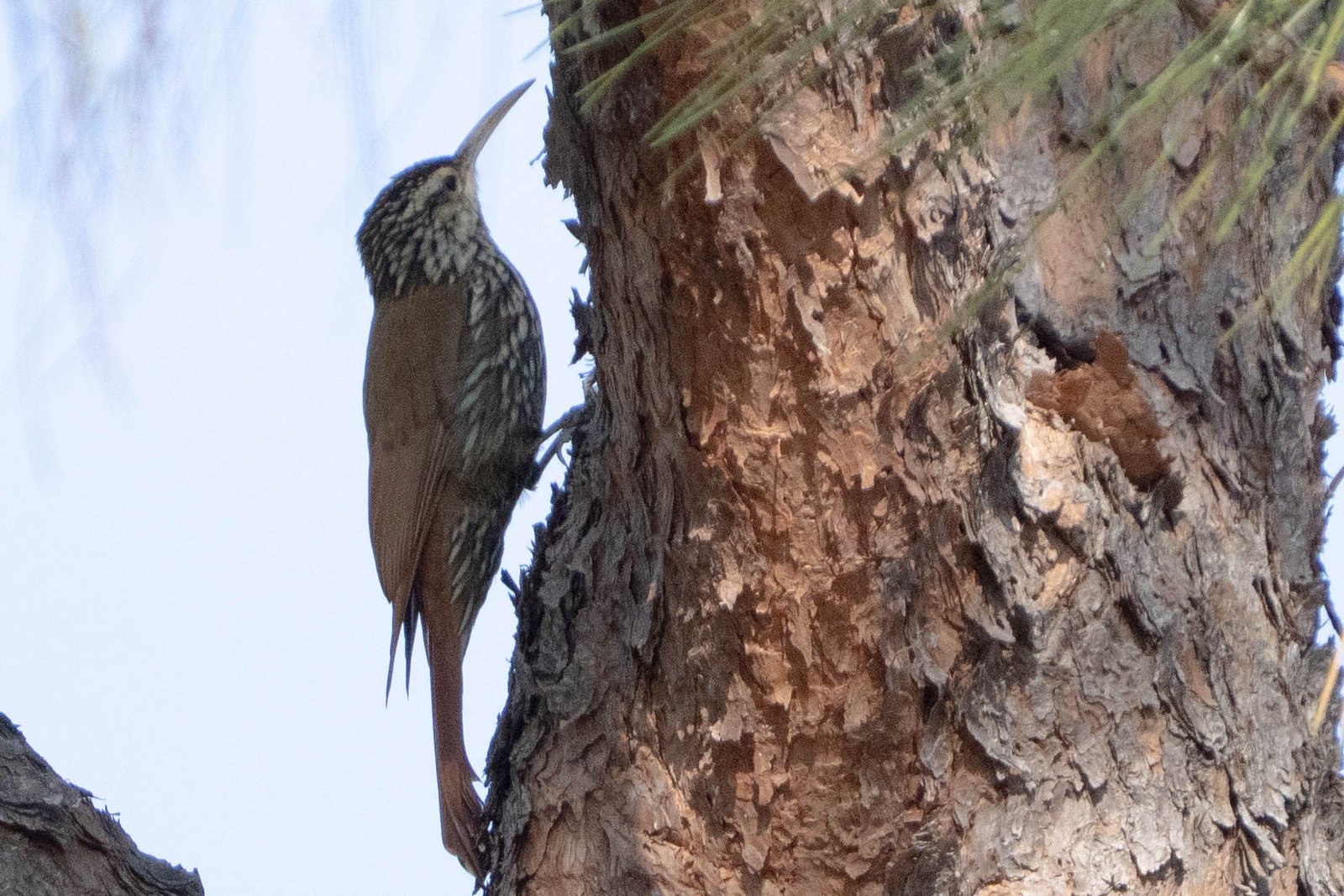
The White-striped Woodcreeper is a woodcreeper of the montane forests of western and southern Mexico, with strikingly pale, white-streaked underparts. It occurs only in Mexico.
Voice
A series of high, thin, somewhat trilling notes, and sharp, short calls.
Recording: Richard E. Webster — CC BY-NC-SA 4.0 · converted to mono · xeno-canto
Identification
20–22 cm. Bill fairly long, slightly decurved and pale. Head dark with white streaks; throat white. Underparts whitish with broad, dark-edged white streaks, giving the underside a pale, heavily streaked look. Mantle brown with pale streaks, wings and tail rufous. Male and female are alike.
Confusion species
Spot-crowned Woodcreeper Lepidocolaptes affinis has browner underparts with narrower, teardrop-shaped streaks and pale spots on the crown. Streak-headed Woodcreeper Lepidocolaptes souleyetii is smaller, browner and lives mainly in the lowlands.
Habitat
Pine-oak forest, oak forest and other montane forest in the highlands, often between about 1500 and 3000 m. It climbs trunks and large branches and searches the bark for insects; it often joins mixed-species foraging flocks.
Where the bird is most at home, classified by the vegetation units of Mexico and Central America.



Range and movements
Only in Mexico: the mountains of the west of the country, from the Sierra Madre Occidental in the north-west south to Guerrero and Oaxaca. Found only in the guide area.
- Resident
- dark = core range, pale = thinly spread
How and when to look
Look for it in mixed flocks in pine-oak forest in the mountains of western Mexico; the pale, heavily streaked underparts stand out.
Conservation status
Not threatened. Locally fairly common, but dependent on montane forest that is shrinking through logging and clearance.
Scientific name
Lepidocolaptes leucogaster | (Swainson, 1827)
Swainson described the species in 1827 as Xiphorhynchus leucogaster; because it was later moved to another genus, the author and year stand in brackets. The genus Lepidocolaptes was introduced in 1853 by Reichenbach. Lepidocolaptes is Greek, from lepis, lepidos 'scale' and kolaptēs 'chiseller, woodpecker', after the scaly markings on head and breast. leucogaster is Greek, from leukos 'white' and gastēr 'belly', after the whitish underparts. The specimen the first description was based on came from Temascaltepec, Mexico.