All species › Passerines › Tyrant flycatchers and allies › White-ringed Flycatcher
Position in the tree Birds Aves › Birds with a flexible palate Neognathae › All other modern birds Neoaves › Landbirds Telluraves › Falcons, parrots and passerines Australaves › Falcons and passerines Eufalconimorphae › Parrots and passerines Psittacopasserae
White-ringed Flycatcher | Conopias albovittatus
Witringtiran | Mosquero aureola
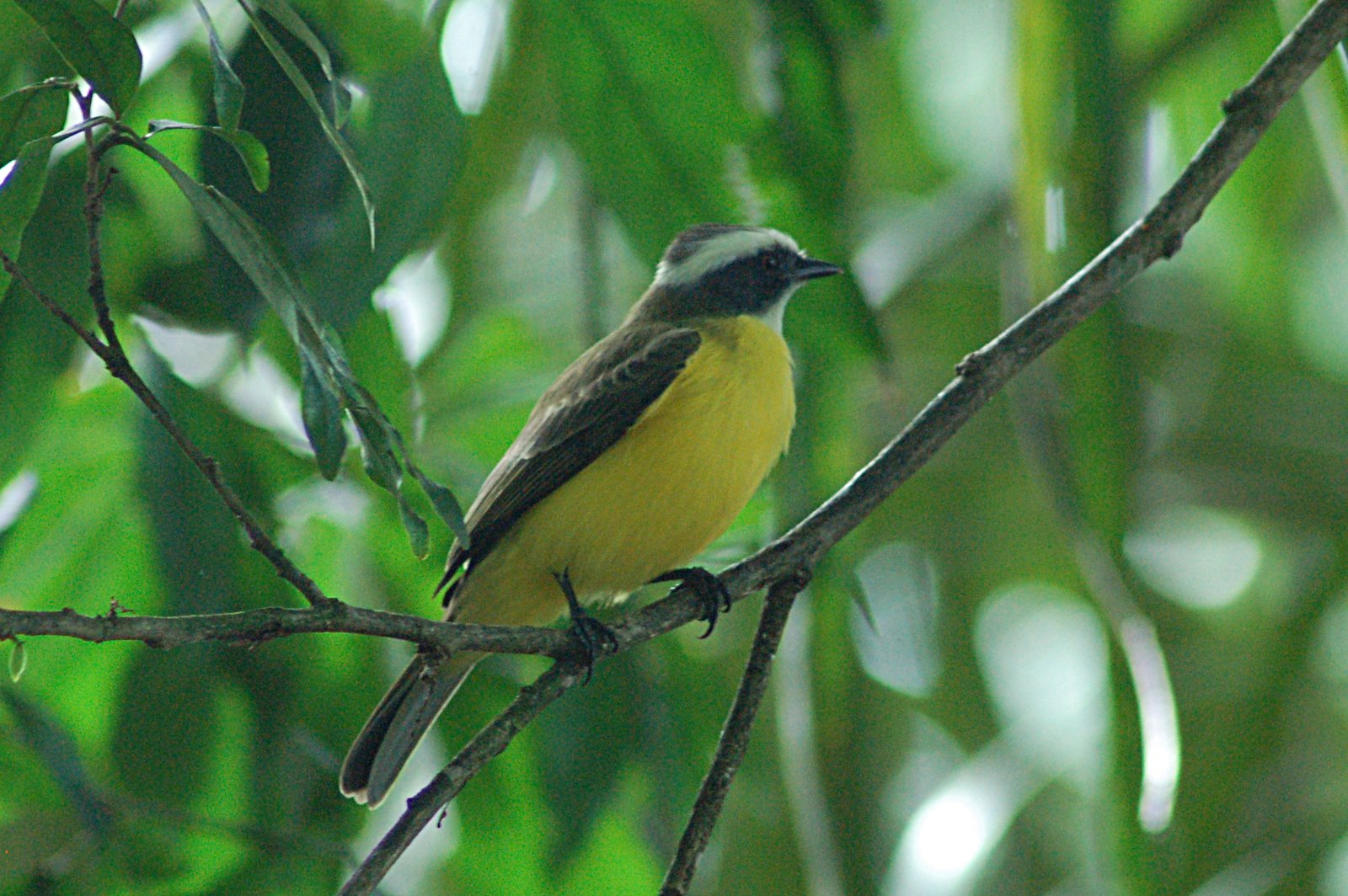
The White-ringed Flycatcher is a medium-sized tyrant flycatcher of the canopy of humid lowland forest, with a black crown completely encircled by a narrow white band. It usually lives in pairs or small groups high in the trees and is heard more often than seen. In the guide area it lives on the Caribbean slope from Honduras to Costa Rica and in Panama.
Voice
A rolling, trilled trrreeeer, often repeated from the canopy, sometimes by two birds together.
Recording: Jonas Nilsson — CC BY-NC-SA 4.0 · shortened to the first 60 s, mono · xeno-canto
Identification
16–17 cm, with a fairly small, narrow black bill. Crown black with a concealed yellow crown patch, completely encircled by a narrow white band running across the forehead and along the supercilia around the back of the head; a broad black mask. Back olive-green, wings and tail brown without rufous edges. Throat white, rest of the underparts bright yellow. Male and female are alike.
Confusion species
Social Flycatcher Myiozetetes similis has a dark grey crown, a white supercilium that does not continue around the back of the head and a shorter, stubbier bill, and usually perches lower and in open country. Grey-capped Flycatcher Myiozetetes granadensis has a grey crown with only a short white line above the bill. Great Kiskadee Pitangus sulphuratus and Boat-billed Flycatcher Megarynchus pitangua are much larger, with a heavy bill.
Habitat
Canopy and edges of humid evergreen lowland and foothill forest, also tall trees along clearings and rivers. It forages high in the canopy for insects, snatched from leaves and branches or caught in the air.
Where the bird is most at home, classified by the vegetation units of Mexico and Central America.




Range and movements
Caribbean slope of eastern Honduras, Nicaragua and Costa Rica; in Panama on the Caribbean slope and in the east also on the Pacific slope, into Darién. Outside the guide area in western Colombia and north-western Ecuador.
- Resident
- dark = core range, pale = thinly spread
How and when to look
Usually located by its rolling call from the canopy; viewpoints above the forest, such as towers and slopes, give the best chance of also seeing it.
Conservation status
Not threatened. Locally fairly common in humid lowland forest, but inconspicuous because it lives high in the canopy; declines where forest disappears.
Scientific name
Conopias albovittatus | (Lawrence, 1862)
Lawrence described the species in 1862 as Pitangus albovittatus; because it was later moved to another genus, the author and year stand in brackets. The genus Conopias was introduced in 1860 by Cabanis & Heine. Conopias is Greek, from kōnōps 'gnat' and piazō 'to seize': 'gnat-catcher'. albovittatus is Latin, from albus 'white' and vittatus 'banded', after the white band encircling the crown. The specimen the first description was based on came from Isthmus of Panama.