All species › Passerines › Tyrant flycatchers and allies › Boat-billed Flycatcher
Position in the tree Birds Aves › Birds with a flexible palate Neognathae › All other modern birds Neoaves › Landbirds Telluraves › Falcons, parrots and passerines Australaves › Falcons and passerines Eufalconimorphae › Parrots and passerines Psittacopasserae
Boat-billed Flycatcher | Megarynchus pitangua
Bootsnaveltiran | Luis pico grueso
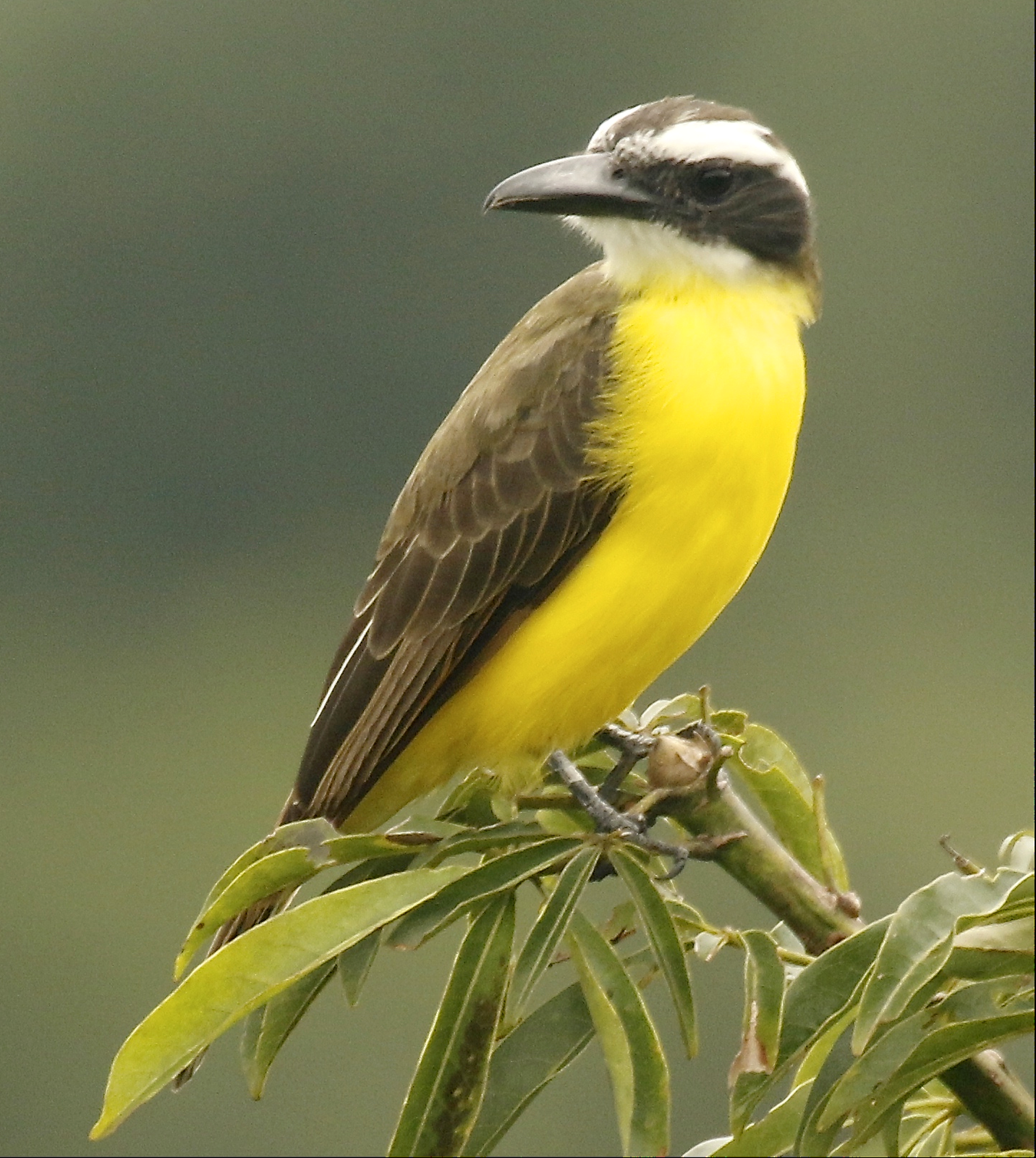
The Boat-billed Flycatcher is a large tyrant flycatcher that closely resembles the Great Kiskadee but has a much broader, heavier bill. It lives high in the trees at forest edges and in semi-open country and gives itself away with its harsh, rattling call. In the guide area it lives from north-western and north-eastern Mexico to Panama.
Voice
A harsh, rattling kirr-r-r-r and a nasal, plaintive tee-jeeer, often from a high treetop.
Recording: Robson Silva e Silva — CC BY-NC-SA 4.0 · shortened to the first 60 s, mono · xeno-canto
Identification
21–24 cm, with a very broad, heavy black bill with a curved culmen. Crown grey to dark olive-grey with a concealed orange-yellow crown patch; a broad white supercilium that does not meet on the nape, and a broad blackish mask. Back olive-brown to olive-green, wings and tail brown without rufous edges. Throat white, rest of the underparts bright yellow. Male and female are alike.
Confusion species
Great Kiskadee Pitangus sulphuratus has a narrower bill, a blacker crown and distinct rufous edges to the wings and tail, and more often perches low and near water. Social Flycatcher Myiozetetes similis and Grey-capped Flycatcher Myiozetetes granadensis are much smaller, with a short, stubby bill. White-ringed Flycatcher Conopias albovittatus is smaller, with a small bill and a white band encircling the whole crown.
Habitat
Forest edges, clearings, gallery forest, secondary forest, plantations, shade coffee and pasture with tall trees, also gardens and parks; in the lowlands and lower mountains. It usually perches high in the canopy. It eats large insects, often snatched from leaves and branches, and also fruit. The nest is a shallow, open cup of twigs high in a tree.
Where the bird is most at home, classified by the vegetation units of Mexico and Central America.







Range and movements
From southern Sinaloa on the Pacific slope and southern Tamaulipas on the Atlantic slope through all of Central America to Panama. Outside the guide area over much of tropical South America, to northern Argentina.
- Resident
- dark = core range, pale = thinly spread
How and when to look
The harsh, rattling call from a high treetop is often the first sign. With any kiskadee-like flycatcher high in a tree it pays to check the bill: that of the Boat-billed Flycatcher is strikingly broad.
Conservation status
Not threatened. Common and widespread at forest edges and in semi-open country with tall trees.
Scientific name
Megarynchus pitangua | (Linnaeus, 1766)
Linnaeus described the species in 1766 as [Lanius] Pitangua; because it was later moved to another genus, the author and year stand in brackets. The genus Megarynchus was introduced in 1824 by Thunberg. Megarynchus is Greek, from megas 'great' and rhunkhos 'bill', after the strikingly broad, heavy bill. pitangua comes from Pitanguá, the Tupí name for a large flycatcher, the same source as the genus Pitangus. The specimen the first description was based on came from Brazil (later restricted to Rio de Janeiro).