All species › Passerines › Wrens › White-headed Wren
Position in the tree Birds Aves › Birds with a flexible palate Neognathae › All other modern birds Neoaves › Landbirds Telluraves › Falcons, parrots and passerines Australaves › Falcons and passerines Eufalconimorphae › Parrots and passerines Psittacopasserae
White-headed Wren | Campylorhynchus albobrunneus
Witkopwinterkoning | Cucarachero cabeciblanco
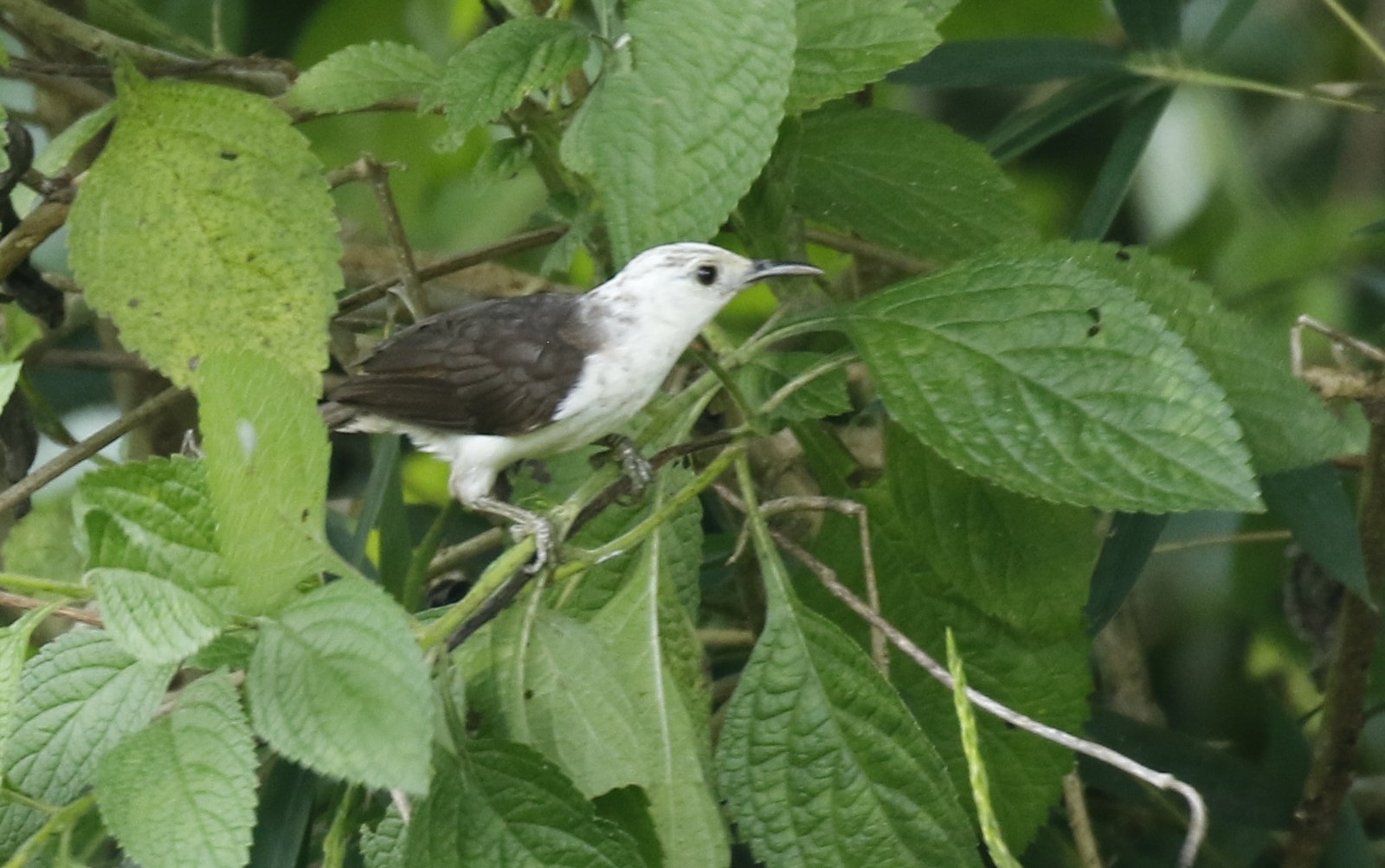
The White-headed Wren is a large Campylorhynchus wren with a white head and underparts and dark brown upperparts. It lives in noisy family groups high in the canopy of humid forest. In the guide area it occurs only in Panama.
Voice
Groups are noisy, with harsh, scratchy and rasping calls. The song consists of repeated, rhythmic, rattling phrases often sung by several birds at once.
Recording: Nando Quiroz — CC BY-NC-SA 4.0 · converted to mono · xeno-canto
Identification
19 cm. Head, neck and underparts white, sometimes with some dull greyish-brown on the hindcrown and nape. Back, wings and tail plain dark chocolate-brown. Bill fairly long, slightly decurved and dark. Sexes alike.
Confusion species
No species in Panama is very similar; the combination of white head and underparts with a plain dark brown back is distinctive. Band-backed Wren Campylorhynchus zonatus, in western Panama, has a barred back and spotted breast.
Habitat
Canopy and edges of humid lowland and foothill forest, also tall trees in semi-open country. Small groups search for insects and other invertebrates among epiphytes, leaves and moss. Builds a domed nest with a side entrance in a tree.
Where the bird is most at home, classified by the vegetation units of Mexico and Central America.




Range and movements
Central and eastern Panama, east to Darién. Outside the guide area in western Colombia and extreme north-western Ecuador.
- Resident
- dark = core range, pale = thinly spread
How and when to look
Watch for noisy groups high in trees along forest edges and clearings; the white head is visible even at a distance.
Conservation status
Not threatened. Locally fairly common in humid forest; sensitive to deforestation.
Scientific name
Campylorhynchus albobrunneus | (Lawrence, 1862)
Lawrence described the species in 1862 as Heleodytes albo-brunneus; because it was later moved to another genus, the author and year stand in brackets. The genus Campylorhynchus was introduced in 1824 by Spix. Campylorhynchus is Greek, from kampulos 'curved' and rhunkhos 'bill', after the slightly decurved bill. albobrunneus is Latin, from albus 'white' and brunneus 'brown', after the white head and underparts and brown back. The specimen the first description was based on came from along the Panama Railroad, Atlantic slope, Panama.