All species › Passerines › Antbirds › White-flanked Antwren
Position in the tree Birds Aves › Birds with a flexible palate Neognathae › All other modern birds Neoaves › Landbirds Telluraves › Falcons, parrots and passerines Australaves › Falcons and passerines Eufalconimorphae › Parrots and passerines Psittacopasserae
White-flanked Antwren | Myrmotherula axillaris
Witflankmiersluiper | Hormiguerito flanquiblanco
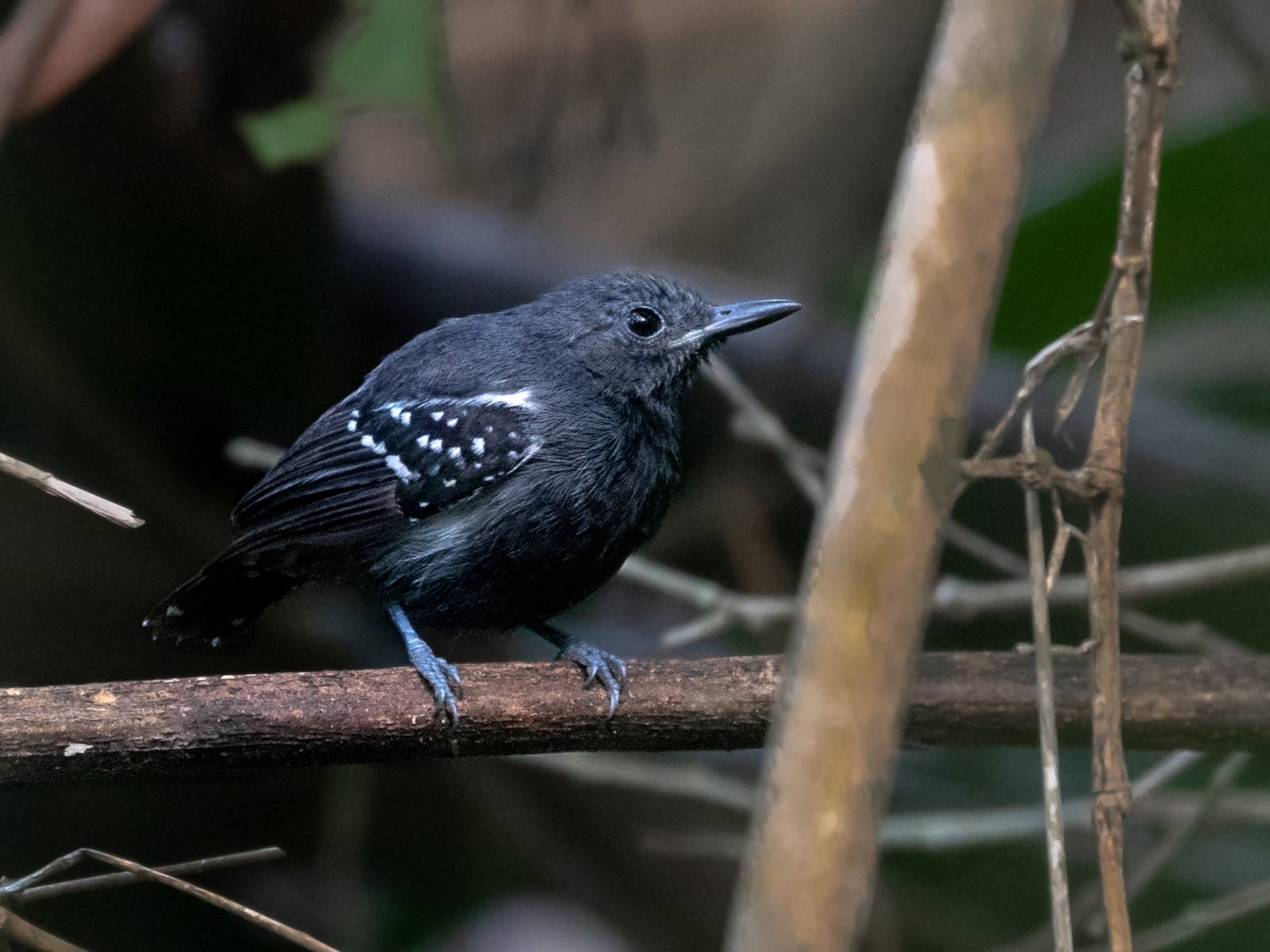
The White-flanked Antwren is a small, active antwren of the understorey of humid lowland forest and a regular member of mixed flocks. The male is blackish-grey with long white flank feathers that show when it flicks its wings. In the guide area it lives from Honduras to Panama.
Voice
The song is a series of clear, whistled notes that gradually descends. The call is a sharp, two-note chee-oo, often heard in mixed flocks.
Recording: Juan Freile — CC BY-NC-SA 4.0 · shortened to the first 60 s, mono · xeno-canto
Identification
9–10 cm; tail short. Male slate-grey with black throat and breast, black wings with white spots on the coverts and white tail tips; long, silky white feathers on the flanks, partly hidden under the wings. Female brown above with buff wing spots, buffy brown below with whitish flanks and a greyer head.
Confusion species
The male Slaty Antwren Myrmotherula schisticolor lacks the white flanks and lives mainly in foothill and montane forest. The female Checker-throated Stipplethroat Epinecrophylla fulviventris is warmer brown, without white flanks. The male Dot-winged Antwren Microrhopias quixensis has a much longer tail.
Habitat
Understorey and lower middle levels of humid lowland and foothill forest, also mature secondary forest, to about 1000 m. It searches leaves for insects, often in understorey mixed flocks, constantly flicking its wings.
Where the bird is most at home, classified by the vegetation units of Mexico and Central America.




Range and movements
Caribbean slope of Honduras, Nicaragua and Costa Rica; in Panama on both slopes. Outside the guide area widely in northern and central South America, to Bolivia and Brazil.
- Resident
- dark = core range, pale = thinly spread
How and when to look
A regular member of understorey mixed flocks; the constant wing-flicking, briefly flashing the white flanks, makes it quickly recognisable.
Conservation status
Not threatened. Fairly common in continuous forest; disappears where forest becomes fragmented.
Scientific name
Myrmotherula axillaris | (Vieillot, 1817)
Vieillot described the species in 1817 as Myrmothera axillaris; because it was later moved to another genus, the author and year stand in brackets. The genus Myrmotherula was introduced in 1858 by Sclater. Myrmotherula is a diminutive of Myrmothera, Greek for 'ant-hunter' (murmos 'ant', -thēras 'hunter'): 'little ant-hunter'. axillaris is Latin, from axilla 'armpit', after the white flank feathers under the wing. The specimen the first description was based on came from Cayenne, French Guiana.