All species › Passerines › Antbirds › Slaty Antwren
Position in the tree Birds Aves › Birds with a flexible palate Neognathae › All other modern birds Neoaves › Landbirds Telluraves › Falcons, parrots and passerines Australaves › Falcons and passerines Eufalconimorphae › Parrots and passerines Psittacopasserae
Slaty Antwren | Myrmotherula schisticolor
Leigrijze miersluiper | Hormiguerito pizarroso
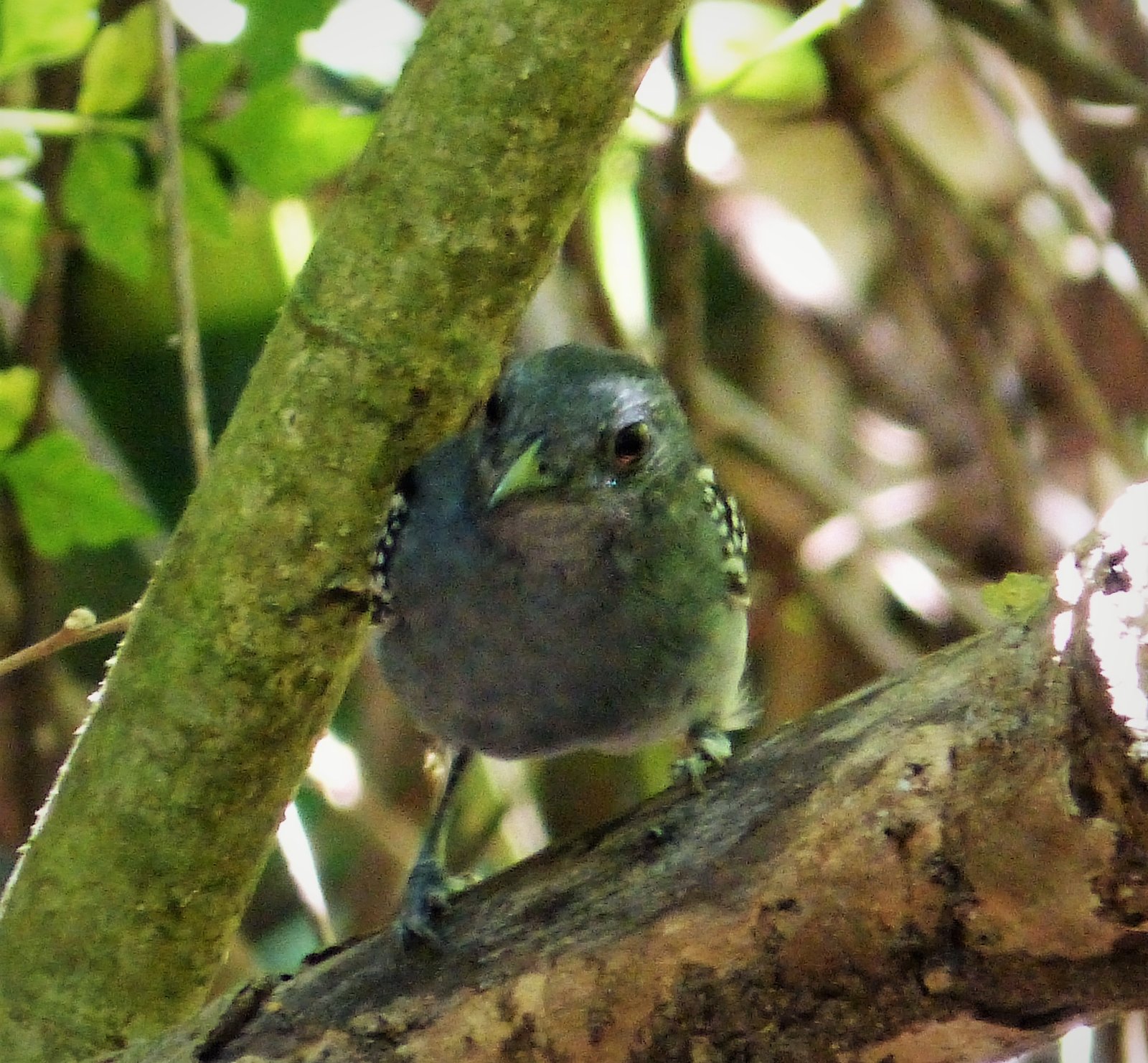
The Slaty Antwren is a small, short-tailed antbird of the understorey of humid foothill and montane forest. The male is plain slate-grey with a black throat and breast, the female brown and ochre. It usually forages with mixed-species flocks in the vegetation below the canopy. In the guide area it lives locally from southern Mexico to Panama.
Voice
A short series of clear, whistled notes and a plaintive, nasal call, often heard from within a mixed flock.
Recording: José María Loaiza B. — CC BY-NC-SA 4.0 · converted to mono · xeno-canto
Identification
9–10 cm, with a short tail and a thin, pointed bill. Male slate-grey with a black throat and breast; wing coverts black with white tips forming two or three rows of dots; tail grey with narrow white tips. Female olive-brown above with a greyer head, warm ochre-brown below, wings without white dots.
Confusion species
White-flanked Antwren Myrmotherula axillaris lives mainly in the lowlands; the male is blacker, with a white tuft along the flank that shows when it flicks its wings. Pacific Antwren Myrmotherula pacifica and Moustached Antwren Myrmotherula ignota are streaked black and white. Plain Antvireo Dysithamnus mentalis is stockier, with a thicker bill, and lacks the male's black throat.
Habitat
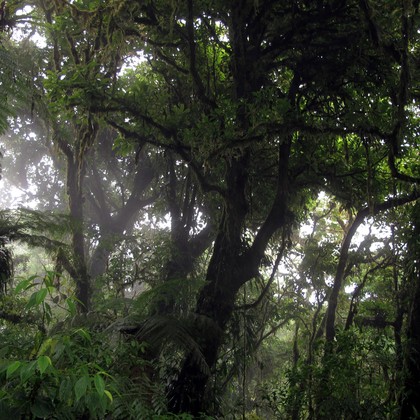
Understorey and middle levels of humid evergreen foothill forest and lower montane forest, mostly between about 400 and 1600 m. It gleans insects and spiders from leaves and twigs, often in mixed flocks with other antbirds, ovenbirds and tanagers.
Where the bird is most at home, classified by the vegetation units of Mexico and Central America.


Range and movements
Locally from southern Mexico through Central America to Panama, mainly in the foothills and lower mountains. Outside the guide area in the Andes from western Venezuela and Colombia to Peru.
- Resident
- dark = core range, pale = thinly spread
How and when to look
Best found by following a mixed flock through the understorey of humid foothill or montane forest; the Slaty Antwren usually moves with the others a few metres above the ground.
Conservation status
Not threatened. Locally fairly common in continuous forest, but sensitive to clearance of forest on hills and slopes.
Scientific name
Myrmotherula schisticolor | (Lawrence, 1865)
Lawrence described the species in 1865 as Formicivora schisticolor; because it was later moved to another genus, the author and year stand in brackets. The genus Myrmotherula was introduced in 1858 by Sclater. Myrmotherula is a diminutive of Myrmothera, Greek for 'ant-hunter' (murmos 'ant', -thēras 'hunter'): 'little ant-hunter'. schisticolor is Latin, from schistus 'slate' and color 'colour', after the male's slate-grey plumage. The specimen the first description was based on came from Turrialba, Costa Rica.