All species › Pigeons and doves › Doves and pigeons › White-faced Quail-Dove
Position in the tree Birds Aves › Birds with a flexible palate Neognathae › All other modern birds Neoaves › Doves, turacos and allies Columbaves › Doves and sandgrouse Columbimorphae
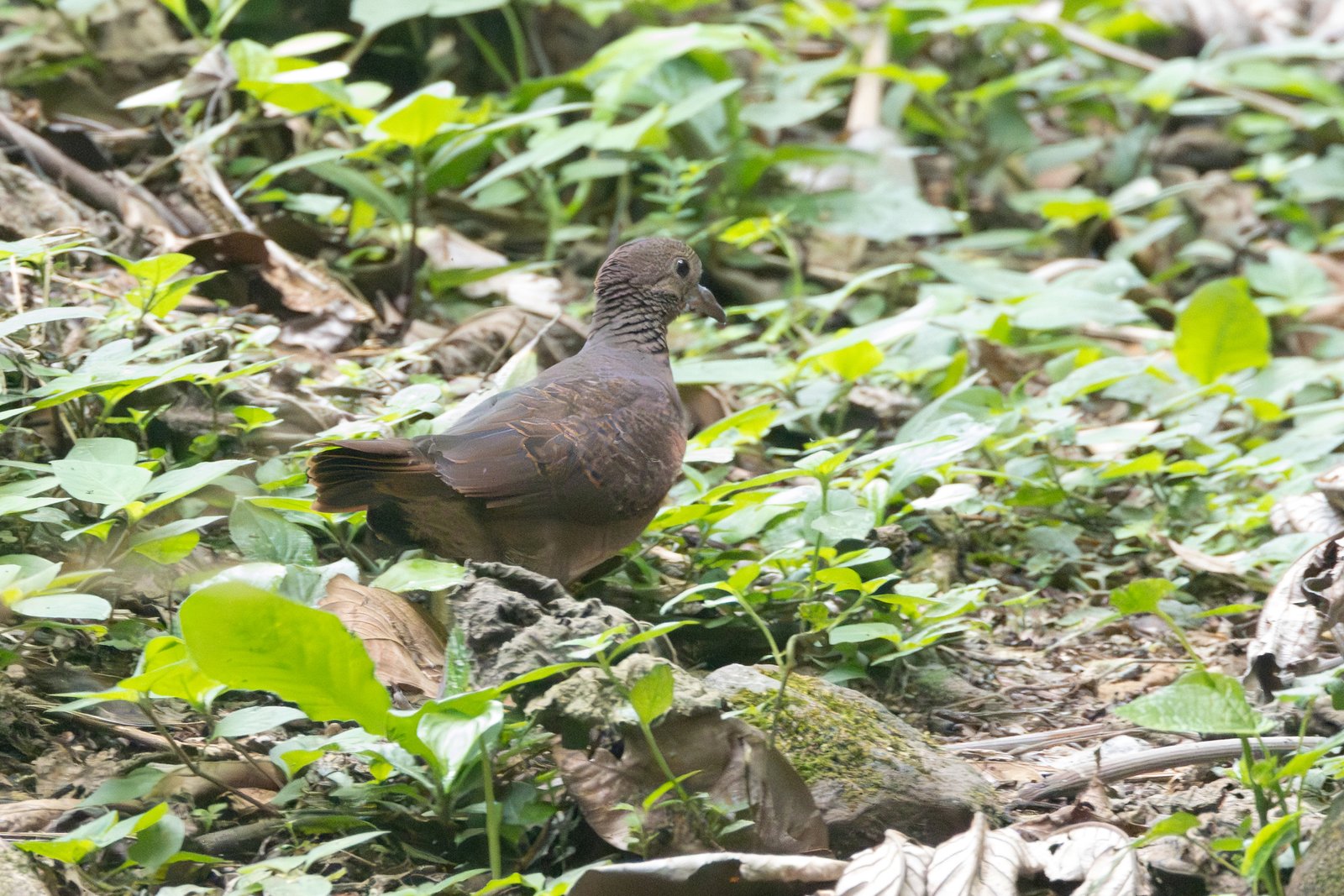
White-faced Quail-Dove | Zentrygon albifacies
Witgezichtkwartelduif | Paloma perdiz cara blanca
White-faced Quail-Dove is the quail-dove of montane forest in Mexico and northern Central America, from the Sierra Madre Oriental and Guerrero to northern Nicaragua. It is a large, shy ground dove that is usually only noticed when it flushes from a forest trail with clattering wings. The species does not occur outside the guide area.
Voice
A low, hollow, mournful call, ooooo or hoo-ooo, falling slightly and repeated for long periods at intervals of a few seconds. It is heard mainly in the early morning and at dusk, from the ground or a low branch.
Recording: Richard E. Webster — CC BY-NC-SA 4.0 · converted to mono · xeno-canto
Identification
29–31 cm; a large, compact quail-dove with a short tail and pink to red legs. The forehead and face are whitish to pale buff, without a black moustachial stripe. The crown and nape are grey; the feathers on the side of the neck are pale grey with dark edges, giving a finely streaked or furrowed pattern. The mantle and back are rufous-brown with a purple gloss on the upper mantle, the wings warm brown. The breast is greyish to pale buff, the belly ochre-buff. Male and female are almost alike. Birds in Honduras and Nicaragua are on average darker and more rufous than those in Mexico and Guatemala.
Confusion species
Ruddy Quail-Dove Geotrygon montana lives mainly lower down, is smaller and plain rusty brown above, with a pale cheek stripe bordered below by a dark stripe. White-tipped Dove Leptotila verreauxi is more often seen in the open, is slimmer and greyer, with a pink-tinged breast and white tail corners that show in flight. White-faced Quail-Dove lacks the black moustachial stripe of the quail-doves of Costa Rica and Panama.
Habitat
Humid montane forest, cloud forest and humid pine-oak forest from about 900 to 3000 m, mainly between 1200 and 2500 m, with dense undergrowth and a thick layer of leaf litter; also in ravines and old secondary forest. It forages on foot on the forest floor for seeds, acorns, fallen fruit and small invertebrates. The nest is a loose platform of twigs, low in shrubs or creepers.
Where the bird is most at home, classified by the vegetation units of Mexico and Central America.


Range and movements
In Mexico in the Sierra Madre Oriental from San Luis Potosí, Querétaro and Hidalgo through Puebla and Veracruz to northern Oaxaca, in the Sierra Madre del Sur of Guerrero and Oaxaca, and in the highlands of Chiapas. Further in the highlands of Guatemala, El Salvador, Honduras and northern Nicaragua, including Jinotega, Matagalpa and Estelí. The species does not occur outside the guide area.
- Resident
- dark = core range, pale = thinly spread
How and when to look
Well-known sites include El Triunfo and other montane forests in Chiapas, the forests on the slopes of the volcanoes around Lake Atitlán in Guatemala, Montecristo and Cerro Verde in western El Salvador, and the cloud forests of Jinotega and Matagalpa in Nicaragua. The bird is shy; the best chance is early in the morning on quiet forest trails.
Conservation status
Not threatened. Locally fairly common in larger montane forests, but vulnerable to the clearance and fragmentation of cloud forest and to hunting.
Scientific name
Zentrygon albifacies | (Sclater, 1858)
Sclater described the species in 1858 as Geotrygon albifacies; because it was later moved to another genus, the author and year stand in brackets. The genus Zentrygon was introduced in 2013 by Banks, Weckstein, Remsen & Johnson. Zentrygon is a blend of the genera Zenaida and Geotrygon, reflecting these quail-doves' close relationship with Zenaida. albifacies is Latin, from albus 'white' and facies 'face', after the white face. The specimen the first description was based on came from Xalapa, Veracruz, Mexico.