All species › Pigeons and doves › Doves and pigeons › Purplish-backed Quail-Dove
Position in the tree Birds Aves › Birds with a flexible palate Neognathae › All other modern birds Neoaves › Doves, turacos and allies Columbaves › Doves and sandgrouse Columbimorphae
Purplish-backed Quail-Dove | Zentrygon lawrencii
Lawrence' kwartelduif | Paloma perdiz de Lawrence
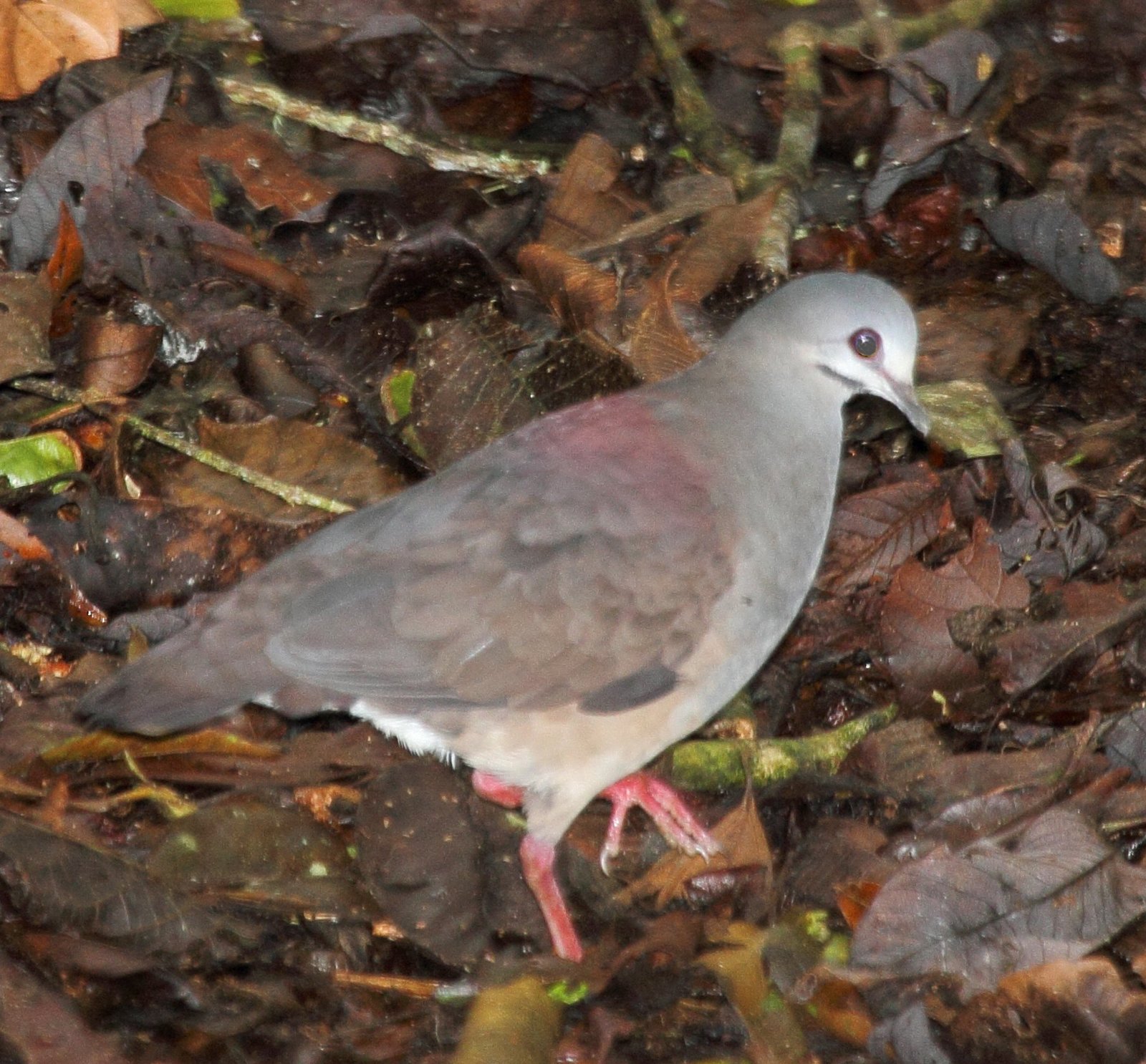
Purplish-backed Quail-Dove is a shy ground dove of humid foothill forest and lower montane forest in Costa Rica and Panama. It lives mainly on the Caribbean slope, below the zone of the other highland quail-doves, and is rarely seen. Tuxtla Quail-Dove of Los Tuxtlas in Veracruz used to be treated as a subspecies of this species.
Voice
A low, hollow call in three parts, the first soft and short, the last two louder, roughly took-woo-ooo. The call is repeated at intervals of a few seconds from the ground and is hard to locate.
Recording: William Adsett — CC BY-NC-SA 4.0 · converted to mono · xeno-canto
Identification
25–28 cm; a medium-sized, compact quail-dove with a short tail and reddish legs. The forehead and face are whitish to pale grey, with a narrow black moustachial stripe and a white throat. The crown and hindneck are grey, the hindneck with a greenish gloss. The mantle is a conspicuous deep purple to purplish brown; the back and wings are olive-brown. The breast is grey, the belly whitish to pale buff. Male and female are almost alike; juveniles are browner and duller, with rufous fringes.
Confusion species
Buff-fronted Quail-Dove Zentrygon costaricensis lives higher up and has an ochre forehead, a green-glossed hindneck and warm chestnut upperparts. Chiriqui Quail-Dove Zentrygon chiriquensis has a cinnamon-rufous face and rufous underparts. Olive-backed Quail-Dove Leptotrygon veraguensis, in the lowlands, is dark olive-brown with a white stripe below the eye and a dark breast. In eastern Panama, Russet-crowned Quail-Dove Zentrygon goldmani resembles this species, but has a rufous crown and a rusty face.
Habitat
Undisturbed, humid foothill forest and lower montane forest from about 400 to 1500 m, with open undergrowth and plenty of leaf litter, also in ravines. It forages on foot on the forest floor for seeds, fallen fruit and small invertebrates. The nest is a platform of twigs, low in shrubs or saplings.
Where the bird is most at home, classified by the vegetation units of Mexico and Central America.


Range and movements
In Costa Rica mainly on the Caribbean slope of the Cordillera de Guanacaste, Cordillera de Tilarán and Cordillera Central to the northern Talamanca range. In Panama on both slopes, from Bocas del Toro, the Comarca Ngäbe-Buglé and Veraguas through Coclé and the hills east of the Panama Canal, such as Cerro Azul and Cerro Jefe, to Guna Yala and Darién.
- Resident
- dark = core range, pale = thinly spread
How and when to look
In Costa Rica many records come from the forests around Bajos del Toro and other sites on the Caribbean slope in Alajuela province; in Panama from El Valle de Antón in Coclé and from Cerro Azul and Cerro Jefe near Panama City. The bird is mostly heard; anyone standing quietly on a forest trail may see one walk across the path early in the morning.
Conservation status
Not threatened. Generally scarce and patchily distributed, and vulnerable to the loss of foothill forest, which is under greater pressure than forest at higher elevations.
Scientific name
Zentrygon lawrencii | (Salvin, 1874)
Salvin described the species in 1874 as Geotrygon lawrencii; because it was later moved to another genus, the author and year stand in brackets. The genus Zentrygon was introduced in 2013 by Banks, Weckstein, Remsen & Johnson. Zentrygon is a blend of the genera Zenaida and Geotrygon, reflecting these quail-doves' close relationship with Zenaida. lawrencii honours the American businessman and ornithologist George Newbold Lawrence (1806–1895). The specimen the first description was based on came from Calobre, Veraguas, Panama.