All species › Tubenoses › Petrels, shearwaters and diving petrels › Wedge-tailed Shearwater
Position in the tree Birds Aves › Birds with a flexible palate Neognathae › All other modern birds Neoaves › Birds of the elements Elementaves › Tropicbirds and waterbirds Phaethoquornithes › Core waterbirds Aequornithes
Wedge-tailed Shearwater | Ardenna pacifica
Wigstaartpijlstormvogel | Pardela colicuña
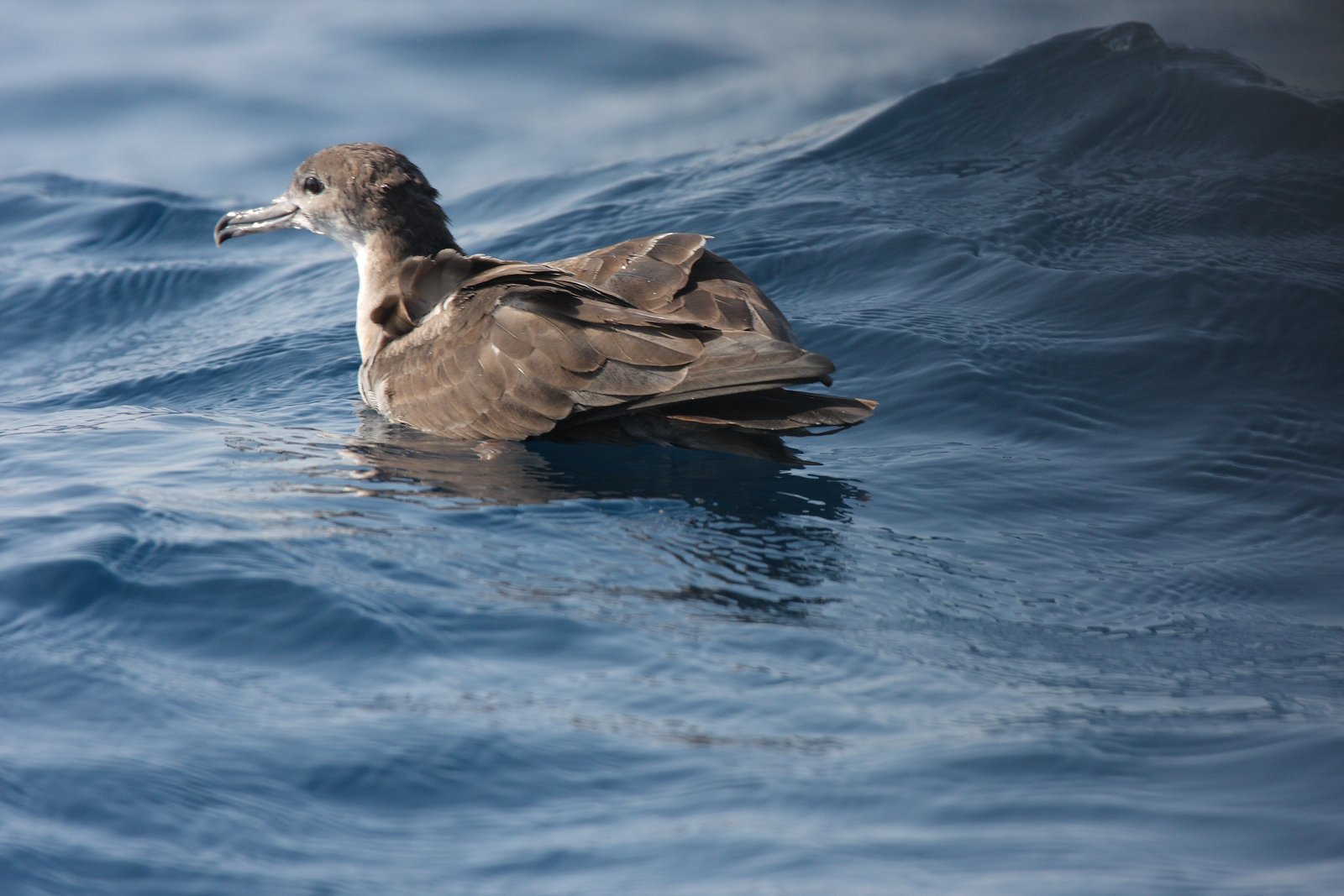
The Wedge-tailed Shearwater is a large shearwater of the tropical Indian and Pacific Oceans, with a long, wedge-shaped tail and a calm, floating flight. In the guide area it breeds on the Revillagigedo Islands, far off the coast of Mexico, the easternmost breeding sites of the species. At sea off the Pacific coast it is one of the commonest shearwaters.
Voice
Usually silent at sea. In the colonies at night drawn-out moaning and wailing calls, sounding like a mournful duet from the burrows.
Recording: Kathryn Hodder — CC BY-NC-SA 4.0 · shortened to the first 60 s, mono · xeno-canto
Identification
41–46 cm, slender, with long, fairly broad wings, a long, wedge-shaped tail that usually looks pointed, a thin, dark grey hooked bill and flesh-coloured legs. There are two morphs. In the light morph, which predominates in the eastern Pacific, the upperparts are grey-brown and the underparts white; the white underwing has broad dark margins. The dark morph is uniformly dark brown. Flies low and relaxed, with the wings held forward and slightly bowed, with slow beats and long glides.
Confusion species
Townsend's Shearwater Puffinus auricularis is smaller and black and white, with a short tail and quick beats. Black-vented Shearwater Puffinus opisthomelas is smaller, with dark undertail coverts and a faster wingbeat. Pink-footed Shearwater Ardenna creatopus is heavier, with a pink, dark-tipped bill and a shorter tail. Sooty Shearwater Ardenna grisea has a silvery band on the underwing, a short tail and a stiff flight; Christmas Shearwater Puffinus nativitatis is smaller and has dark legs and a rounded tail.
Habitat
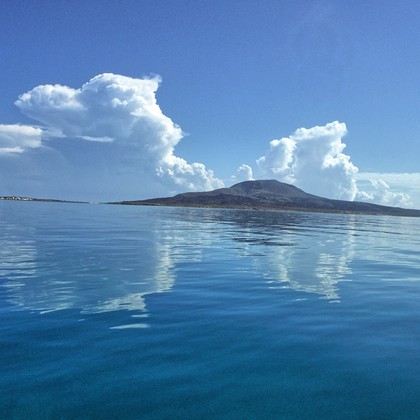
Open, warm ocean, both far offshore and over the continental shelf. Takes fish and squid at the surface or in short dives, often in mixed flocks over schools of tuna or dolphins. Breeds in burrows in sandy or vegetated ground on oceanic islands.
Where the bird is most at home, classified by the vegetation units of Mexico and Central America.


Range and movements
In the guide area breeds on the Revillagigedo Islands, including San Benedicto. At sea widespread off the Pacific coast from Mexico to Panama, mainly far offshore; absent from the Caribbean side. Records come mainly from ships, so its distribution at sea is incompletely known. Outside the guide area the species breeds on islands in the tropical and subtropical Indian and Pacific Oceans, from East Africa and Australia to Hawaii.
- Resident
- Summer visitor (c. Apr–Sep)
- Winter visitor (c. Oct–Mar)
- Passage (Mar–Apr, Oct–Nov)
- dark = core range, pale = thinly spread
How and when to look
Pelagic trips off the Pacific coast offer the best chance, especially near the Revillagigedo Islands or over groups of dolphins. The long, pointed tail and the calm flight with forward-held wings are the best features in both morphs.
Conservation status
Not threatened. The world population numbers millions of birds. Introduced predators and grazers have damaged colonies on some islands; on the Revillagigedo Islands introduced mammals have partly been removed.
Scientific name
Ardenna pacifica | (Gmelin, 1789) (GBIF: Puffinus pacificus)
Gmelin described the species in 1789 as Procellaria pacifica; because it was later moved to another genus, the author and year stand in brackets. The genus Ardenna was introduced in 1853 by Reichenbach. Ardenna goes back to Artenna, the spelling the Italian naturalist Ulisse Aldrovandi used for a seabird in 1603 and which Reichenbach cited when naming the genus. pacifica is Latin for 'of the Pacific Ocean', after its range. The specimen the first description was based on came from Pacific Ocean; later restricted to the Kermadec Islands.