All species › Passerines › Ovenbirds and woodcreepers › Wedge-billed Woodcreeper
Position in the tree Birds Aves › Birds with a flexible palate Neognathae › All other modern birds Neoaves › Landbirds Telluraves › Falcons, parrots and passerines Australaves › Falcons and passerines Eufalconimorphae › Parrots and passerines Psittacopasserae
Wedge-billed Woodcreeper | Glyphorynchus spirurus
Wigsnavelmuisspecht | Trepatroncos picocuña
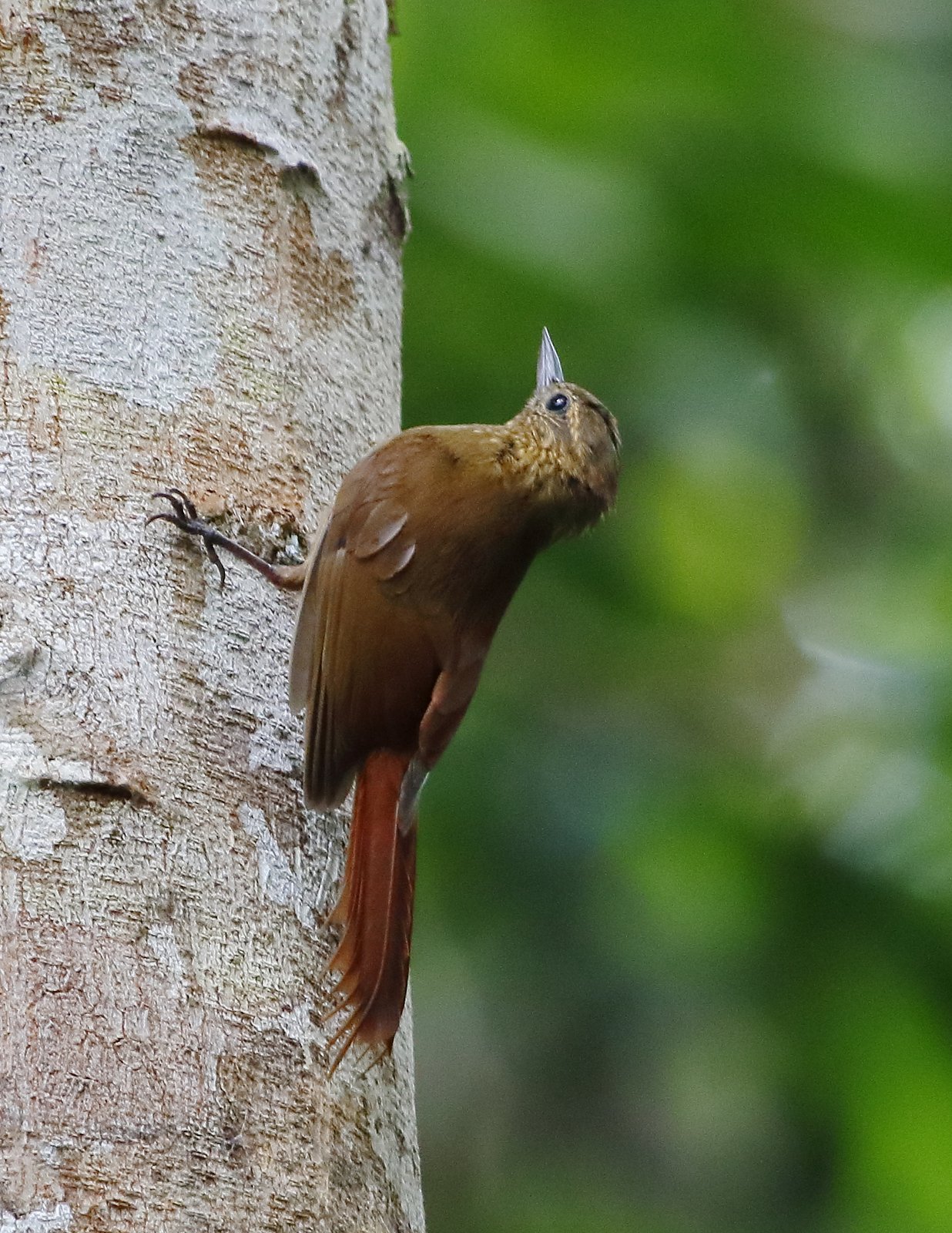
The Wedge-billed Woodcreeper is the smallest woodcreeper in the guide area, with a short, wedge-shaped bill. It climbs tree trunks in short hops, often spiralling, and usually starts low near the base. In humid lowland forest it is one of the commonest woodcreepers.
Voice
The song is a fast, rising series of short, high notes, like an excited trill. The call is a short, sharp, rather sneezy chif.
Recording: Jacob Wijpkema — CC BY-NC-SA 4.0 · converted to mono · xeno-canto
Identification
14–15 cm. Upperparts warm brown, rump and tail rufous; the tail feathers have stiff, projecting tips used as a prop against the trunk. A pale buffy eyebrow and throat; breast brown with fine pale drop-shaped streaks. Bill short and straight with a slightly upturned lower mandible, giving a wedge-shaped look. In flight a pale buffy band across the wing. Male and female are alike.
Confusion species
Olivaceous Woodcreeper Sittasomus griseicapillus is just as small but has a greyish-olive head and underparts without streaks and a thin, straight bill. Piping Long-tailed Woodcreeper Deconychura typica is larger, slimmer and longer-tailed, with a longer bill. Other woodcreepers are larger and have clearly longer bills.
Habitat
Interior of humid evergreen lowland and foothill forest, also mature secondary forest and shady forest edges. It searches for small insects and spiders on trunks and thick branches, mainly in the lower and middle storeys. It often joins mixed flocks. It nests in a crevice or cavity in a trunk or stump.
Where the bird is most at home, classified by the vegetation units of Mexico and Central America.




Range and movements
From south-eastern Mexico (from southern Veracruz and Oaxaca) through Belize, Guatemala, Honduras, Nicaragua and Costa Rica to Panama. Outside the guide area widespread in humid forest of northern South America, Amazonia and parts of Brazil.
- Resident
- dark = core range, pale = thinly spread
How and when to look
Regularly seen at La Selva in Costa Rica and along Pipeline Road (Camino del Oleoducto) in Panama. Watch for a small brown bird that starts low on a trunk and quickly spirals upwards.
Conservation status
Not threatened. Common in humid forest; disappears where forest is cleared completely.
Scientific name
Glyphorynchus spirurus | (Vieillot, 1819)
Vieillot described the species in 1819 as Neops spirurus; because it was later moved to another genus, the author and year stand in brackets. The genus Glyphorynchus was introduced in 1831 by Wied-Neuwied. Glyphorynchus is Greek, from gluphō 'to carve' and rhunkhos 'bill', after the short, chisel-like bill. spirurus is Greek, from speira 'coil, spiral' and -ouros '-tailed', after the stiff tail feathers with inward-curving shaft tips. The specimen the first description was based on came from Cayenne, French Guiana (inferred).