All species › Waders, gulls and terns › Sandpipers and allies › Wandering Tattler
Position in the tree Birds Aves › Birds with a flexible palate Neognathae › All other modern birds Neoaves › Birds of the elements Elementaves › Cranes and waders Gruimorphae
Wandering Tattler | Tringa incana
Amerikaanse grijze ruiter | Playero vagabundo
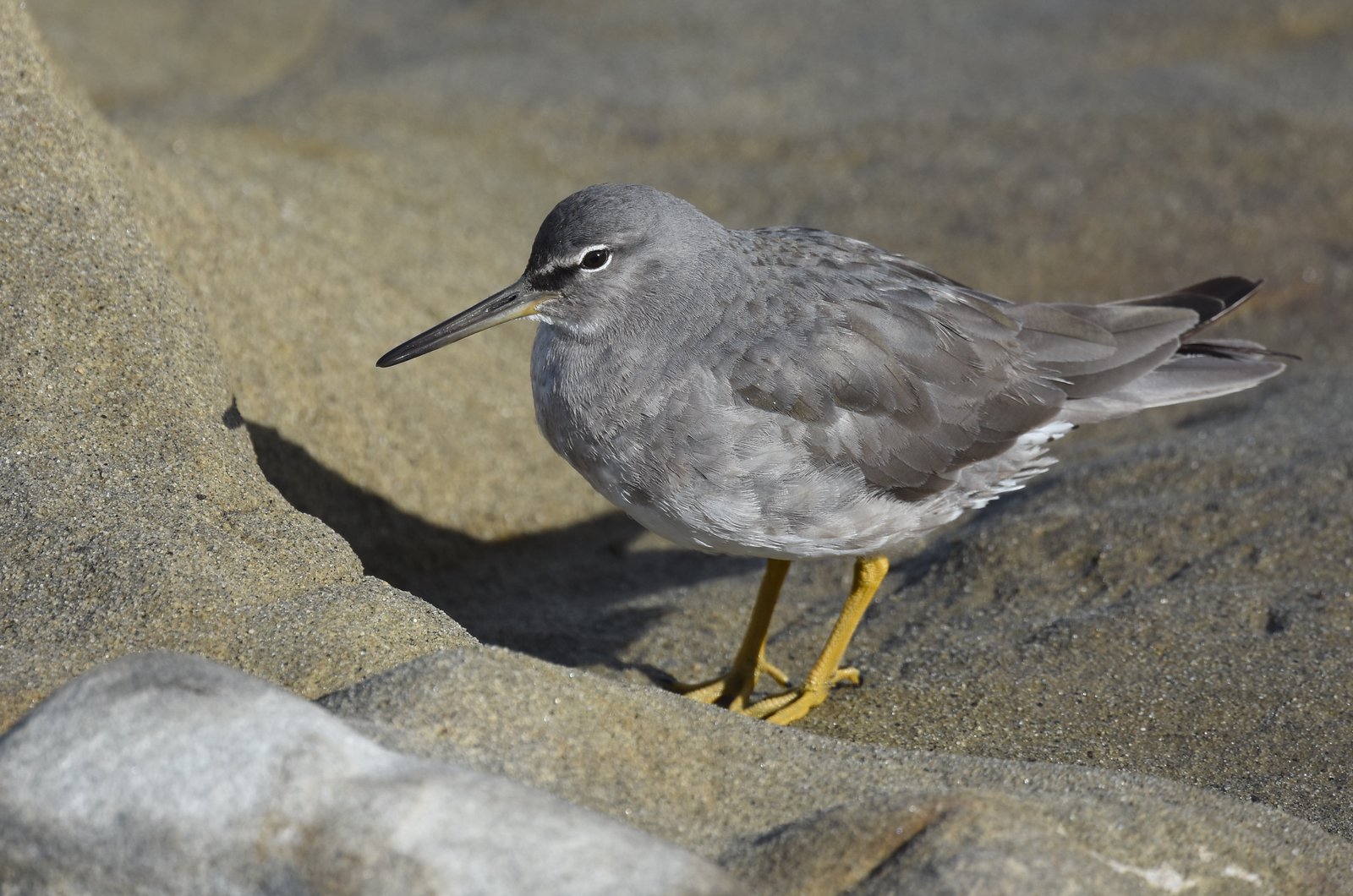
The Wandering Tattler is a plain slate-grey wader of rocky shores that bobs its rear end like a Spotted Sandpiper. It breeds along mountain streams in Alaska and north-western Canada and winters along coasts and on islands around the Pacific Ocean. In the guide area it is a winter visitor along the Pacific coast and on the islands off that coast.
Voice
A rapid, clear, whistled trill of evenly pitched notes, wee-dee-dee-dee-dee, often on taking flight; the series sometimes accelerates towards the end.
Recording: Logan McLeod — CC BY-NC-SA 4.0 · converted to mono · xeno-canto
Identification
26–29 cm, fairly compact, with a medium-length, straight, dark bill and short, yellowish legs. In non-breeding plumage plain dark slate-grey above and on the head, breast and flanks, with a white belly, a white supercilium in front of the eye and a dark eye-stripe. In breeding plumage the underparts are densely barred dark. Juveniles have fine pale fringes to the upperparts. In flight uniformly dark, with no wing bar or white rump. It bobs its rear end and moves nimbly over wet rocks in the surf.
Confusion species
Spotted Sandpiper Actitis macularius also bobs, but is smaller and browner, with a white notch in front of the wing and a white wing bar. Willet Tringa semipalmata is larger and paler grey, with thick blue-grey legs and a black-and-white wing pattern in flight. Surfbird Calidris virgata has a short, stout bill with a yellow base, spotted flanks and in flight a white wing bar and white rump.
Habitat
Rocky shores, rocky headlands and breakwaters, rock islets and cliffs in the surf, locally also jetties, harbours and beaches with rocks. It searches among seaweed and barnacles for crabs, worms and molluscs in the splash zone. Usually alone or in small numbers.
Where the bird is most at home, classified by the vegetation units of Mexico and Central America.


Range and movements
Winter visitor along the Pacific coast of Baja California, the Gulf of California and western Mexico, south along the Pacific coast of Central America to Panama, and on offshore islands such as the Revillagigedo Islands and Isla del Coco. Very rare on the Gulf of Mexico and Caribbean side. Outside the guide area the species breeds in Alaska, north-western Canada and north-eastern Siberia and winters along the Pacific coast of North and South America to Ecuador, on the Galápagos and on Pacific islands as far as Australia.
- Winter visitor (c. Oct–Mar)
- dark = core range, pale = thinly spread
How and when to look
Rocky headlands and breakwaters along the Pacific coast are the places to find the species, for example at low tide. The birds blend in against dark rock; the call on take-off and the bobbing help to find them.
Conservation status
Not threatened. The population is small but widespread; because of the remote breeding grounds and scattered wintering areas, trends are hard to measure. Oil pollution along rocky shores is a possible threat.
Scientific name
Tringa incana | (Gmelin, 1789)
Gmelin described the species in 1789 as Scolopax incana; because it was later moved to another genus, the author and year stand in brackets. The genus Tringa was introduced in 1758 by Linnaeus. Tringa is the Neo-Latin name Aldrovandi gave to the green sandpiper, after Ancient Greek trungas, a thrush-sized, white-rumped, tail-bobbing wading bird mentioned by Aristotle. incana is Latin, from incanus 'grey, hoary', after the uniform slate-grey plumage. The specimen the first description was based on came from Moorea (Society Islands) and Palmerston (Cook Islands).