All species › Swifts › Hummingbirds › Violet Sabrewing
Position in the tree Birds Aves › Birds with a flexible palate Neognathae › All other modern birds Neoaves › Birds of the elements Elementaves › Nightjars and swifts Strisores
Violet Sabrewing | Campylopterus hemileucurus
Violette sabelvleugel | Fandanguero morado
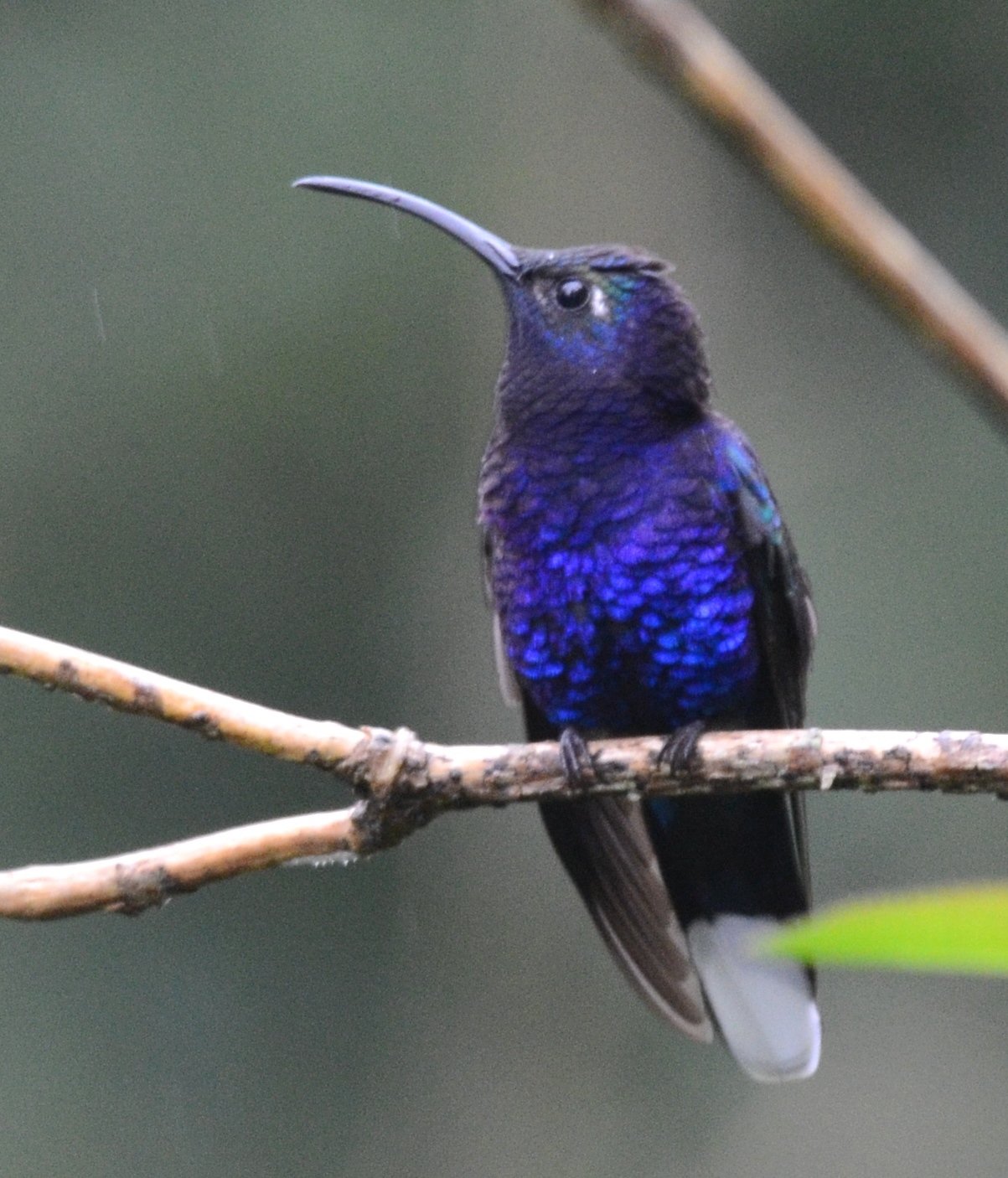
The Violet Sabrewing is one of the largest hummingbirds of the guide area, with a long, decurved bill and a large tail with white corners. The male is almost entirely dark violet. It lives in montane forest from southern Mexico to western Panama and defends flowering plants fiercely against other hummingbirds.
Voice
A loud, sharp chip or chuk, often repeated. Males sing a varied, squeaky and twittering song in groups from perches in the understorey.
Recording: Max Noack — CC BY-NC-SA 4.0 · converted to mono · xeno-canto
Identification
13–15 cm, with a stout, slightly decurved black bill. In the male the shafts of the outer primaries are thickened. The male is dark glossy violet on the head, throat and underparts, with a greener back; the tail is dark blue with broad white tips to the three outer pairs of feathers. The female is green above and grey below, with a violet throat and the same white tail corners. There is a small white spot behind the eye.
Confusion species
Rufous Sabrewing Pampa rufa has rufous underparts and rufous in the tail. Wedge-tailed Sabrewing Pampa curvipennis is smaller, green with grey underparts and has no white in the tail. The male White-necked Jacobin Florisuga mellivora has a blue head, a white nape band and a white belly.
Habitat
Humid montane forest, cloud forest and their edges, ravines with streams, old secondary forest, shade coffee and banana plantings and gardens in the mountains, at about 1000 to 2400 m, outside the breeding season also lower into the foothills. It feeds mainly low down at heliconias, wild bananas and other large flowers, and catches insects.
Where the bird is most at home, classified by the vegetation units of Mexico and Central America.






Range and movements
Endemic to the guide area. In Mexico in the mountains of Guerrero and Oaxaca, central and southern Veracruz and Chiapas; further in the highlands of Guatemala, Belize, El Salvador, Honduras, Nicaragua and Costa Rica, and in western Panama in Chiriquí, Bocas del Toro and Veraguas.
- Resident
- dark = core range, pale = thinly spread
How and when to look
Common at the feeders of lodges in the Costa Rican middle elevations, such as around Monteverde and at the La Paz waterfalls; in Panama around Boquete. Also at flowering bananas and heliconias in mountain gardens.
Conservation status
Not threatened. Fairly common to common in suitable montane forest. Deforestation affects it locally, but it also uses gardens and plantings near forest.
Scientific name
Campylopterus hemileucurus | (Deppe, 1830)
Deppe described the species in 1830 as Trochilus hemileucurus; because it was later moved to another genus, the author and year stand in brackets. The genus Campylopterus was introduced in 1827 by Swainson. Campylopterus is Greek, from kampulos 'curved' and pteron 'wing', after the thickened, curved shafts of the outer primaries. hemileucurus is Greek, from hēmi- 'half', leukos 'white' and -ouros '-tailed', after the large white patches on the outer tail feathers. The specimen the first description was based on came from Mexico (not specified).