All species › Swifts › Hummingbirds › Violet-headed Hummingbird
Position in the tree Birds Aves › Birds with a flexible palate Neognathae › All other modern birds Neoaves › Birds of the elements Elementaves › Nightjars and swifts Strisores
Violet-headed Hummingbird | Klais guimeti
Paarskopkolibrie | Colibrí cabecivioleta
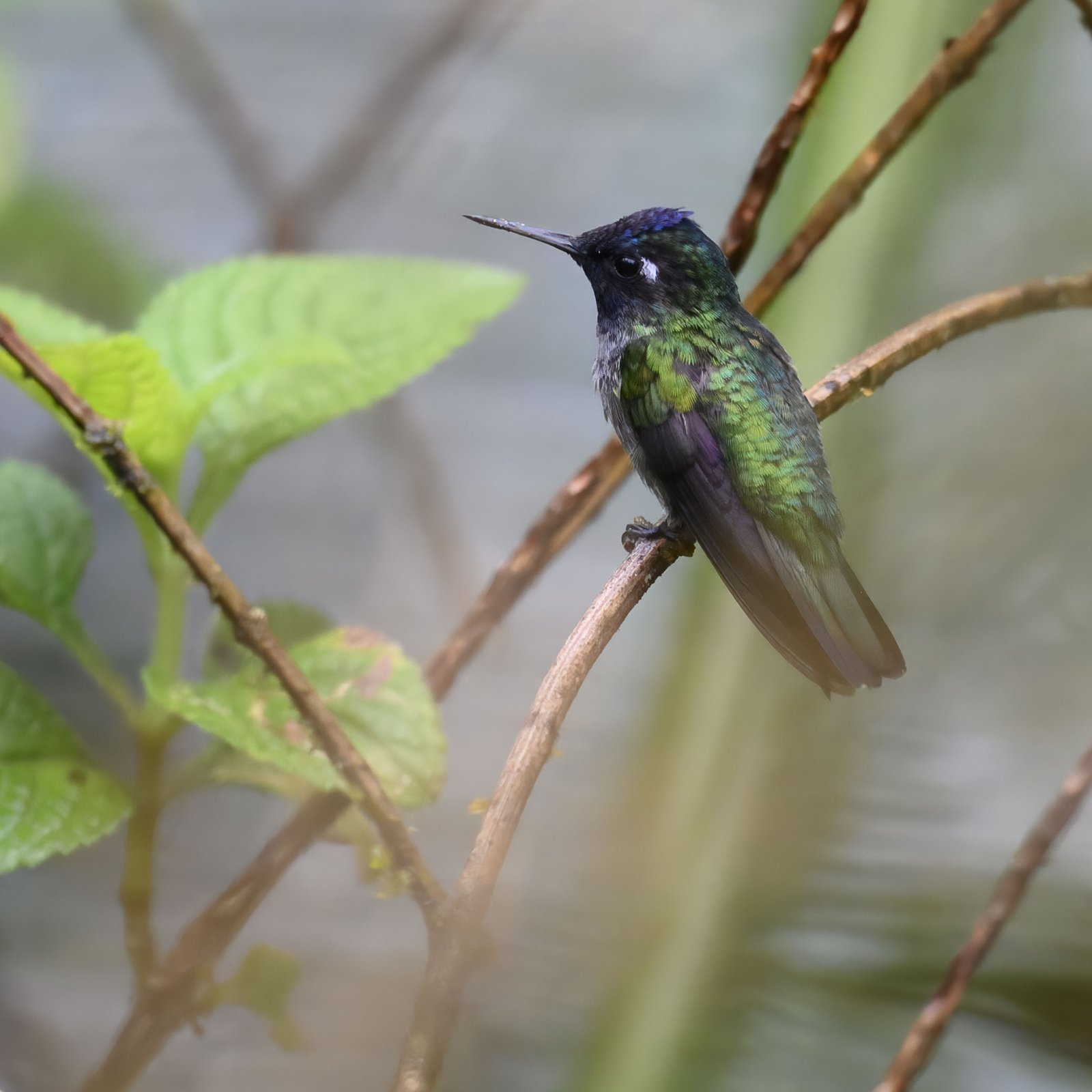
The Violet-headed Hummingbird is a small hummingbird of the foothills on the Caribbean side of Central America, from Honduras to Panama. The male has a violet-blue head and a conspicuous white spot behind the eye. Males sing in loose groups from fixed perches in the understorey and at the forest edge.
Voice
A high, thin, squeaky song of short repeated notes, often given for minutes from the same twig. The call is a dry chip.
Recording: Paul Driver — CC BY-NC-SA 4.0 · converted to mono · xeno-canto
Identification
8 cm, with a short, straight black bill and a white spot behind the eye. The male has a violet-blue crown, cheeks and throat, bronze-green upperparts, grey-green underparts and a green tail with a dark band and grey tips. The female has a blue crown, a grey throat and pale grey underparts; the white spot behind the eye is also obvious in her.
Confusion species
The female Crowned Woodnymph Thalurania colombica is larger, has a longer bill and no white spot behind the eye. Females of Snowcap Microchera albocoronata and Coppery-headed Emerald Microchera cupreiceps are white below and have much white in the tail. Blue-throated Sapphire Chlorestes eliciae has a red bill base and a golden-bronze tail.
Habitat
Edges and clearings of humid foothill and lowland forest, old secondary forest, riverbanks and semi-open country with flowering shrubs, also shade coffee and gardens at the forest edge, mainly between about 300 and 1200 m, locally lower. It feeds low to mid-level at flowers of shrubs and herbs and catches small insects.
Where the bird is most at home, classified by the vegetation units of Mexico and Central America.




Range and movements
In the guide area on the Caribbean slope of Honduras and Nicaragua, in Costa Rica on the Caribbean slope and locally on the Pacific side, and in Panama in the foothills of both slopes east to Darién. Outside the guide area in Colombia, Venezuela and along the eastern Andean slopes to Bolivia.
- Resident
- dark = core range, pale = thinly spread
How and when to look
In Costa Rica in the Caribbean foothills, for example around Arenal Volcano and near Turrialba, at flowering shrubs along forest edges and lodge gardens. A singing male gives itself away by its persistent, high squeaking.
Conservation status
Not threatened. Fairly common in suitable foothill forest. It tolerates edges and secondary forest, but depends on forest nearby.
Scientific name
Klais guimeti | (Bourcier, 1843)
Bourcier described the species in 1843 as Trochilus Guimeti; because it was later moved to another genus, the author and year stand in brackets. The genus Klais was introduced in 1854 by Reichenbach. Klais refers to Kleis, the daughter (and also the mother) of the Greek poetess Sappho of Lesbos. guimeti honours the French industrial chemist Jean-Baptiste Guimet (1795–1871), who devised a process for synthetic ultramarine in 1826. The specimen the first description was based on came from Caracas, Venezuela.