All species › Passerines › Swallows › Violet-green Swallow
Position in the tree Birds Aves › Birds with a flexible palate Neognathae › All other modern birds Neoaves › Landbirds Telluraves › Falcons, parrots and passerines Australaves › Falcons and passerines Eufalconimorphae › Parrots and passerines Psittacopasserae
Violet-green Swallow | Tachycineta thalassina
Groene zwaluw | Golondrina verdemar
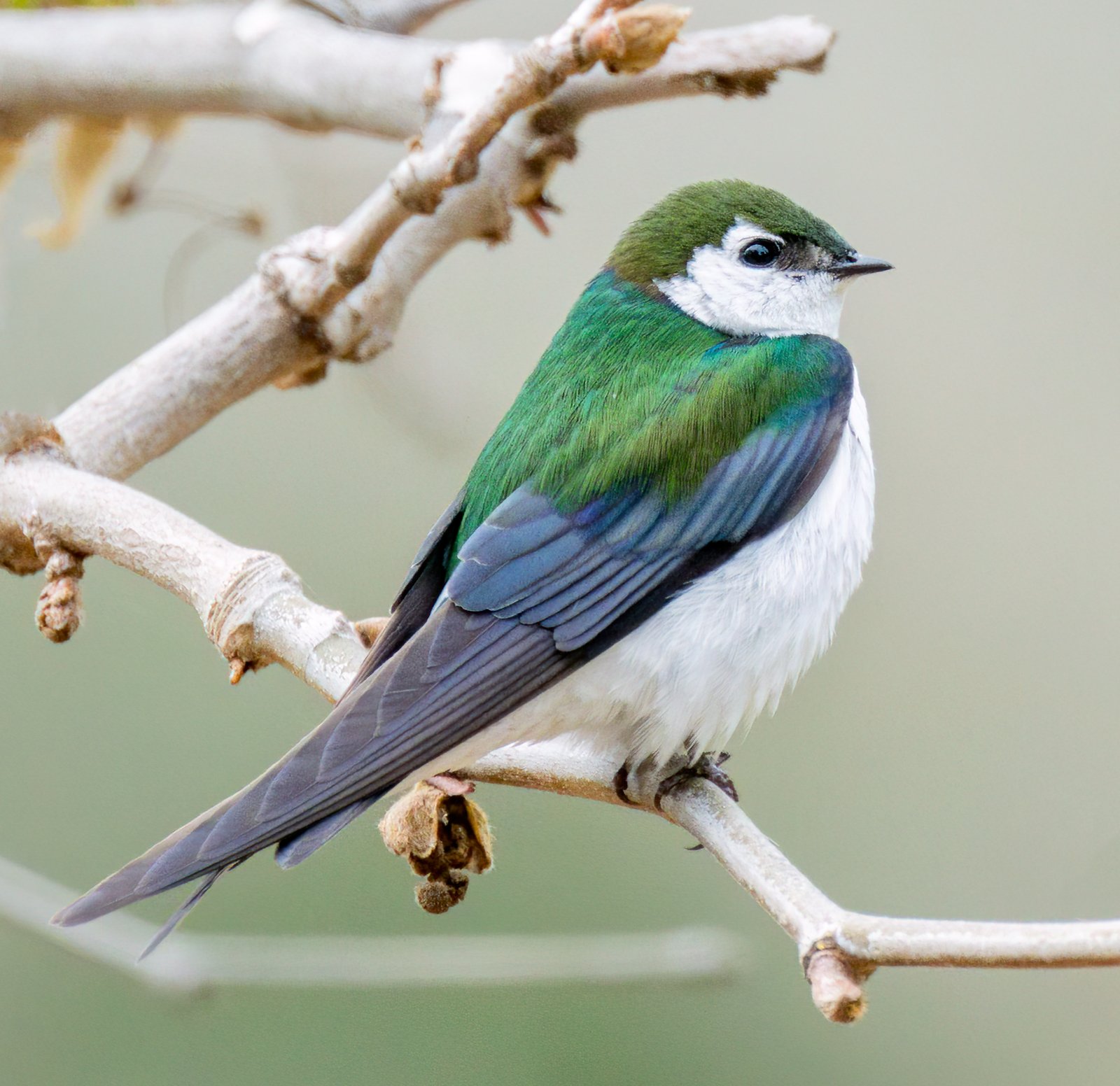
The Violet-green Swallow is a small mountain swallow with green-glossed upperparts, violet rump and tail and much white in the face. White patches on the sides of the rump are conspicuous in flight. It breeds in the highlands of Mexico and in western North America; migrants from the north winter in Mexico and northern Central America.
Voice
Thin, high chirps and a rapid, dry chee-chee; in the breeding season also a series of such notes as song, often before dawn.
Recording: Richard E. Webster — CC BY-NC-SA 4.0 · converted to mono · xeno-canto
Identification
12–13 cm. Male bronzy to emerald green above with violet gloss on the rump and tail. The white of the underparts extends above and behind the eye, so that the dark eye sits in a white cheek. Large white flank patches extend onto the sides of the rump. Tail short and slightly notched; at rest the wingtips project well beyond the tail. Female duller and browner above, with less white in the face.
Confusion species
Tree Swallow Tachycineta bicolor is slightly larger and bluer, has a dark cheek reaching below the eye and no white patches on the rump. Mangrove Swallow Tachycineta albilinea has a wholly white rump and lives in the lowlands near water.
Habitat
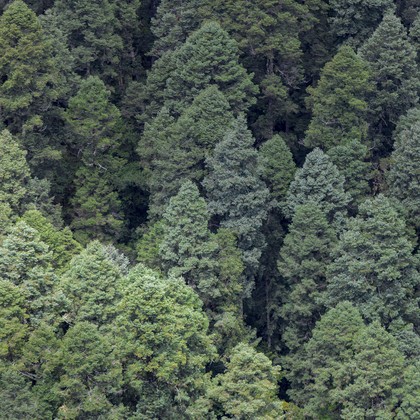
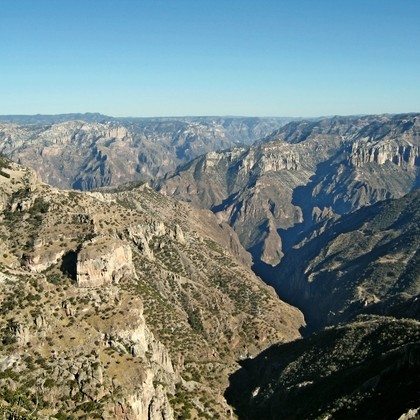
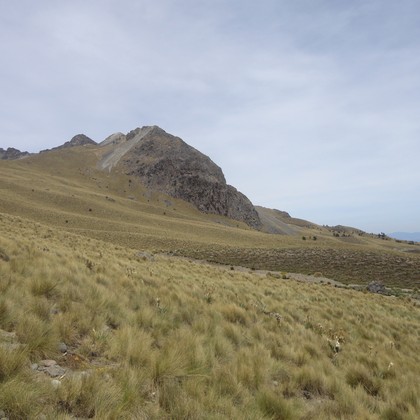
Open forest in the mountains, especially pine-oak, oak and conifer forest, also canyons, cliffs and mountain meadows; often hunts high in the air over forest, valleys and lakes. Nests in tree cavities, old woodpecker holes and rock crevices. Wintering birds also hunt over lower open country and water.
Where the bird is most at home, classified by the vegetation units of Mexico and Central America.



Range and movements
Breeds in the mountains of Baja California and from northern Mexico south through the Sierra Madre and the highlands to about Oaxaca. In winter it is joined by migrants from North America, which spread over much of Mexico and reach south in small numbers into Guatemala, El Salvador and Honduras. Outside the guide area the species breeds in the western United States and Canada and in Alaska.
- Resident
- Summer visitor (c. Apr–Sep)
- Winter visitor (c. Oct–Mar)
- Passage (Mar–Apr, Oct–Nov)
- dark = core range, pale = thinly spread
How and when to look
Best seen over open pine-oak forest and canyons in the mountains of Mexico, often together with other swallows and swifts. In flight look for the white patches on the sides of the rump.
Conservation status
Not threatened. Common in suitable habitat.
Scientific name
Tachycineta thalassina | (Swainson, 1827)
Swainson described the species in 1827 as Hirundo thalassinus; because it was later moved to another genus, the author and year stand in brackets. The genus Tachycineta was introduced in 1851 by Cabanis. Tachycineta is Greek, from takhukinētos 'moving quickly', after the fast, agile flight. thalassina is from Greek thalassinos 'sea-green, of the sea', after the glossy green upperparts. The specimen the first description was based on came from Real del Monte, Hidalgo, Mexico.