All species › Owls › Owls › Unspotted Saw-whet Owl
Position in the tree Birds Aves › Birds with a flexible palate Neognathae › All other modern birds Neoaves › Landbirds Telluraves › Raptors, owls, kingfishers and woodpeckers Afroaves › Hawks and owls Hieraves
Unspotted Saw-whet Owl | Aegolius ridgwayi
Ridgways zaaguil | Tecolote canelo
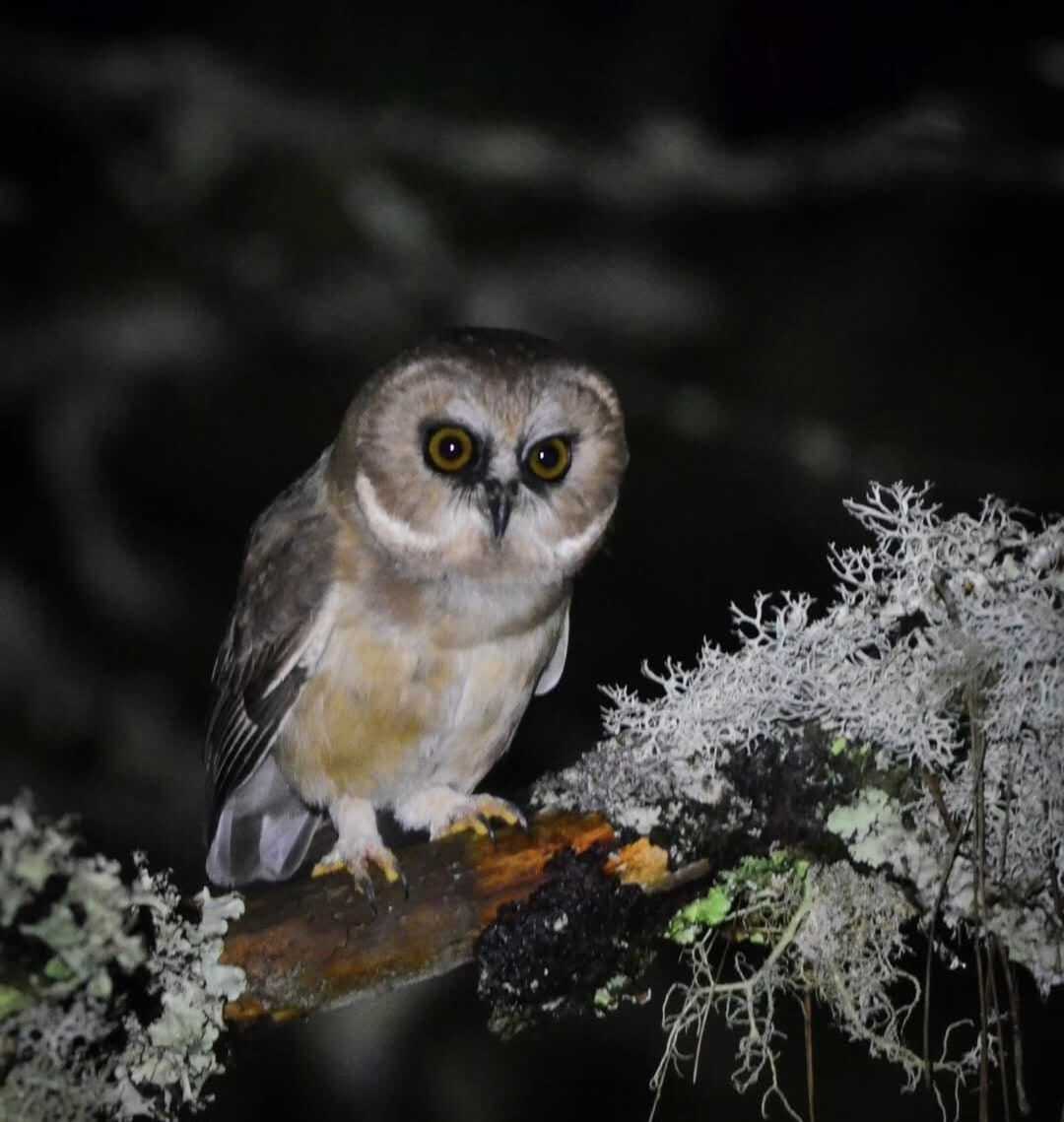
The Unspotted Saw-whet Owl is a small, little-known owl of the high montane forests from Chiapas to western Panama. It is the southern counterpart of the Northern Saw-whet Owl and resembles a juvenile of that species in plumage. It is strictly nocturnal and is detected almost only by its song. Almost nothing is known of its breeding habits. The species occurs only in the guide area.
Voice
The song is a long series of even, whistled toots, too-too-too-too, very similar to that of the Northern Saw-whet Owl. Other calls are barely described.
Recording: GABRIEL LEITE — CC BY-NC-SA 4.0 · converted to mono · xeno-canto
Identification
18–20 cm, with a large round head without ear tufts, yellow eyes and a short tail. The upperparts are plain dark chocolate brown, with no or only a few white spots on the wing. The facial disc is brown, with a whitish V above the bill and white eyebrows. The underparts are plain buff to cinnamon, without streaks, with a brown band across the breast. Male and female are alike.
Confusion species
The Northern Saw-whet Owl Aegolius acadicus occurs in the guide area only north of the Isthmus of Tehuantepec; adults have a streaked crown and reddish-brown streaked underparts, but juveniles closely resemble this species. The pygmy owls of the same forests, such as the Northern Pygmy Owl Glaucidium gnoma and the Costa Rican Pygmy Owl Glaucidium costaricanum, are smaller, with a longer, barred tail and false eyes on the nape. The Mottled Owl Strix virgata is much larger and has dark eyes.
Habitat
Cloud forest, montane rainforest and oak and conifer forest in the highest parts of the mountains, also forest edges and clearings with scattered trees; mainly above about 1500 m, in Costa Rica to above 3000 m. The nest site is barely known; it presumably nests in tree cavities like related species. It feeds on small mammals, small birds and large insects.
Where the bird is most at home, classified by the vegetation units of Mexico and Central America.




Range and movements
Resident in the high mountains of Chiapas, Guatemala, El Salvador and Honduras, and in the Cordillera Central and Cordillera de Talamanca of Costa Rica to western Panama, in Chiriquí. Not reliably recorded in Nicaragua. Everywhere scarce or rarely detected; the distribution is incompletely known. Does not occur outside the guide area.
- Resident
- dark = core range, pale = thinly spread
How and when to look
In Costa Rica it is heard most often in oak forest along the Cerro de la Muerte and on the slopes of Irazú; in Guatemala in the montane forests of the western highlands. The best chance of singing birds is in the dry season, from February to May, on calm nights.
Conservation status
Not threatened, but poorly known. The species depends on high-elevation montane forest, which is declining in Chiapas and Guatemala through logging and agriculture.
Scientific name
Aegolius ridgwayi | (Alfaro, 1905)
Alfaro described the species in 1905 as Cryptoglaux ridgwayi; because it was later moved to another genus, the author and year stand in brackets. The genus Aegolius was introduced in 1829 by Kaup. Aegolius is the Latin word for a screech owl, taken from Greek aigōlios, 'a bird of ill omen'. ridgwayi honours the American ornithologist Robert Ridgway (1850–1929) of the Smithsonian. The specimen the first description was based on came from Cerro de la Candelaria near Escazú, Costa Rica.