All species › Owls › Owls › Tropical Screech Owl
Position in the tree Birds Aves › Birds with a flexible palate Neognathae › All other modern birds Neoaves › Landbirds Telluraves › Raptors, owls, kingfishers and woodpeckers Afroaves › Hawks and owls Hieraves
Tropical Screech Owl | Megascops choliba
Cholibaschreeuwuil | Autillo tropical
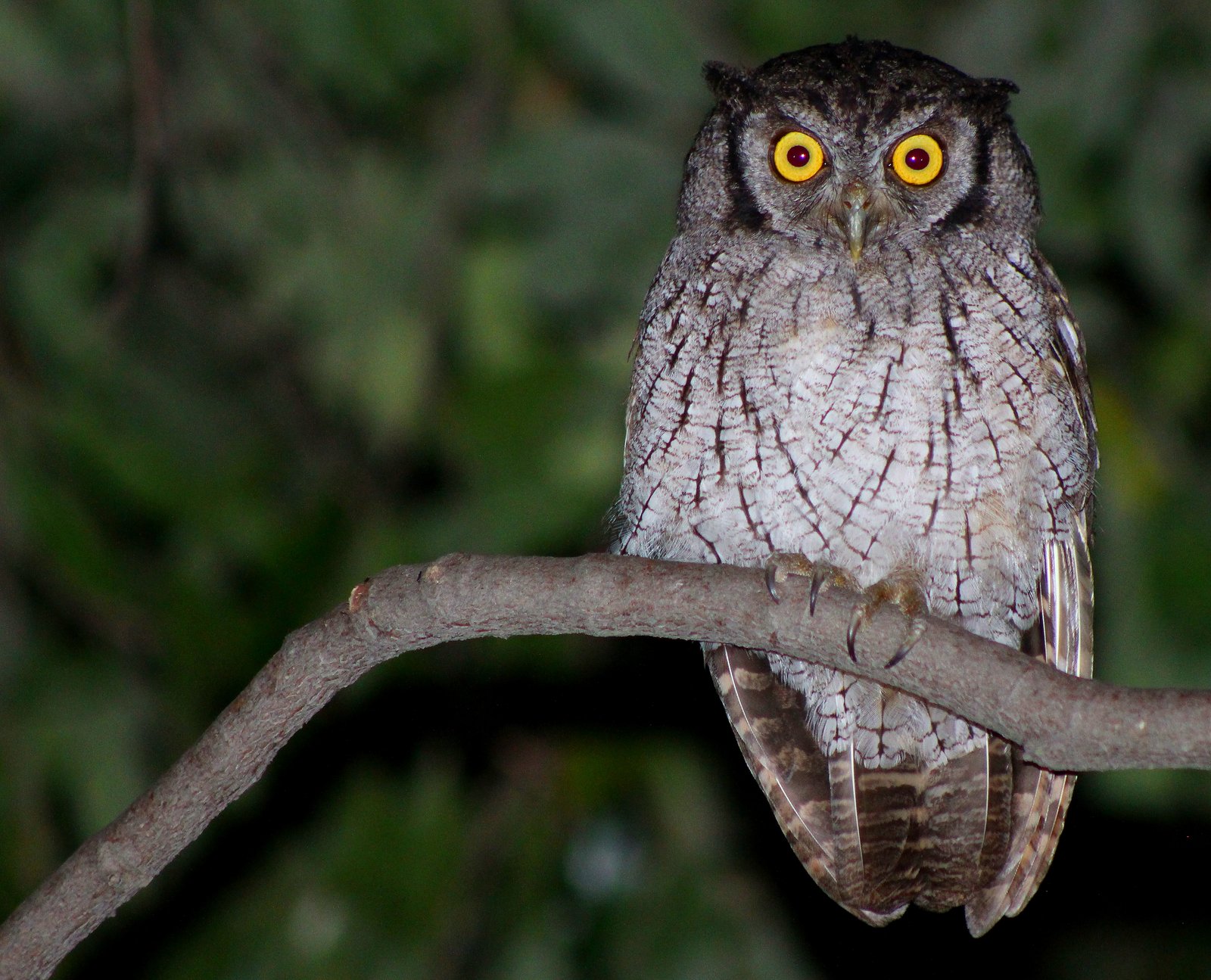
The Tropical Screech Owl is the commonest screech owl of South America and reaches the northern limit of its range in Costa Rica. In the guide area it lives only in Costa Rica and Panama, in semi-open country with trees, including gardens and parks in towns. It is strictly nocturnal and is heard more often than seen.
Voice
A short, purring trill followed by one or two emphatic notes, prrrrrr-kook-kook; the female sings higher. Also a bubbling boo-boo-boo-boo in courtship, and cackling and longer calls. Heard year-round, mainly in the first hours after sunset.
Recording: Juan Freile — CC BY-NC-SA 4.0 · converted to mono · xeno-canto
Identification
21–23 cm, with short ear tufts that are hardly noticeable on a relaxed bird, and yellow eyes. Most birds are grey-brown, less often brown or rufous. The pale grey facial disc has a distinct blackish rim. The upperparts are finely spotted and streaked, with a row of white spots on the scapulars. The underparts are pale with dark streaks and fine cross-lines that together form a herringbone pattern. Male and female are alike.
Confusion species
Middle American Screech Owl Megascops guatemalae and Choco Screech Owl Megascops centralis have finely vermiculated plumage with a weaker rim to the facial disc and sing a long trill; they live in humid forest. Bare-shanked Screech Owl Megascops clarkii is warmer cinnamon-brown, has large white spots on the underparts and lives higher in the mountains. Ferruginous Pygmy Owl Glaucidium brasilianum is smaller, without ear tufts, with a longer tail and two dark ‘false eyes’ on the nape, and is also active by day.
Habitat
Semi-open country: secondary forest, forest edges, dry forest, gallery forest, pasture with trees, shade coffee, and gardens and parks with trees, also in towns. Dense, closed rainforest is usually avoided. It occurs from the lowlands to about 1500 metres, locally higher in Costa Rica. It nests in tree cavities. It eats large arthropods such as grasshoppers, moths, beetles and spiders, also frogs, lizards, small birds and rodents.
Where the bird is most at home, classified by the vegetation units of Mexico and Central America.






Range and movements
Resident in Costa Rica, mainly in the Central Valley around San José, Cartago and Alajuela and on the Pacific slope of Puntarenas southward; scarce on the Caribbean slope and in Guanacaste. Widespread in Panama, especially on the Pacific slope from Chiriquí to the Panama City area and in the Canal Area, east to Darién. A few reports from Guatemala and Honduras are uncertain. Outside the guide area through most of South America to northern Argentina and Uruguay, and on Trinidad.
- Resident
- dark = core range, pale = thinly spread
How and when to look
In the Central Valley of Costa Rica it is often heard after sunset in gardens, coffee plantations and parks, also on the outskirts of San José. In Panama it calls around the Canal Area and in the lowlands of Coclé, and sometimes perches on a lamppost or branch along a road. The purring song with its closing notes gives the bird away.
Conservation status
Not threatened. The species is common and benefits from semi-open farmland and urban green space, as long as trees with cavities remain.
Scientific name
Megascops choliba | (Vieillot, 1817)
Vieillot described the species in 1817 as Strix choliba; because it was later moved to another genus, the author and year stand in brackets. The genus Megascops was introduced in 1848 by Kaup. Megascops combines the Greek megas 'great' with Scops, the old genus name of the scops owls. choliba comes from chóliba, an Aragonese name for the Eurasian scops owl that Félix de Azara knew from his boyhood and gave to this South American owl. The specimen the first description was based on came from Paraguay.