All species › Passerines › Gnatwrens and gnatcatchers › Trilling Gnatwren
Position in the tree Birds Aves › Birds with a flexible palate Neognathae › All other modern birds Neoaves › Landbirds Telluraves › Falcons, parrots and passerines Australaves › Falcons and passerines Eufalconimorphae › Parrots and passerines Psittacopasserae
Trilling Gnatwren | Ramphocaenus melanurus
Zwartstaartmuggensluiper | Soterillo picudo
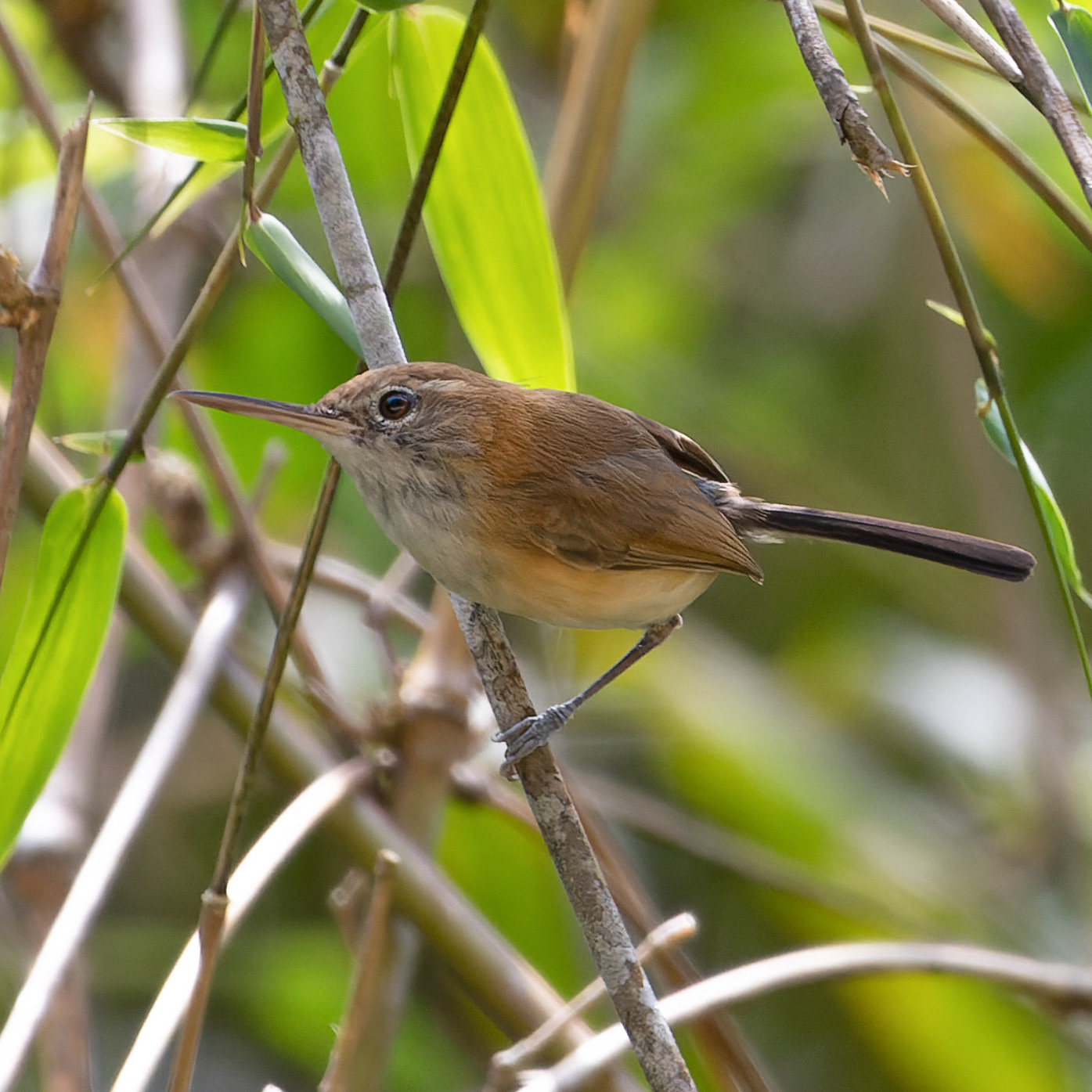
The Trilling Gnatwren is a small, slim bird with a very long, thin bill and a long, narrow tail that is often held cocked or waved from side to side. It lives in dense vine tangles and scrub from southern Mexico to Panama.
Voice
A long, even, musical trill on roughly one pitch, sometimes swelling slightly or rising. Also dry, short calls.
Recording: Juan Freile — CC BY-NC-SA 4.0 · converted to mono · xeno-canto
Identification
12–13 cm, including the long tail. Upperparts greyish brown, face and flanks cinnamon. Throat whitish, underparts dull buff. Tail long and narrow, blackish with white tips to the outer feathers. Bill very long, straight and thin, about as long as the head or longer.
Confusion species
Tawny-faced Gnatwren Microbates cinereiventris has a short tail, a grey belly and a black malar stripe. Gnatcatchers (Polioptila) are blue-grey with a short bill. Wrens have a shorter bill and usually barred wings or tail.
Habitat
Dense vine tangles and undergrowth at forest edges, in secondary forest and in the middle and lower levels of both humid and fairly dry forest; from the lowlands into the foothills. It searches leaves and tendrils for insects and spiders, often in mixed flocks.
Where the bird is most at home, classified by the vegetation units of Mexico and Central America.






Range and movements
From southern Mexico, including the Yucatán Peninsula, through Belize, Guatemala, El Salvador, Honduras, Nicaragua and Costa Rica to Panama. Outside the guide area across much of tropical South America.
- Resident
- dark = core range, pale = thinly spread
How and when to look
Heard far more often than seen: the long trill comes from dense thickets. Watch for the quick movements of the long tail among the vines.
Conservation status
Not threatened. Common at forest edges and in secondary forest. Following a recent split this species has not yet been assessed separately by the IUCN; the former, broader species is listed as not threatened.
Scientific name
Ramphocaenus melanurus | Vieillot, 1819
Vieillot described the species in 1819 and placed it straight away in the genus where it still stands. He introduced the genus Ramphocaenus in that same work. Ramphocaenus is Greek, from rhamphos 'bill' and kainos 'new, strange': 'strange bill', after the long, thin bill. melanurus is Greek, from melas 'black' and oura 'tail', after the blackish tail. The specimen the first description was based on came from vicinity of Rio de Janeiro, Brazil.