All species › Passerines › Gnatwrens and gnatcatchers › Tawny-faced Gnatwren
Position in the tree Birds Aves › Birds with a flexible palate Neognathae › All other modern birds Neoaves › Landbirds Telluraves › Falcons, parrots and passerines Australaves › Falcons and passerines Eufalconimorphae › Parrots and passerines Psittacopasserae
Tawny-faced Gnatwren | Microbates cinereiventris
Grijsbuikmuggensluiper | Soterillo caricastaño
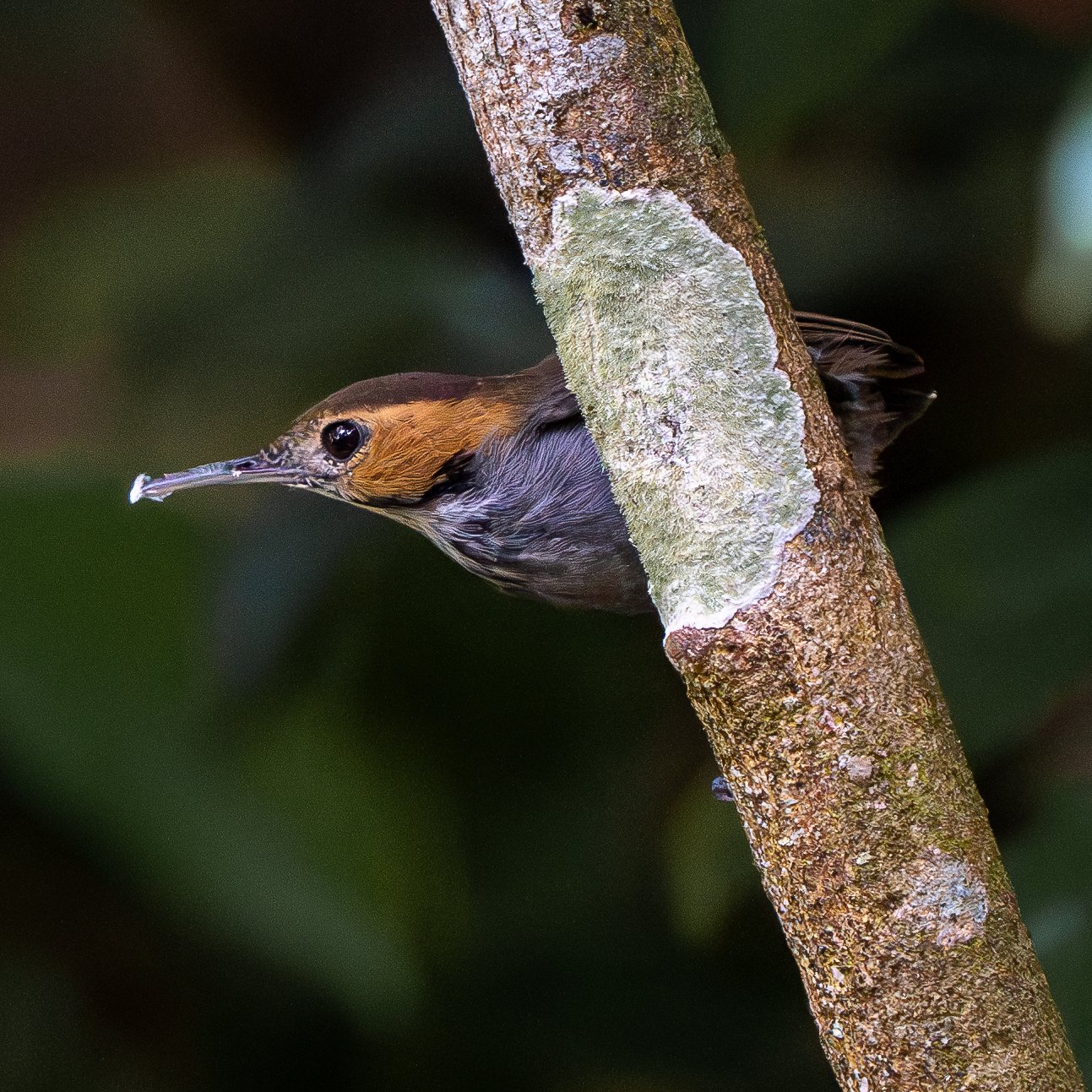
The Tawny-faced Gnatwren is a small, compact bird with a short tail, a long bill and a warm tawny-orange face. It lives low in the undergrowth of humid lowland forest from south-eastern Nicaragua to Panama.
Voice
A drawn-out, soft, plaintive whistle, often repeated. Also short, dry calls.
Recording: Daan van der Hoeven — CC BY-NC-SA 4.0 · converted to mono · xeno-canto
Identification
10 cm. Face bright tawny-orange, with a blackish line behind the eye. Throat white, bordered by a black malar stripe; breast and belly grey. Upperparts brown. Tail short, often cocked. Bill long, straight and thin.
Confusion species
Trilling Gnatwren Ramphocaenus melanurus has a long, slender, blackish tail with white tips, an even longer bill and paler, buffy underparts. Wood wrens such as White-breasted Wood Wren Henicorhina leucosticta have a streaked face and a shorter bill.
Habitat
Undergrowth of humid lowland and foothill forest, especially in ravines and along streams in shady forest, mostly below 1000 m. It forages close to the ground, often in pairs, for insects and spiders among leaves and twigs.
Where the bird is most at home, classified by the vegetation units of Mexico and Central America.



Range and movements
Caribbean slope of extreme south-eastern Nicaragua and of Costa Rica, and much of Panama. Outside the guide area in western Colombia and Ecuador and along the eastern foot of the Andes.
- Resident
- dark = core range, pale = thinly spread
How and when to look
Keeps to the dark undergrowth; the plaintive whistle usually gives it away. Stand still by a forest stream and wait for the bird to come closer.
Conservation status
Not threatened. Widespread, but sensitive to the loss and fragmentation of humid forest.
Scientific name
Microbates cinereiventris | (Sclater, 1855)
Sclater described the species in 1855 as Ramphocaenus cinereiventris; because it was later moved to another genus, the author and year stand in brackets. The genus Microbates was introduced in 1873 by Sclater & Salvin. Microbates is Greek, from mikros 'small' and batēs 'walker, treader': 'small walker'. cinereiventris is Latin, from cinereus 'ash-grey' and venter 'belly', after the grey underparts. The specimen the first description was based on came from Buenaventura, Colombia.