All species › Gamebirds › New World quail › Tawny-faced Quail
Position in the tree Birds Aves › Birds with a flexible palate Neognathae › Fowl Galloanserae
Tawny-faced Quail | Rhynchortyx cinctus
Langpootkwartel | Codorniz carirrufa
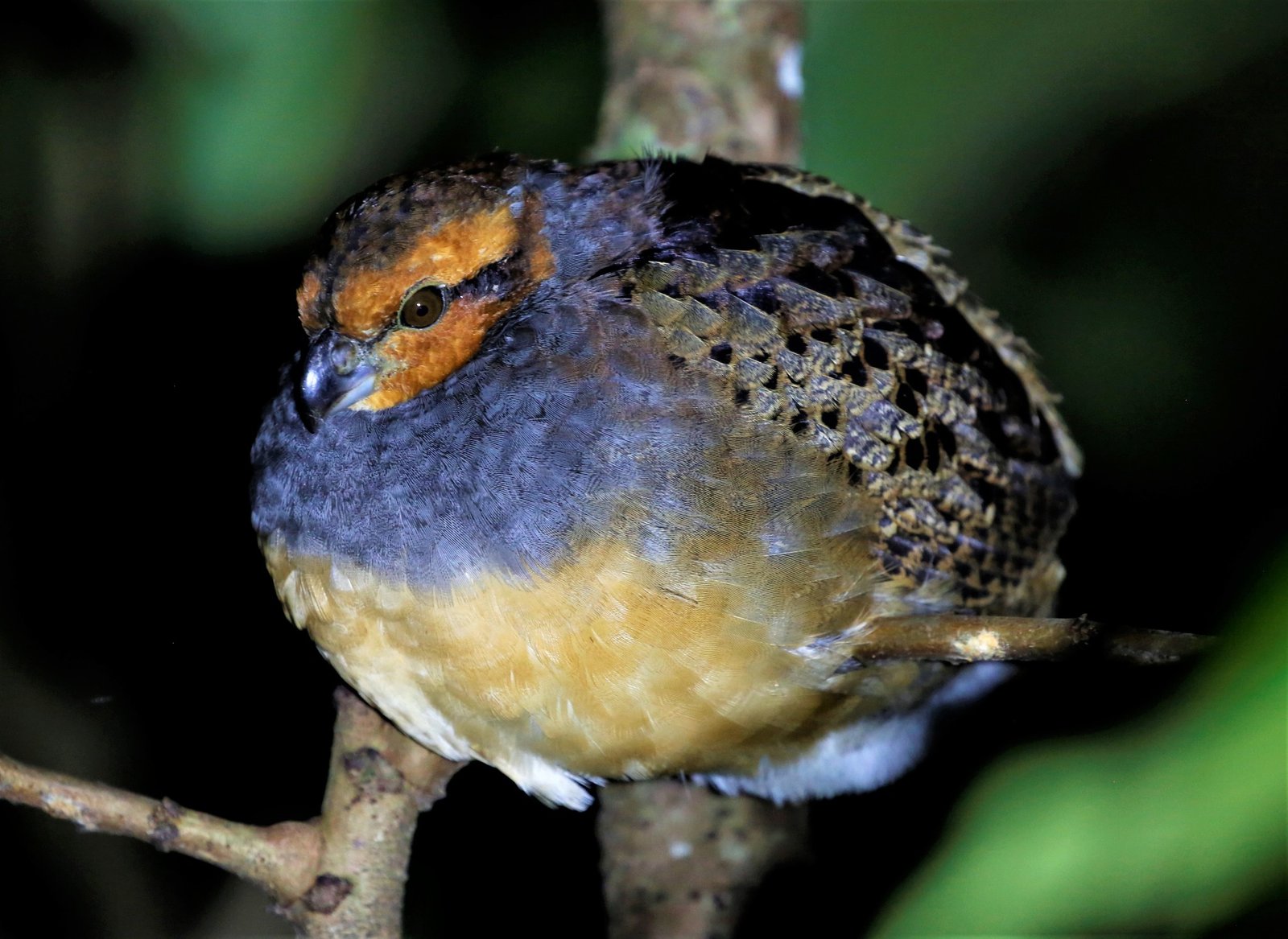
The Tawny-faced Quail is a small, long-legged quail of the floor of wet lowland forest, from eastern Honduras to Panama. It is the only species in its genus and differs from the other quails of the guide area in its long legs and short tail. The species lives a hidden life and is heard far more often than seen.
Voice
A series of pure, monotonous whistles followed by a series of whistles at a lower or higher pitch, mainly at dusk and when going to roost. Members of a group keep in contact with soft peeping notes.
Recording: Jorge Gabriel Campos — CC BY-NC-SA 4.0 · converted to mono · xeno-canto
Identification
17–20 cm; a compact quail with relatively long grey legs, a stout dark bill and a very short tail, without a crest. The male has a warm orange-brown to tawny face with a dark eyestripe, a dark brown crown and hindneck, a grey throat and upper breast and ochre-buff underparts. The upperparts are grey-brown with black streaks and fine markings. The female is browner, with a rufous face and upper breast, a white supercilium and white throat, and a pale lower breast and belly barred black. The guide area holds R. c. pudibundus (Honduras, paler) and R. c. cinctus (Nicaragua to Panama); R. c. australis follows in eastern Panama.
Confusion species
Wood quails such as Marbled Wood Quail Odontophorus gujanensis and Black-breasted Wood Quail Odontophorus leucolaemus are larger and darker, have a crest and live in larger groups. Singing Quail Dactylortyx thoracicus also has a coloured face, but a longer tail and shorter legs, and is absent from most of the range of Tawny-faced Quail. Tinamous such as Little Tinamou Crypturellus soui have a thin, curved bill and a smaller head on a longer neck.
Habitat
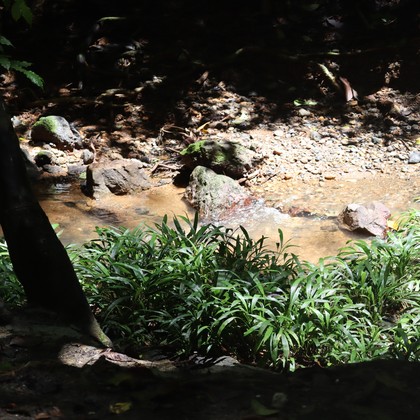
Humid to wet lowland and foothill forest, from sea level to about 1450 m, mainly in old forest with an open floor and little undergrowth; locally also in older secondary forest. It lives alone, in pairs or in small groups on the forest floor and searches the leaf litter for seeds, fruit and invertebrates. It roosts low in shrubs or saplings.
Where the bird is most at home, classified by the vegetation units of Mexico and Central America.


Range and movements
In the guide area in the Caribbean lowlands of eastern Honduras and Nicaragua, in Costa Rica mainly on the Caribbean side, and in Panama, with most records in the centre and east into Darién. Outside the guide area in north-western Colombia and western Ecuador.
- Resident
- Summer visitor (c. Apr–Sep)
- Winter visitor (c. Oct–Mar)
- Passage (Mar–Apr, Oct–Nov)
- dark = core range, pale = thinly spread
How and when to look
The species is found mainly by listening for its whistled call at dusk, for example along the trails of large lowland forests in Caribbean Costa Rica and in Darién in Panama. A surprised bird freezes or runs off quickly and rarely flushes.
Conservation status
Near Threatened. The species is rare in much of its range and suffers from deforestation and hunting. Where large, unbroken lowland forest remains, it still occurs locally.
Scientific name
Rhynchortyx cinctus | (Salvin, 1876)
Salvin described the species in 1876 as Odontophorus cinctus; because it was later moved to another genus, the author and year stand in brackets. The genus Rhynchortyx was introduced in 1893 by Ogilvie-Grant. Rhynchortyx is Greek, from rhunkhos 'bill' and ortux 'quail', after the relatively stout bill. cinctus is Latin for 'girdled', after the band across the breast. The specimen the first description was based on came from Veraguas, western Panama.