All species › Passerines › New World sparrows › Striped Sparrow
Position in the tree Birds Aves › Birds with a flexible palate Neognathae › All other modern birds Neoaves › Landbirds Telluraves › Falcons, parrots and passerines Australaves › Falcons and passerines Eufalconimorphae › Parrots and passerines Psittacopasserae
Striped Sparrow | Oriturus superciliosus
Zwartwanggors | Zacatonero rayado
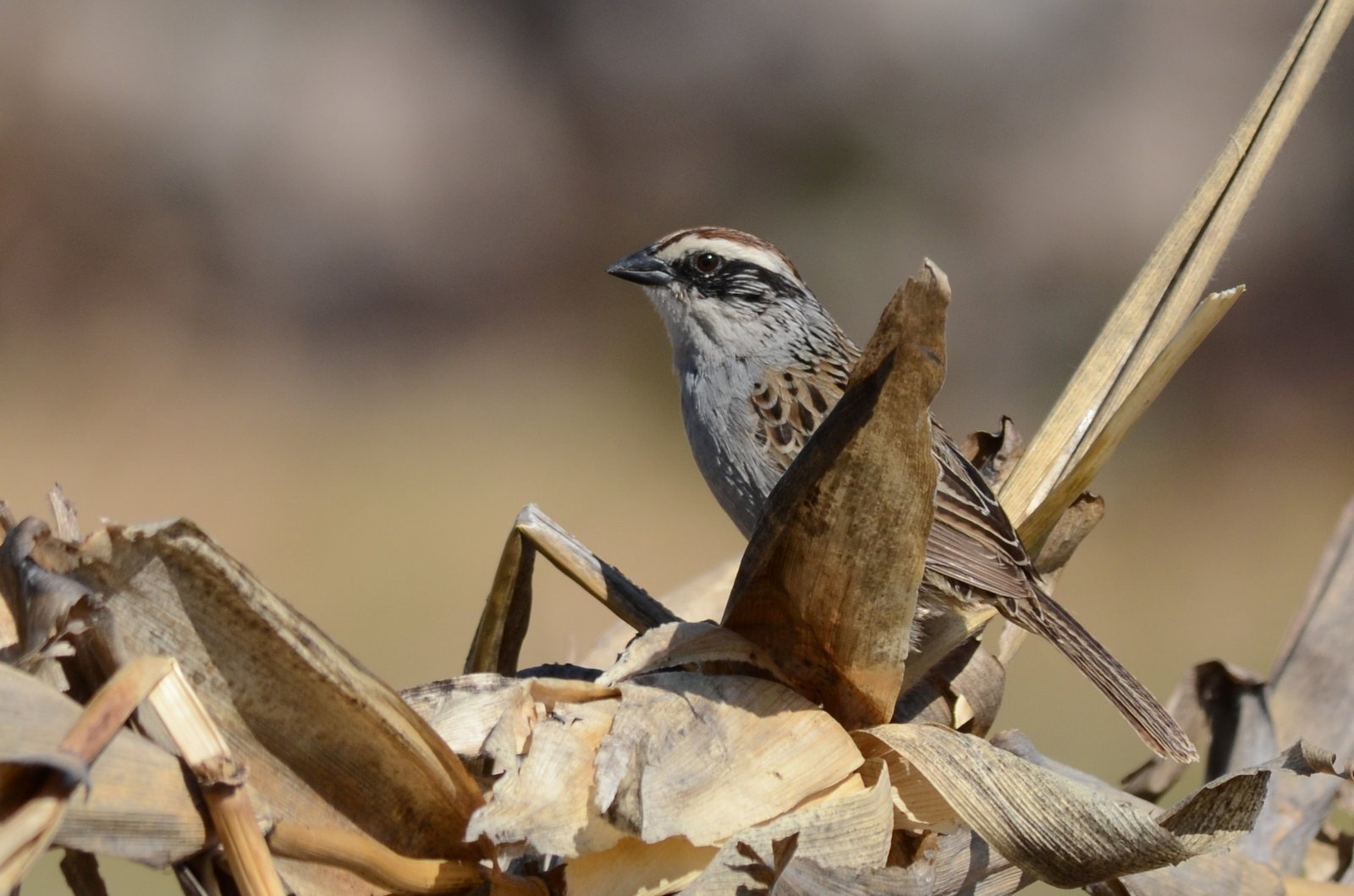
The Striped Sparrow is a large, sturdy sparrow of the mountain grasslands of Mexico, with a black ear-patch and a crisp white supercilium. It occurs only in Mexico and lives on the open, bunchgrass-covered slopes and forest edges of the high mountains, often in noisy family groups.
Voice
Very vocal. The song is a rapid, jumbled series of shrill, chirping and chattering notes, often sung by several birds at once. The call is a sharp, nasal chip or chenk.
Recording: Matthew L. Brady — CC BY-NC-SA 4.0 · converted to mono · xeno-canto
Identification
16–18 cm. Large and heavily built, with a conical black bill and a fairly long tail. Crown rufous-brown with dark streaks, a broad white supercilium and a black ear-patch running from the bill to behind the eye. Throat white, breast and belly plain grey, flanks brownish. Back brown with black streaks. The sexes are alike; young birds are browner and have streaks on the breast. Birds in the north of the range are somewhat paler.
Confusion species
Sierra Madre Sparrow Xenospiza baileyi, which lives in some of the same mountain grasslands, is much smaller, has a streaked breast and no black ear-patch. Rusty Sparrow Aimophila rufescens has a rufous back, a black malar stripe instead of a black cheek and lives at forest edges at lower elevations. Yellow-eyed Junco Junco phaeonotus has yellow eyes, a grey head and white outer tail feathers.
Habitat
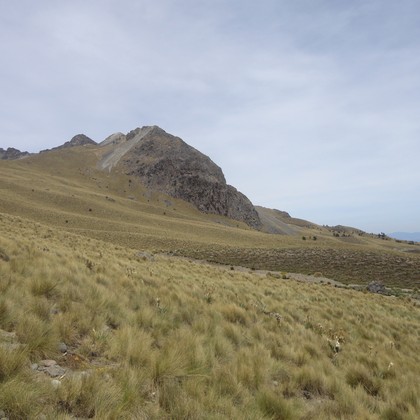
Mountain grassland with tall bunchgrass (zacatonal), open grassy slopes and open pine-oak and conifer forest with a grassy understorey, mainly between about 2000 and 4000 metres. It lives in groups that defend a territory together. It takes seeds and insects on the ground between the grass tussocks and often perches on shrubs, rocks or fence posts.
Where the bird is most at home, classified by the vegetation units of Mexico and Central America.



Range and movements
Endemic to Mexico. Resident in the mountains of the Sierra Madre Occidental, from Sonora and Chihuahua south through Durango to Jalisco, and in the volcanic belt of central Mexico, from Michoacán through the State of México, Morelos and Puebla to western Veracruz.
- Resident
- dark = core range, pale = thinly spread
How and when to look
In the high mountains around Mexico City, for example on the slopes of the great volcanoes, the species often draws attention through its noisy groups calling from shrubs and rocks.
Conservation status
Least Concern (LC). Locally common within a fairly restricted range. Overgrazing, fires and conversion of mountain grassland to farmland are a local threat.
Scientific name
Oriturus superciliosus | (Swainson, 1838)
Swainson described the species in 1838 as Aimophila superciliosa; because it was later moved to another genus, the author and year stand in brackets. The genus Oriturus was introduced in 1850 by Bonaparte. Oriturus joins Orites, an old genus name for the long-tailed tit, with Greek oura 'tail', after the long, graduated tail. superciliosus is Latin for 'eyebrowed', from supercilium 'eyebrow', after the pale supercilium. The specimen the first description was based on came from Mexico (not specified further).