All species › Owls › Owls › Striped Owl
Position in the tree Birds Aves › Birds with a flexible palate Neognathae › All other modern birds Neoaves › Landbirds Telluraves › Raptors, owls, kingfishers and woodpeckers Afroaves › Hawks and owls Hieraves
Striped Owl | Asio clamator
Gestreepte ransuil | Búho listado
The Striped Owl is a medium-sized Asio owl of open and semi-open country, found from southern Mexico to Argentina. In the guide area it is a local resident in the lowlands, from Veracruz to Panama. It is nocturnal, hunts mainly rodents from a perch and has benefited from the conversion of forest to pasture. It is sometimes placed in a genus of its own, Pseudoscops.
Voice
A series of loud, barking calls, woo-woo-woo, sometimes reminiscent of a dog, and a long, descending whistle, wheeeeoo, mainly by the female. It calls mostly after sunset and before dawn.
Recording: Jacob Wijpkema — CC BY-NC-SA 4.0 · shortened to the first 60 s, mono · xeno-canto
Identification
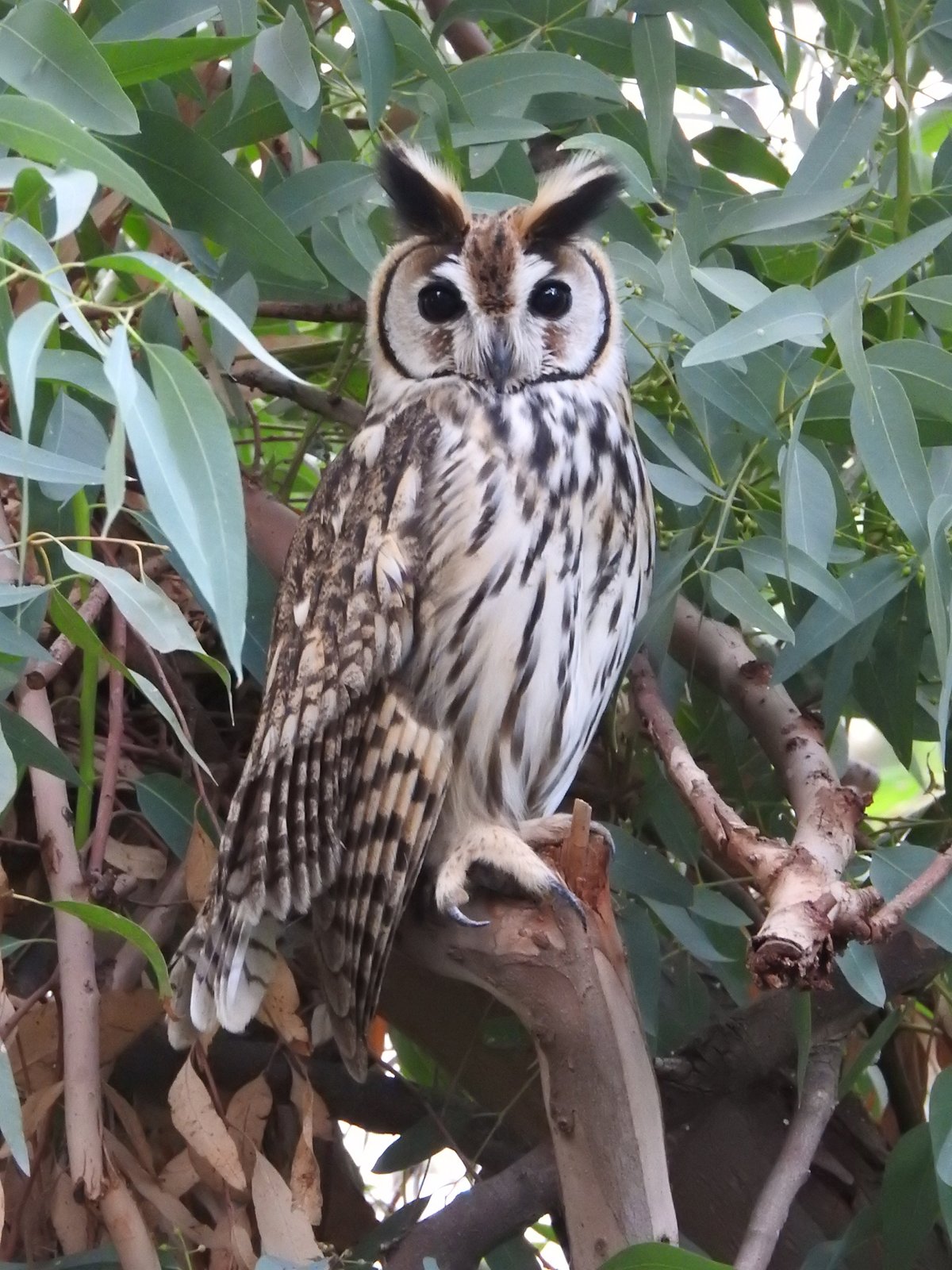
30–38 cm, with long, conspicuous ear tufts set wide apart on the head. The facial disc is white to off-white with a narrow black rim; the eyes are dark brown to cinnamon-brown. The upperparts are buff with black streaks and fine markings. The underparts are pale buff with broad black streaks on the breast and flanks, without crossbars. The toes are feathered. Females are larger than males.
Confusion species
The Stygian Owl Asio stygius is much darker, with a blackish face and yellow eyes, and lives in forest. The Long-eared Owl Asio otus has a rufous face and orange eyes and occurs only in northern Mexico. The Short-eared Owl Asio flammeus has yellow eyes set in dark patches and short ear tufts. The American Barn Owl Tyto furcata has a heart-shaped, pale facial disc without ear tufts and unstreaked underparts. The Mottled Owl Strix virgata has no ear tufts.
Habitat
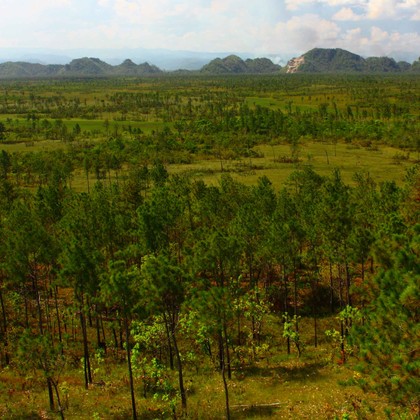
Pasture and grassland with scattered trees and hedgerows, lowland savanna, farmland, the edges of marshes and wet grasslands, forest edges and open secondary forest, also around villages and in town parks. Mainly in the lowlands, locally up to about 1,600 metres. By day it roosts in dense foliage, often in a clump of trees in pasture, or on the ground in tall grass. At night it hunts from a post or branch for rodents, also birds, bats and large insects. It nests on the ground in grass or low vegetation.
Where the bird is most at home, classified by the vegetation units of Mexico and Central America.





Range and movements
Local resident in the lowlands of southern Mexico, mainly on the coastal plain of Veracruz, further in Oaxaca, Tabasco and Chiapas; very rare on the Yucatán Peninsula. Further in Belize, Guatemala, Honduras, El Salvador and Nicaragua, mainly on the Caribbean side, and in Costa Rica and Panama on both sides of the mountains. In Costa Rica it is increasing with the spread of pasture. Outside the guide area in South America south to northern Argentina and Uruguay, and on Tobago.
- Resident
- dark = core range, pale = thinly spread
How and when to look
Best looked for after sunset along roads through pasture with scattered trees in the lowlands, for example in central Veracruz and in the Caribbean lowlands of Costa Rica, where the owl may perch on posts and wires. In the headlights the long ear tufts and white face stand out. In Costa Rica birds sometimes roost by day in trees in town parks and hotel grounds.
Conservation status
Not threatened. The species benefits from deforestation that creates pasture and open country, but the use of rat poison can be a local threat.
Scientific name
Asio clamator | (Vieillot, 1808) (GBIF: Pseudoscops clamator)
Vieillot described the species in 1808 as Bubo Clamator; because it was later moved to another genus, the author and year stand in brackets. The genus Asio was introduced in 1760 by Brisson. Asio is the Latin name of a horned or eared owl. clamator is Latin for 'shouter', after the loud call. The specimen the first description was based on came from Cayenne, French Guiana.