All species › Swifts › Hummingbirds › Stripe-tailed Hummingbird
Position in the tree Birds Aves › Birds with a flexible palate Neognathae › All other modern birds Neoaves › Birds of the elements Elementaves › Nightjars and swifts Strisores
Stripe-tailed Hummingbird | Eupherusa eximia
Streepstaartkolibrie | Colibrí cola rayada
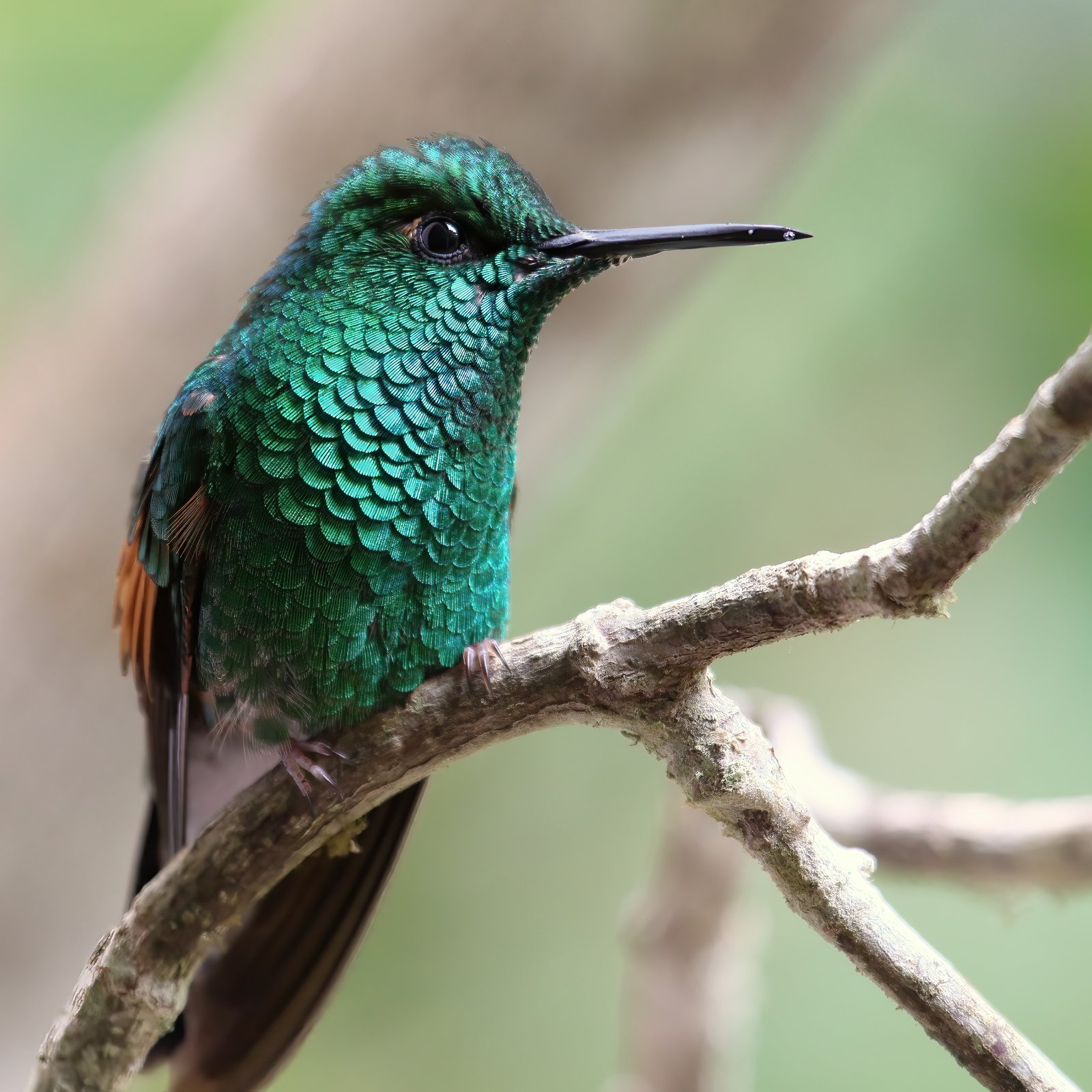
The Stripe-tailed Hummingbird is the most widespread species of the genus Eupherusa, from south-eastern Mexico to western Panama. Both sexes have a rufous patch in the wing and a tail with white inner webs and black outer webs to the outer feathers. In montane forest it is one of the more common small hummingbirds.
Voice
The song consists of squeaky, sometimes metallic notes, followed by a low, dry, insect-like trill. Calls include rattling trills and sharp, high notes.
Recording: GABRIEL LEITE — CC BY-NC-SA 4.0 · converted to mono · xeno-canto
Identification
9–10 cm, with a straight black bill. The male is glittering grass-green above and below, with white undertail coverts and a cinnamon patch on the secondaries. The inner tail feathers are dark bronze-green; the outer two pairs have a white inner web, a black outer web and a black tip, giving a striped pattern in flight. The female has the same wing patch and tail, and brownish-grey underparts with green spots on the flanks.
Confusion species
The male Black-bellied Hummingbird Eupherusa nigriventris is smaller and has a black face and black underparts; its outer tail feathers are entirely white. White-tailed Hummingbird Eupherusa poliocerca and Oaxaca Hummingbird Eupherusa cyanophrys have more white in the tail and occur only in Guerrero and southern Oaxaca. Blue-tailed Hummingbird Saucerottia cyanura and Berylline Hummingbird Saucerottia beryllina also have rufous in the wing, but a dark tail without white and a red base to the lower mandible.
Habitat
Edges and interior of humid montane forest, semi-deciduous forest and pine-oak forest, also in plantations and shade coffee, from about 300 to 2400 m, in Mexico locally lower. It breeds in the higher part of its elevational range and after breeding some birds move to lower forest.
Where the bird is most at home, classified by the vegetation units of Mexico and Central America.






Range and movements
Endemic to the guide area. In Mexico in the mountains of Veracruz, Oaxaca and Chiapas; further in Guatemala, Belize, Honduras, Nicaragua and Costa Rica to western Panama, in Chiriquí, Bocas del Toro and the Ngäbe-Buglé area.
- Resident
- dark = core range, pale = thinly spread
How and when to look
Common in the montane forest of Costa Rica, for example around Monteverde and in the Talamanca; in Panama around Boquete and Volcán in Chiriquí; in Mexico in the montane forest of Chiapas.
Conservation status
Not threatened. Fairly common over a large area. In southern Mexico loss of montane forest may affect the species locally.
Scientific name
Eupherusa eximia | (Delattre, 1843)
Delattre described the species in 1843 as Ornismya eximia; because it was later moved to another genus, the author and year stand in brackets. The genus Eupherusa was introduced in 1857 by Gould. Eupherusa is Greek, from eu 'well, finely' and pherousa 'bearing' (from pherō 'to carry'): 'finely bearing', probably after the boldly patterned tail. eximia is Latin for 'distinguished, excellent' (from eximius), after its fine appearance. The specimen the first description was based on came from Cobán, Guatemala.