All species › Swifts › Hummingbirds › Black-bellied Hummingbird
Position in the tree Birds Aves › Birds with a flexible palate Neognathae › All other modern birds Neoaves › Birds of the elements Elementaves › Nightjars and swifts Strisores
Black-bellied Hummingbird | Eupherusa nigriventris
Zwartbuikkolibrie | Colibrí ventrinegro
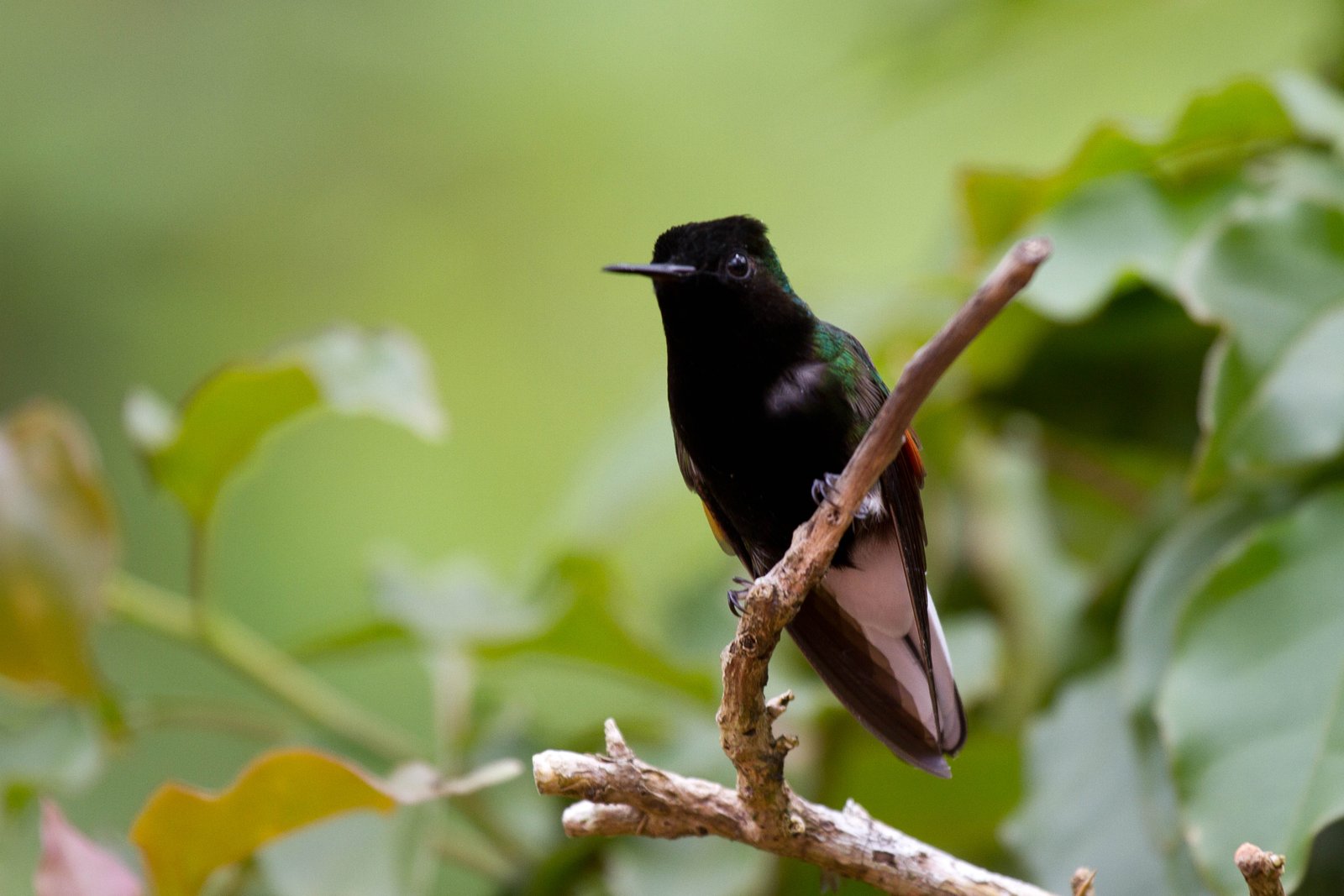
The Black-bellied Hummingbird is a small hummingbird of the Caribbean slope of the mountains of Costa Rica and western Panama. The male has a black face and black underparts, and both sexes have white outer tail feathers. The species is best known from feeders at the forest edge.
Voice
The song is a high, thin, sputtering warble from a perch at a gap in the forest. Calls include sharp, high notes and a high twittering in chases.
Recording: Andrew Spencer — CC BY-NC-SA 3.0 · converted to mono · xeno-canto
Identification
7–8 cm, with a short, straight black bill. The male is bronze-green above, with a black forehead, face, breast and belly, green breast sides, white undertail coverts and a rufous patch on the secondaries. The central tail feathers are dull black with a bronze gloss, the outer ones white. The female is glittering bronze-green above and greyish white below, with the same wing patch and white outer tail feathers.
Confusion species
Stripe-tailed Hummingbird Eupherusa eximia is larger, has green underparts and black outer webs and tips to the outer tail feathers. The female Snowcap Microchera albocoronata is smaller, lacks rufous in the wing and has a tail with white tips rather than white outer feathers.
Habitat
Edges and interior of humid montane forest and cloud forest, at about 600 to 2000 m. It feeds at flowers in the understorey and at forest edges. After the breeding season some birds move to lower elevations.
Where the bird is most at home, classified by the vegetation units of Mexico and Central America.



Range and movements
Endemic to the guide area. On the Caribbean slope of the mountains of Costa Rica, from the Cordillera de Tilarán and the Cordillera Central to the Talamanca, and in western Panama, in Chiriquí, Bocas del Toro, the Ngäbe-Buglé area and Veraguas.
- Resident
- dark = core range, pale = thinly spread
How and when to look
At feeders in Cinchona and Bajos del Toro on the Caribbean side of the Cordillera Central in Costa Rica; in Panama along the road over the continental divide in the Fortuna Forest Reserve.
Conservation status
Not threatened. Locally fairly common in suitable montane forest. The population trend is unknown; loss of montane forest on the Caribbean side may affect the species locally.
Scientific name
Eupherusa nigriventris | Lawrence, 1868
Lawrence described the species in 1868 and placed it straight away in the genus where it still stands. The genus Eupherusa was introduced in 1857 by Gould. Eupherusa is Greek, from eu 'well, finely' and pherousa 'bearing' (from pherō 'to carry'): 'finely bearing', probably after the boldly patterned tail. nigriventris is Latin, from niger 'black' and venter 'belly', after the male's black underparts. The specimen the first description was based on came from Costa Rica.