All species › Woodpeckers and allies › Woodpeckers › Stripe-cheeked Woodpecker
Position in the tree Birds Aves › Birds with a flexible palate Neognathae › All other modern birds Neoaves › Landbirds Telluraves › Raptors, owls, kingfishers and woodpeckers Afroaves › Mousebirds, rollers and woodpeckers Coraciimorphae › Trogons and cavity nesters Cavitaves › Hornbills, kingfishers and woodpeckers Picocoraciae › Kingfishers, bee-eaters and woodpeckers Picodynastornithes
Stripe-cheeked Woodpecker | Piculus callopterus
Streepwangspecht | Carpintero panameño
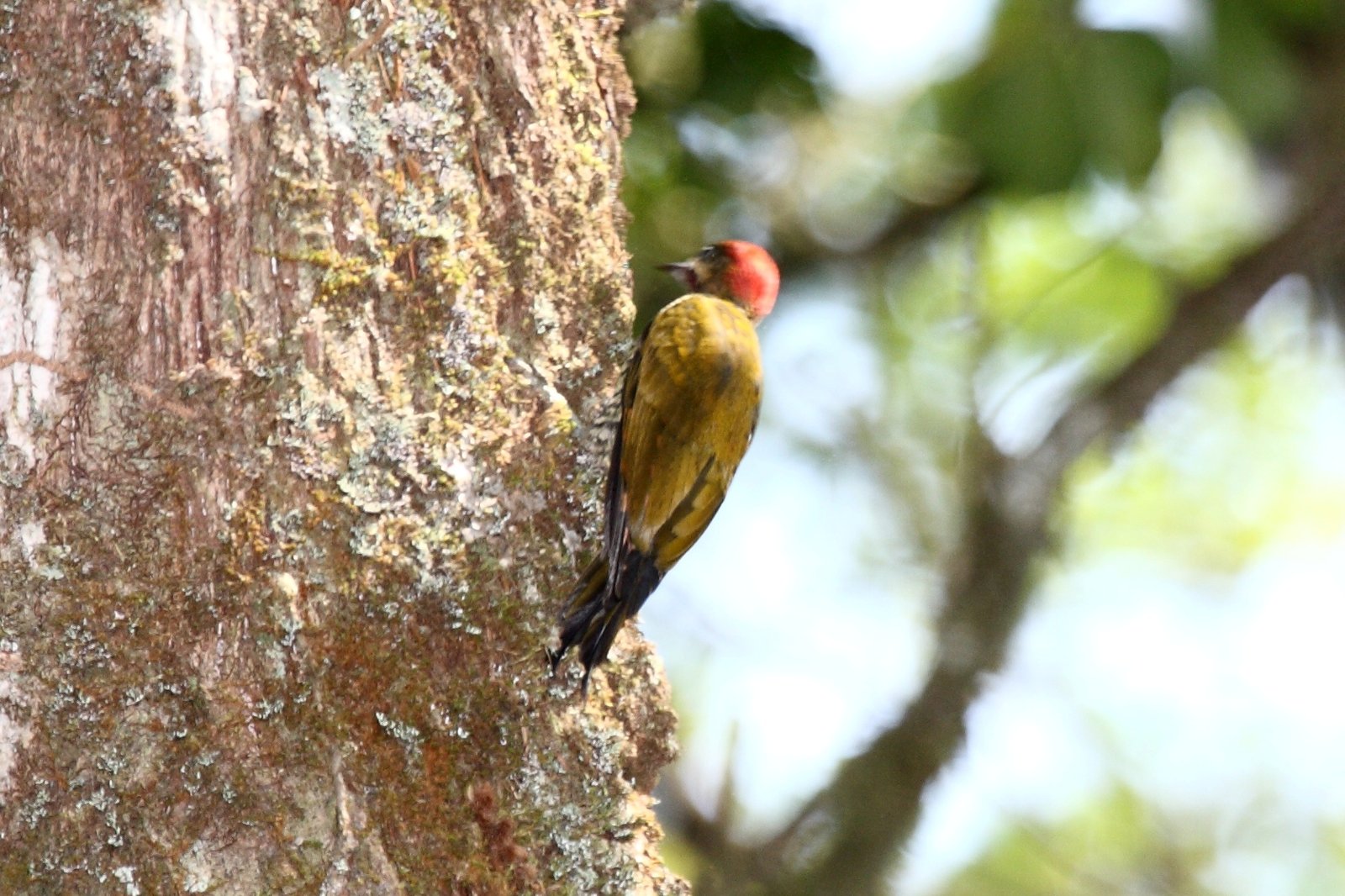
The Stripe-cheeked Woodpecker is a small, olive-green woodpecker with fine white streaks on the cheeks and rufous flight feathers. The species occurs almost only in Panama and is therefore one of the species peculiar to the guide area. It lives mainly in humid foothill forest.
Voice
A nasal, plaintive shee-ah and a soft, rattling series; little known and not often heard.
Recording: Jerome Fischer — CC BY-NC-SA 4.0 · converted to mono · xeno-canto
Identification
17–18 cm. The upperparts are olive-green with faint pale yellow barring on the back; the flight feathers are rufous. The cheeks are olive with fine white streaks, the throat olive with white streaks. The underparts are olive with dense pale yellow to whitish barring and spots. The eye is dark. The male has a red crown and nape and a red moustache; the female has only a red nape.
Confusion species
Rufous-winged Woodpecker Piculus simplex (western Panama and further north) is very similar but has a plain olive face without white streaks and a pale eye. Golden-green Woodpecker Piculus chrysochloros (eastern Panama) is larger, with a yellow stripe along the side of the neck and a yellow throat. Golden-olive Woodpecker Colaptes rubiginosus has a grey crown and pale, unstreaked cheeks.
Habitat
Humid foothill and lower montane forest, mainly between about 300 and 1200 m, locally also in the lowlands on the Caribbean slope; also tall secondary forest and forest edges. It forages in the middle layer and canopy for ants and other insects, often with mixed flocks.
Where the bird is most at home, classified by the vegetation units of Mexico and Central America.




Range and movements
Almost entirely restricted to Panama: from Veraguas east through Coclé, Colón, Panamá Province and Guna Yala to Darién, mainly on the Caribbean slope and in the eastern mountains. Elsewhere only a few records from extreme north-western Colombia.
- Resident
- dark = core range, pale = thinly spread
How and when to look
Well-known sites are Cerro Azul and Cerro Jefe east of Panama City, El Valle de Antón and Santa Fe in Veraguas. With mixed flocks in foothill forest it pays to watch for a small green woodpecker with streaked cheeks.
Conservation status
Not threatened. The range is small, but the species still occurs in many forested foothills.
Scientific name
Piculus callopterus | (Lawrence, 1862)
Lawrence described the species in 1862 as Chloronerpes callopterus; because it was later moved to another genus, the author and year stand in brackets. The genus Piculus was introduced in 1824 by Spix. Piculus is a diminutive of Latin picus 'woodpecker': 'little woodpecker'. callopterus is Greek, from kallos 'beauty' and -pteros '-winged': 'beautiful-winged', after the rufous flight feathers. The specimen the first description was based on came from Lion Hill on the Panama Railway, Panama.