All species › Passerines › Antbirds › Streak-crowned Antvireo
Position in the tree Birds Aves › Birds with a flexible palate Neognathae › All other modern birds Neoaves › Landbirds Telluraves › Falcons, parrots and passerines Australaves › Falcons and passerines Eufalconimorphae › Parrots and passerines Psittacopasserae
Streak-crowned Antvireo | Dysithamnus striaticeps
Streepkapmiervireo | Batarito pechirrayado
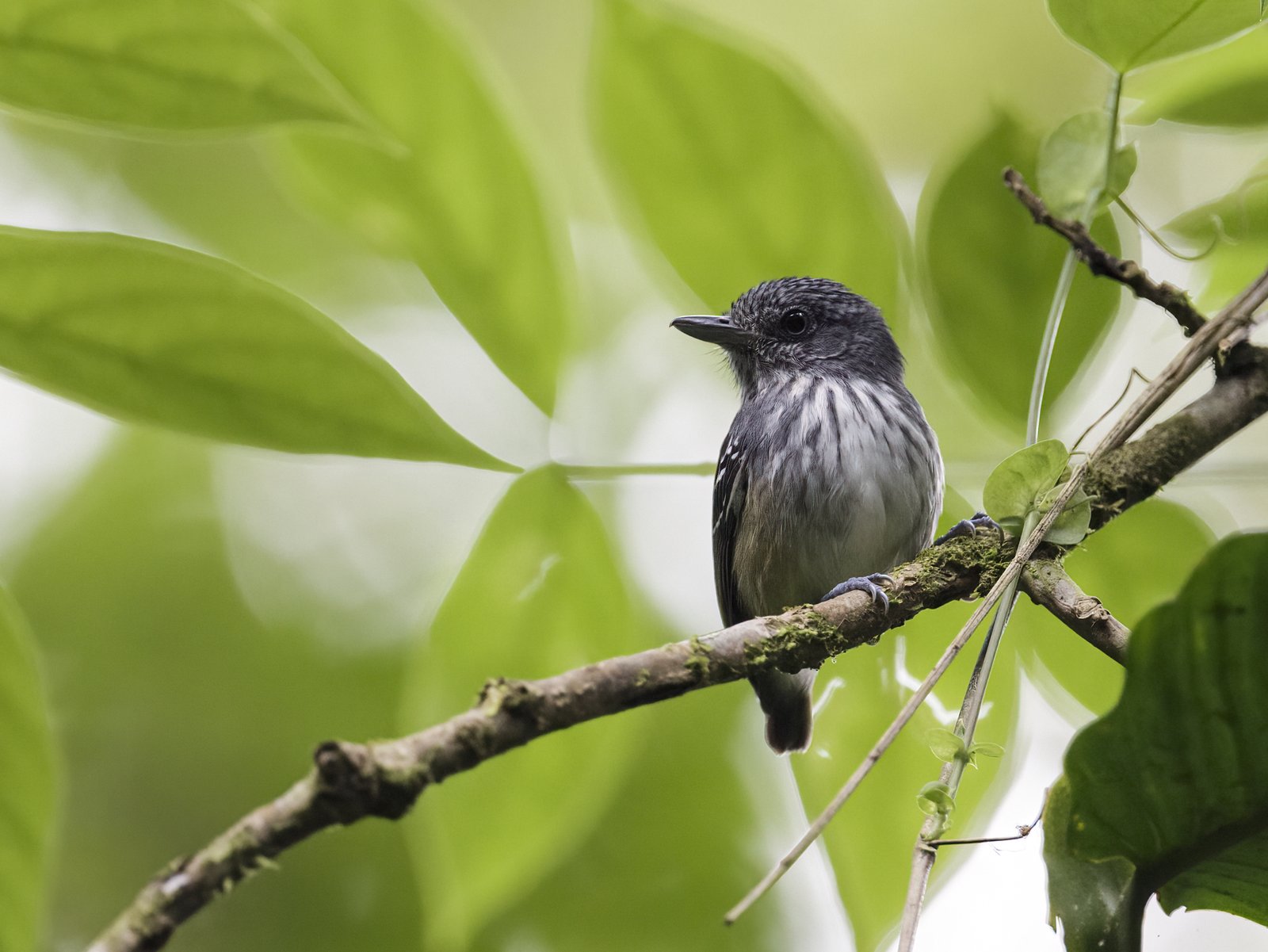
The Streak-crowned Antvireo is a small, stocky antbird of the Caribbean slope of southern Central America. Both sexes have a streaked crown and a streaked breast. It lives in the understorey of humid lowland and foothill forest and joins mixed-species flocks. In the guide area it occurs from eastern Honduras to Costa Rica and possibly extreme western Panama.
Voice
An accelerating series of short, rather nasal notes, similar to the song of Plain Antvireo.
Recording: GABRIEL LEITE — CC BY-NC-SA 4.0 · converted to mono · xeno-canto
Identification
11 cm, stocky, with a fairly thick, slightly hooked bill and a short tail. Male crown black with grey streaks, upperparts grey with an olive tinge, wings dark with two rows of white dots; underparts whitish with distinct grey streaks on throat and breast. Female crown rufous with black streaks, upperparts olive-brown, underparts pale yellow to ochre with dark streaks on the breast.
Confusion species
Spot-crowned Antvireo Dysithamnus puncticeps replaces it further south-east; the male has a crown with white spots instead of streaks and less distinct breast streaking. Plain Antvireo Dysithamnus mentalis has a plain crown and no breast streaks.
Habitat
Understorey and middle levels of humid evergreen lowland and foothill forest on the Caribbean slope, from the lowlands to about 900 m. It gleans insects quietly from leaves and twigs, usually in pairs and often in mixed flocks.
Where the bird is most at home, classified by the vegetation units of Mexico and Central America.


Range and movements
Caribbean slope of eastern Honduras, Nicaragua and Costa Rica; possibly to extreme western Panama (Bocas del Toro). Endemic to the guide area.
- Resident
- dark = core range, pale = thinly spread
How and when to look
Found with understorey mixed flocks in humid forest on the Caribbean slope of Costa Rica, for example at La Selva.
Conservation status
Near Threatened. Small range in the Caribbean lowlands, where much forest has been converted to farmland and plantations.
Scientific name
Dysithamnus striaticeps | Lawrence, 1865
Lawrence described the species in 1865 and placed it straight away in the genus where it still stands. The genus Dysithamnus was introduced in 1847 by Cabanis. Dysithamnus is Greek, from duō 'to plunge into' and thamnos 'bush', after its life in dense undergrowth. striaticeps is Latin, from striatus 'striped' and -ceps '-headed', after the streaked crown. The specimen the first description was based on came from Angostura, Costa Rica.