All species › Passerines › New World blackbirds, troupials and allies › Streak-backed Oriole
Position in the tree Birds Aves › Birds with a flexible palate Neognathae › All other modern birds Neoaves › Landbirds Telluraves › Falcons, parrots and passerines Australaves › Falcons and passerines Eufalconimorphae › Parrots and passerines Psittacopasserae
Streak-backed Oriole | Icterus pustulatus
Vlekrugtroepiaal | Bolsero dorso rayado
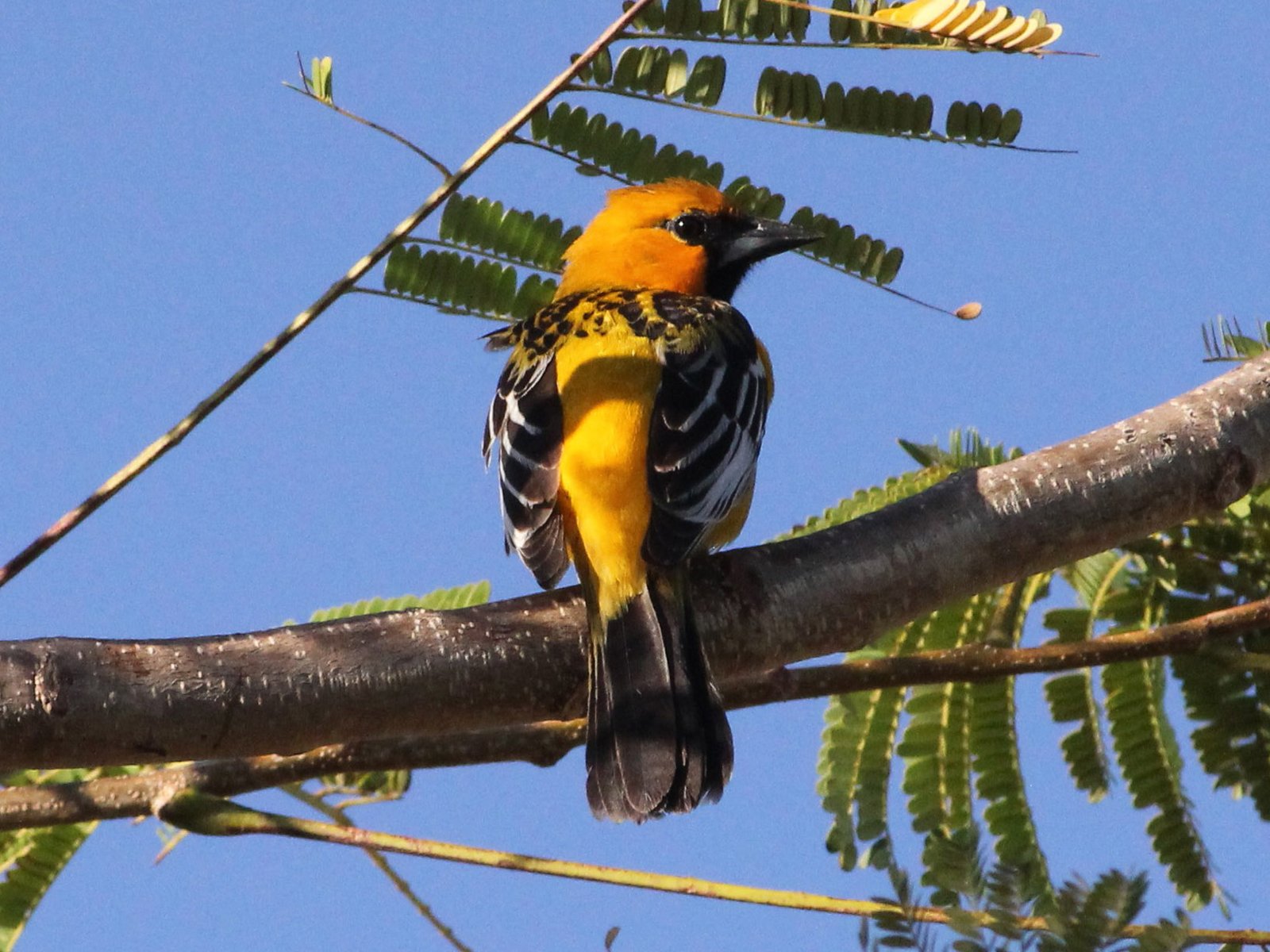
The Streak-backed Oriole is an orange oriole of dry forest and thorn scrub on the Pacific slope of Mexico and northern Central America. It is recognised by the orange back with black spots or streaks. The forms within the species differ markedly; those of the Tres Marías Islands and those of southern Mexico and Central America are recognised as separate subspecies groups.
Voice
The song is a series of full whistles interspersed with chattering notes. Calls include a dry, rasping chatter and a short chek.
Recording: Étienne Leroy — CC BY-NC-SA 4.0 · converted to mono · xeno-canto
Identification
19–21 cm. Male: head and underparts yellow-orange to flame orange-red, most richly coloured in the south; black lores and a black throat patch. Back orange with black spots or streaks, in southern birds so dense that the back looks almost black. Wings black with a white wing bar and broad white edges to the greater coverts and flight feathers. Tail black. Female: yellower and duller, with an olive, streaked back and a smaller black throat patch. Young birds are olive-yellow with little black on the throat.
Confusion species
The male Hooded Oriole Icterus cucullatus has an unstreaked black back and a longer, more decurved bill. Altamira Oriole Icterus gularis is larger, with a thick bill, a black back and an orange shoulder patch. Bullock's Oriole Icterus bullockiorum, present in the same area in winter, has a black eye-stripe and crown and an unstreaked back. Spot-breasted Oriole Icterus pectoralis has a black back and black spots on the sides of the breast.
Habitat
Dry tropical forest, thorn scrub, riparian woodland in dry regions, semi-open country with scattered trees and pasture, also villages and gardens, from sea level to about 1800 m in interior valleys. It eats insects, fruit and nectar, often in flowering trees. The nest is a long, hanging pouch at the tip of a branch.
Where the bird is most at home, classified by the vegetation units of Mexico and Central America.





Range and movements
Endemic to the guide area: Pacific slope of Mexico from southern Sonora and western Chihuahua to Chiapas, including the Balsas basin and the Tres Marías Islands, and on through Guatemala, El Salvador, Honduras and Nicaragua to north-western Costa Rica (Guanacaste). It occasionally wanders to the south-western United States.
- Resident
- dark = core range, pale = thinly spread
How and when to look
Regularly seen in dry forest and villages along the Pacific coast of Mexico, for example around San Blas in Nayarit, and in Guanacaste in Costa Rica, often at flowering trees in the dry season.
Conservation status
Not threatened (LC). Fairly common in dry, semi-open country; the loss of dry forest to agriculture is a local threat.
Scientific name
Icterus pustulatus | (Wagler, 1829)
Wagler described the species in 1829 as Ps[arocolius] pustulatus; because it was later moved to another genus, the author and year stand in brackets. The genus Icterus was introduced in 1760 by Brisson. Icterus is from Ancient Greek ikteros, a yellow bird usually taken to be the golden oriole, the sight of which was thought to cure jaundice. pustulatus is Latin for 'blistered, pimpled', from pustula 'pimple', after the black spots and streaks on the back. The specimen the first description was based on came from Mexico.