All species › Passerines › Ovenbirds and woodcreepers › Straight-billed Woodcreeper
Position in the tree Birds Aves › Birds with a flexible palate Neognathae › All other modern birds Neoaves › Landbirds Telluraves › Falcons, parrots and passerines Australaves › Falcons and passerines Eufalconimorphae › Parrots and passerines Psittacopasserae
Straight-billed Woodcreeper | Dendroplex picus
Priemsnavelmuisspecht | Trepatroncos piquirrecto
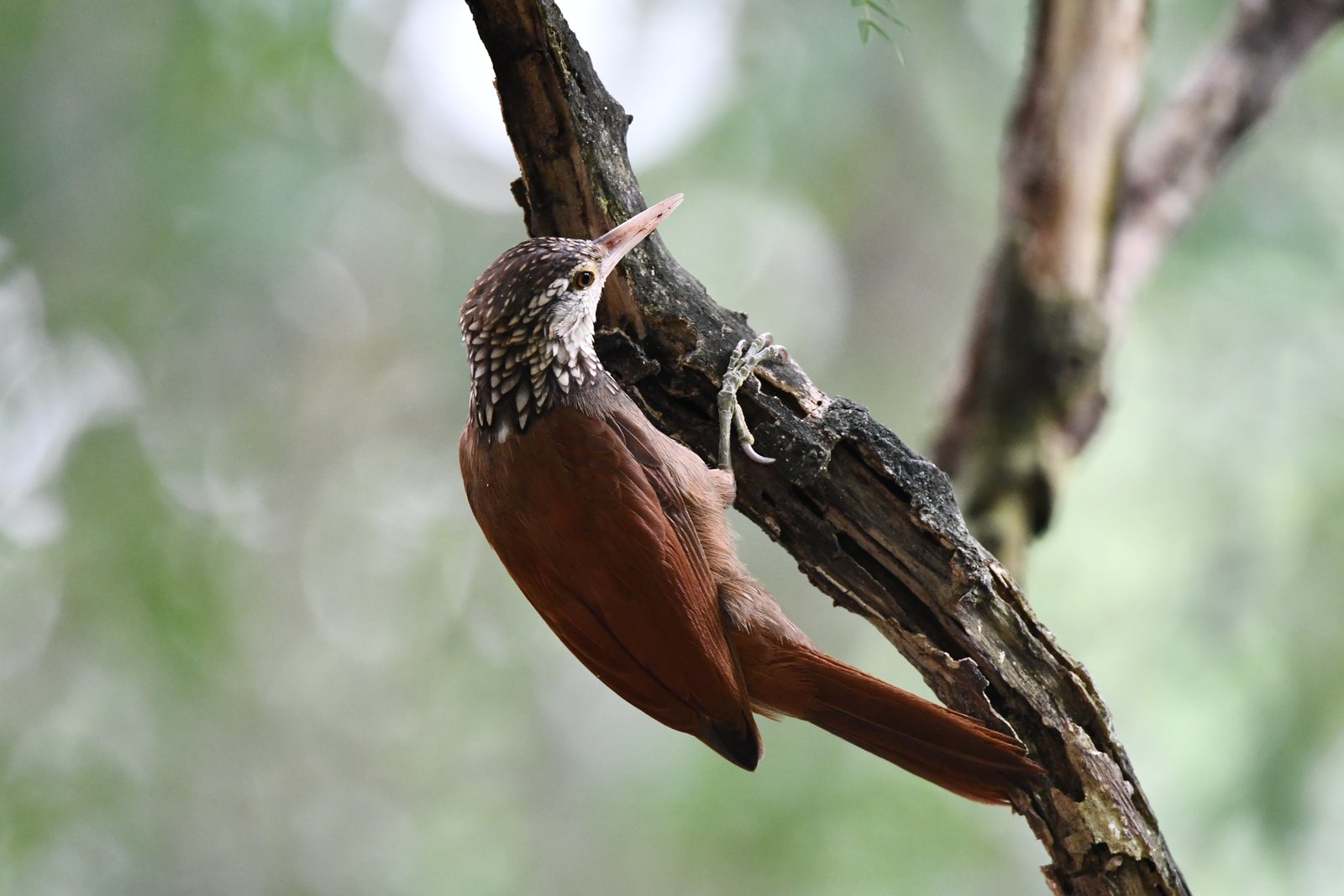
The Straight-billed Woodcreeper is a medium-sized, rufous-brown woodcreeper with a straight, pale, dagger-shaped bill. It is widespread in South America and reaches the northern limit of its range in Panama, where it lives mainly in mangroves.
Voice
A fast, descending series of clear, somewhat laughing notes. Also short, sharp calls.
Recording: Juan Freile — CC BY-NC-SA 4.0 · converted to mono · xeno-canto
Identification
20–22 cm. Bill straight, pointed and pale, whitish to pinkish horn, which is unusual for a woodcreeper. Head and breast dark brown with pale buff to whitish teardrop streaks and spots; throat plain pale buff and a pale supercilium. Back, wings and tail warm rufous-brown, belly olive-brown. Like other woodcreepers it climbs trunks, propped on its stiff tail. Male and female are alike.
Confusion species
Streak-headed Woodcreeper Lepidocolaptes souleyetii is smaller and has a thin, slightly decurved bill. Ivory-billed Woodcreeper Xiphorhynchus flavigaster and Cocoa Woodcreeper Xiphorhynchus susurrans are larger, have a longer, slightly curved bill and live mainly in forest.
Habitat
In the guide area mainly mangroves and the forest edges behind them; elsewhere in its range also gallery forest, seasonally flooded forest, dry forest and open country with trees in the lowlands. It searches trunks and branches for insects and other invertebrates. It nests in a tree cavity.
Where the bird is most at home, classified by the vegetation units of Mexico and Central America.




Range and movements
In the guide area only in Panama, locally along the coast. Outside the guide area across much of the tropical lowlands of South America, from Colombia and Venezuela to Bolivia and Brazil.
- Resident
- dark = core range, pale = thinly spread
How and when to look
Look for it in mangroves along the Pacific coast of Panama; the straight, pale bill is the best feature.
Conservation status
Not threatened. Widespread and fairly common in South America; in the guide area local and tied to mangroves, which are under pressure in many places.
Scientific name
Dendroplex picus | (Gmelin, 1788) (GBIF: Xiphorhynchus picus)
Gmelin described the species in 1788 as Oriolus Picus; because it was later moved to another genus, the author and year stand in brackets. The genus Dendroplex was introduced in 1827 by Swainson. Dendroplex is Greek, from dendron 'tree' and plēssō 'to strike': 'tree-striker'. picus is the Latin word for 'woodpecker', after its woodpecker-like habits. The specimen the first description was based on came from Cayenne, French Guiana.